Domestic researchers, including those from Ulsan National Institute of Science and Technology (UNIST), have developed an anticancer treatment technology capable of overcoming drug resistance, attracting global attention.
On the 9th, UNIST announced that Professor Yujahyeong's team in the Department of Chemistry developed an anticancer treatment technology that selectively destroys cancer cell lysosomes and can overcome drug resistance.
According to the research, lysosomes are organelles that dissolve and recycle unusable cellular components. Anticancer drugs targeting lysosomes are gaining attention as a new type of anticancer agent capable of overcoming existing drug resistance, but active research has not been conducted.
The research team developed a substance forming a 'micelle structure' through self-assembly arranged in a certain pattern. The micelle structure refers to a spherical shape with an oil-friendly part inside and a water-friendly part surrounding the outside. This micelle structure shows stability in the biological environment, allowing it to move without harming other cells.
The micelle is composed of 'RGD peptide,' which selectively targets receptors overexpressed on the cancer cell membrane. Lysosomes in cancer cells overexpress the enzyme 'cathepsin B,' which degrades unnecessary proteins, and the micelle enters the lysosome targeting this enzyme. Once reaching the lysosome, the micelle reacts with cathepsin B.
As a result, a part of the peptide forming the micelle is cleaved by cathepsin B. The cleaved molecules then self-assemble again to form long fibrous structures, during which the lysosomal membrane is damaged. This causes lysosomal dysfunction, ultimately leading to cancer cell death.
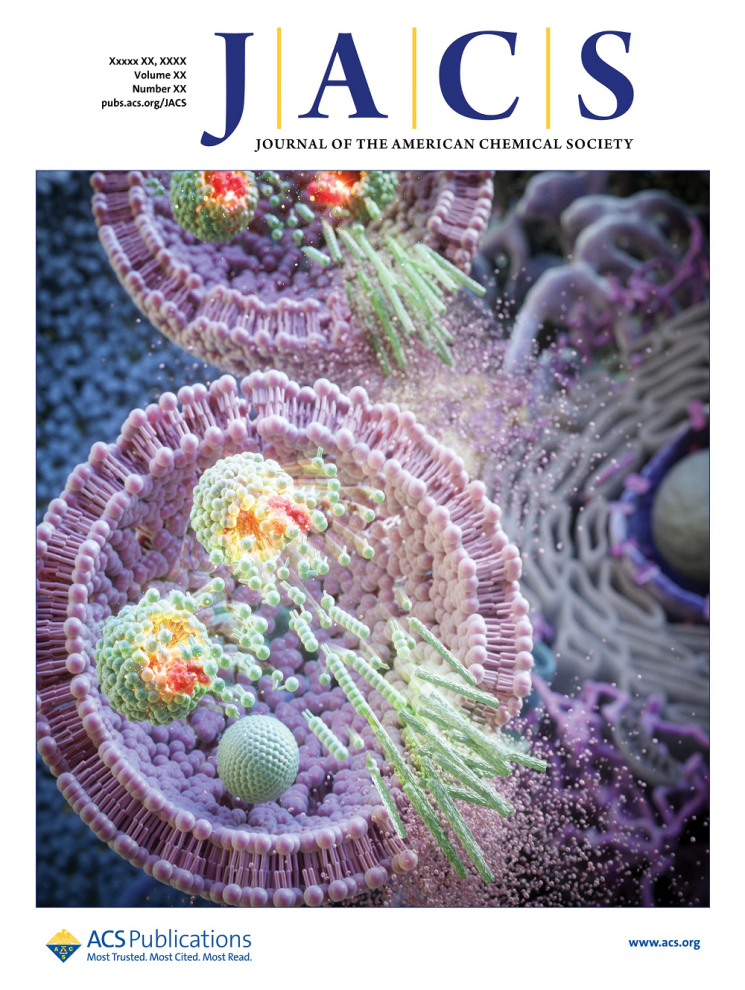 JACS cover article introducing the mechanism of a micelle-type anticancer drug targeting cancer cell lysosomes.
Batakrishna Jana, research professor in the Department of Chemistry at UNIST and first author, along with Seongeon Jin, researcher at the Korea Advanced Institute of Science and Technology (KAIST), stated, “Based on the characteristic overexpression of cathepsin B in cancer cell lysosomes, we induced lysosomal reassembly and confirmed cancer cell death.”
They added, “The lysosome-targeting substance developed this time also showed high cancer cell death efficacy in experiments using live mice.”
The substance developed by the research team is distinguished by its enhanced targeting ability and its overcoming of drug resistance, a drawback of conventional chemical anticancer drugs. Conventional chemotherapy induces resistance due to continuous drug administration, but this problem is solved by selectively destroying cancer cell lysosomes.
Professor Yujahyeong of the Department of Chemistry said, “The development of lysosome-targeting substances for cancer cells makes it possible to develop effective anticancer drugs without drug resistance,” and added, “It is expected to present a new vision for chemical anticancer treatments in the future.”
This research was conducted jointly with Professor Sangkyu Kwak’s team from the Department of Chemical and Biological Engineering at Korea University and was supported by the Mid-career Research Program and the Bio-Medical Technology Development Project of the National Research Foundation of Korea under the Ministry of Science and ICT.
The research results were published online on July 17 in the Journal of the American Chemical Society (JACS).
© The Asia Business Daily(www.asiae.co.kr). All rights reserved.

















