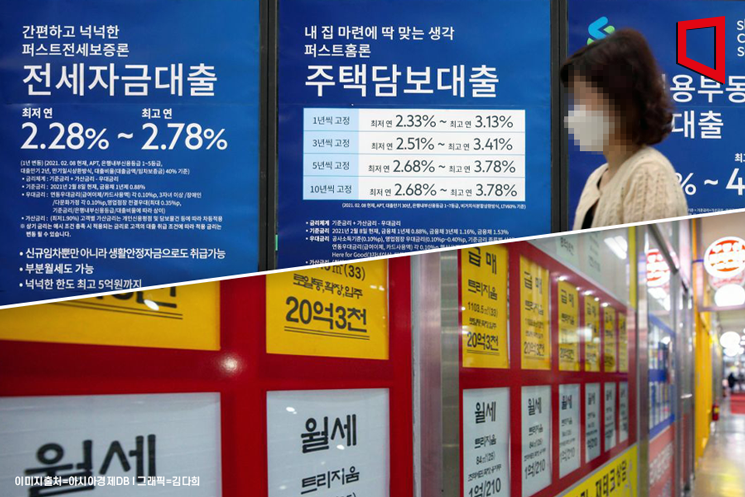
Amid the financial sector's loan interest rates remaining at high levels, household loans in the financial sector increased by more than 5 trillion won in July, mainly driven by mortgage loans, marking the largest monthly increase this year. Experts express concerns that this rising trend in household loans could constrain the Korean economy in the medium to long term. The government has also decided to review the increase in household loans through meetings with related agencies.
According to the Financial Services Commission on the 9th, household loans across all financial sectors increased by 5.4 trillion won compared to the previous month in July. Since a net increase of 200 billion won in April, household loans have been expanding with increases of 2.8 trillion won in May and 3.5 trillion won in June.
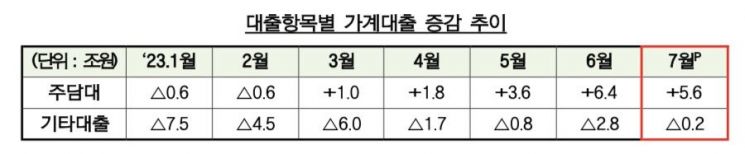
The main cause of the expansion in household loans lies in the active real estate and other asset markets. Breaking down by loan type, mortgage loans increased by 5.6 trillion won, leading the overall loan growth. This increase is the second highest this year following June's 6.4 trillion won.
While jeonse loans and group loans in the banking sector decreased by 100 billion to 200 billion won each, increases in individual mortgage loans (3.9 trillion won) and policy mortgages (2.4 trillion won) contributed to the overall rise in mortgage loans. The Financial Services Commission stated, "Household loans have continued to increase since April due to a recovery in housing transaction volumes."
The recent resurgence of the stock market, centered on secondary battery stocks, has also had an impact. Other loans, including credit loans across all financial sectors, decreased by 200 billion won compared to the previous month, falling to the lowest level this year (ranging from 800 billion to 7.5 trillion won). Authorities explained that this was due to a combination of temporary cash demand from public offering subscriptions and the effect of writing off bad debts in the first half, which reduced the decrease in other loans from insurance companies and specialized credit finance companies.
On the other hand, loan interest rates in the financial sector remain significant. As of this day, the main variable-rate mortgage loan products (based on new COFIX rates) from the four major commercial banks (KB Kookmin, Shinhan, Woori, Hana) ranged from 4.33% to 6.00%. Although not at the level seen at the beginning of the year, products with interest rates in the 3% range have disappeared. Interest burdens are also increasing. According to the Bank of Korea, the balance-based mortgage loan interest rate at deposit banks remained at 4.21% in June, the highest level in 10 years.
The industry explains that despite the serious interest rate situation, the expanding loan growth is a result of the government's accommodative policies implemented since the beginning of the year to ensure a soft landing in the real estate market, such as the launch of special Bogeumjari loans, easing of comprehensive real estate taxes, and relaxation of reverse jeonse return loan regulations. Additionally, the so-called 'interest rate peak theory' gaining traction, centered on the U.S. Federal Reserve (Fed), has created a favorable environment for asset markets like real estate and stocks.
However, the possibility of further interest rate hikes cannot be ruled out. Recently, forecasts that the Fed will maintain the current high interest rate level for a considerable period have persisted, pushing the U.S. 10-year Treasury yield above 4%. As a result, as of the 8th, the 5-year AAA-rated bank bond yield recorded 4.223%. Although this is slightly lower than the 4.354% on the 4th, it shows a clear upward trend compared to early June's 4.094%. This rise in bank bond yields could act as a factor for additional interest rate increases.
Experts say the likelihood of a transition to a systemic crisis is low but express concerns that household debt could hamper Korea's economy in the future. Professor Kim Sang-bong of Hansung University’s Department of Economics stated, "The accommodative policies implemented since the beginning of the year have ultimately increased debt in the real estate sector. Although the U.S. may not raise rates further, it is highly likely to maintain the current rate level (5.25?5.50%) for some time, and the associated household debt risks will be a factor that suppresses Korea's economic growth rate in the medium to long term."
Meanwhile, the government has also decided to monitor the increase in household loans. The financial authorities plan to hold a meeting on the 10th, chaired by Secretary-General Lee Se-hoon, to review the recent trend of expanding household loans with related agencies.
© The Asia Business Daily(www.asiae.co.kr). All rights reserved.


















