Proposing Solutions to Aging and Microplastic Environmental Issues
The research team at Chung-Ang University proposed a fundamental solution to environmental issues by developing an electrostatic device using microplastics. Electrostatic devices are technologies that convert mechanical energy into electrical energy by utilizing the triboelectric effect and electrostatic induction principles.
 Research team led by Professor Sangmin Lee, Department of Mechanical Engineering, Chung-Ang University. (From left) Kyunghwan Cha, integrated master's and doctoral student, Professor Jinki Hong, Yonsei University, Professor Sangmin Lee, Chung-Ang University / Photo by Chung-Ang University
On the 9th, Chung-Ang University announced that Professor Sangmin Lee's research team from the Department of Mechanical Engineering, in collaboration with Professor Jinki Hong's team at Yonsei University, succeeded in developing an electrostatic device that harvests electrical energy using microplastics. Microplastics have been identified as one of the main culprits causing environmental pollution, as their generation and discharge have increased through various pathways following the surge in plastic usage since industrialization.
This study is significant in that it achieved waste-to-energy by implementing a mechanism that harvests electrical energy using microplastics?small plastic particles less than 5 mm?as a component material in an eco-friendly energy harvesting system.
The biggest advantage of the microplastic-based electrostatic device developed by the joint research team is that it can be used regardless of the type of plastic or aging time. It can generate electrical output through the same mechanism without discrimination among PP, PS, PET, and mixed plastics, which constitute the largest proportion of microplastics.
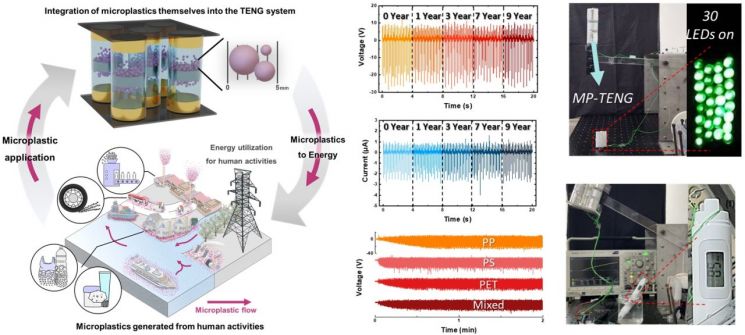 Schematic of low-cost, long-life electrostatic device based on aging microplastics / Photo by Chung-Ang University
Experimental results also confirmed that the device can be used long-term without output degradation even after 150,000 cycles using plastic aged for 9 years. Another advantage is that power generation is possible without additional contamination due to its completely sealed cylinder structure.
It was also confirmed through the research that the developed electrostatic device can generate electrical output to charge capacitors, enabling the operation of 300 LEDs, commercial temperature-humidity meters, and water pollution sensors.
This research was conducted with support from the Basic Research Laboratory and Mid-career Research Program led by the National Research Foundation of Korea, as well as the Eco-mimicry-based Environmental Pollution Management Technology Development Project led by the Ministry of Environment.
The related paper titled "Development of Sustainable Triboelectric Nanogenerators Based on Aged Microplastics" was published last year in the internationally renowned journal Chemical Engineering Journal. The first authors of the paper were Kyunghwan Cha, an integrated master's and doctoral student in Professor Sangmin Lee's lab, and Seongeun Jo, an integrated master's and doctoral student in Professor Jinki Hong's lab.
Professor Sangmin Lee stated, "This research outcome will serve as a solution to fundamentally overcome various environmental problems caused by discarded microplastics," adding, "It is an important technological discovery for sustainable development as it can effectively control the rapidly increasing amount of microplastic waste."
© The Asia Business Daily(www.asiae.co.kr). All rights reserved.


















