Typhoon Khanun, the 6th typhoon heading north toward the Korean Peninsula, approached south of Jeju Island on the morning of the 9th, bringing rain to the southern coast of Jeollanam-do and the Gyeongsang region. The Korea Meteorological Administration forecasted that the rain will spread nationwide starting from the evening of the 9th.
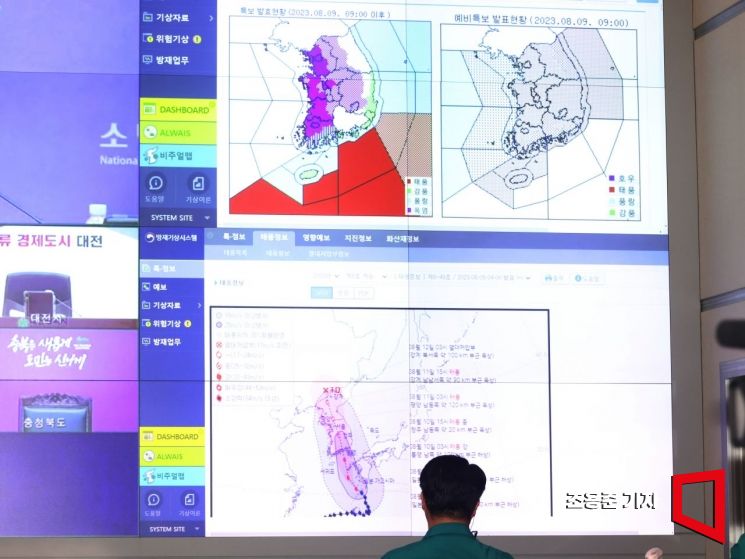 On the morning of the 9th, as Typhoon Khanun, the 6th typhoon, is moving northward toward the Korean Peninsula, an official from the Central Disaster and Safety Countermeasures Headquarters is checking the typhoon's path in the situation room inside the Government Seoul Office in Jongno-gu, Seoul. Photo by Jo Yongjun jun21@
Khanun is expected to be the first typhoon since 1977 to cross the Korean Peninsula inland from the southern tip to the northern tip.
As of 9 a.m. on the 9th, Khanun was moving northwest at 12 km/h about 360 km southeast of Seogwipo. It is expected to make landfall around 9 a.m. on the 10th about 40 km northwest of Tongyeong, Gyeongsangnam-do, then cross the Korean Peninsula heading north. The typhoon's intensity is expected to be "strong," and it is forecasted to pass about 20 km southeast of Cheongju, Chungbuk, around 3 p.m. on the 10th, maintaining its strength with an intensity of "moderate." It is then expected to weaken to a tropical depression near Kangye, Pyonganbuk-do, around 9 p.m. on the 11th and exit the Korean Peninsula.
The southern regions will experience rain from the 9th to the 10th, and the central regions until the 11th. Expected rainfall amounts are ▲ Seoul, Incheon, Gyeonggi, the five West Sea islands, Gangwon Yeongseo, Daejeon, Sejong, Chungnam, Chungbuk, Gwangju, Jeonnam, Jeonbuk, and Jeju Island: 100?200 mm (with heavier rainfall over the southern coast of Jeonnam, eastern inland Jeolla, and mountainous areas of Jeju exceeding 300 mm) ▲ Daegu, Gyeongbuk, Busan, Ulsan, Gyeongnam: 100?300 mm (with heavier rainfall over western inland Gyeongsang and coastal Gyeongsang exceeding 400 mm) ▲ Ulleungdo and Dokdo: 30?80 mm. Particularly, Gangwon Yeongdong is expected to receive 200?400 mm of rain, with some areas forecasted to exceed 600 mm.
Due to Khanun, the southern coast of Jeonnam and the Gyeongsang coast will experience maximum instantaneous wind speeds around 40 m/s; Gangwon Yeongdong, inland Gyeongsang, Honam (excluding the southern coast), Chungnam West Sea coast, and Jeju will have winds of 25?35 m/s; Incheon, Gyeonggi West Sea coast, southern Gyeonggi, Gangwon Yeongseo, and inland Chungcheong will have winds of 20?30 m/s; and Seoul and northern inland Gyeonggi will experience strong winds of 15?25 m/s.
Meanwhile, with Khanun’s landfall on the Korean Peninsula forecasted, about 37,000 participants of the World Scout Jamboree at Saemangeum began evacuating from the Saemangeum campsite on the 8th, relocating to eight cities and provinces nationwide, including the Seoul metropolitan area. However, as Khanun crosses the peninsula, the alternative Saemangeum sites have also come under the typhoon’s influence.
More than half of the remaining period until the Jamboree ends on the 12th is expected to be affected by heavy rain and strong winds. Therefore, alternative programs are unlikely to be held outdoors. In particular, securing safety for the ‘K-POP Concert’ scheduled to be held on the 11th at Seoul’s Sangam World Cup Stadium is considered essential. Safely transporting Jamboree participants scattered across the country to the Sangam World Cup Stadium is also a key concern. Aside from the K-POP Concert, detailed programs to be held in each region have not yet been finalized.
© The Asia Business Daily(www.asiae.co.kr). All rights reserved.

















