Semi-solid Battery with Performance Similar to All-Solid-State, Ahead in Commercialization
Adopted by China's Nio, Major Automakers Take Notice
World's No.1 Company CATL Also Announces Commercialization Within the Year
Kyocera and Freyr Plan Production Using US 24M Technology
Hyundai Motor Also Invests in Semi-solid Batteries
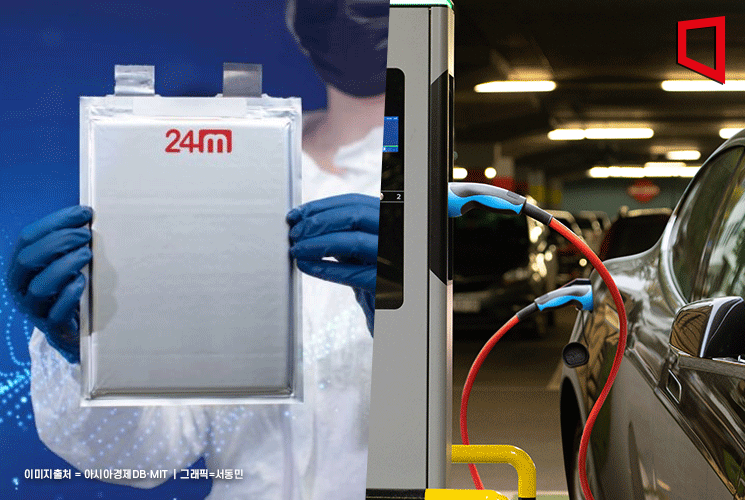
The semi-solid state battery is emerging as an alternative to the solid state battery, often called the "dream battery." The semi-solid state battery has reached a technological stage where it can travel up to 1000 km on a single charge, with improved charging speed and safety compared to current lithium-ion batteries. This surpasses the Tesla Model S's driving range of 640 km. This is why automakers worldwide are paying attention to semi-solid state batteries.
Li Hong, founder of the Chinese battery company Welion, said in an interview with Bloomberg on the 7th (local time), "Not only Volkswagen, Ford, Mercedes-Benz, and Geely Automobile, but also the Chinese electronics company Xiaomi have shown interest in our semi-solid state battery."
"Volkswagen, Ford, Mercedes-Benz, and others interested in Chinese technology"
Welion supplied a 150-kilowatt-hour (kWh) battery pack to the ES6 sport utility vehicle (SUV) of the Chinese electric vehicle company Nio last month. This capacity is double the 75 kWh installed in the existing ES6. Nio explained that this allows driving up to 1000 km on a single charge.
The battery Welion supplied to the ES6 is a semi-solid state battery. This battery has an energy density of 360 watt-hours per kilogram (Wh/kg), which significantly exceeds the energy density of Tesla's cylindrical 4680 battery at 300 Wh/kg. Xu Jiawen, a researcher at Bloomberg NEF, explained, "Welion is not the first company to succeed in commercializing semi-solid state batteries, but an energy density of 360 Wh/kg is currently the highest level among batteries for electric vehicles."
Welion plans to expand its semi-solid state battery supply by building four additional factories in China. Through this, it aims to increase its annual production capacity from the current 6 gigawatt-hours (GWh) to 30 GWh by 2025. It also announced a goal to expand sales to 10 billion yuan (approximately 1.81 trillion KRW) by 2025 and to list on the stock market that year.
Semi-solid state batteries replace the liquid electrolyte in lithium-ion batteries with gel, clay, or resin forms. Liquid electrolytes facilitate easy electron movement, resulting in high energy efficiency, but they have a short lifespan and pose fire risks at high temperatures.
Academia and companies are developing solid state batteries that replace the electrolyte with a solid to overcome the weaknesses of lithium-ion batteries. Solid state batteries, which improve capacity and charging speed while reducing fire risks, are called "dream batteries" or "game changers." However, many technical challenges remain, and commercialization is still a long way off.
Japan's Toyota plans to release an electric vehicle equipped with a solid state battery capable of driving 1200 km after a 10-minute charge by 2025. In South Korea, Samsung SDI is developing solid state batteries aiming for commercialization by 2027.
Meanwhile, semi-solid state batteries have emerged, showing performance nearly comparable to solid state batteries and are recognized as an alternative. Unlike solid state batteries, whose commercialization timeline is uncertain, semi-solid state batteries have already succeeded in commercialization or are close to it.
Global energy consulting firm Wood Mackenzie stated in a report published last year, "Despite promises over the past decade regarding solid state batteries, no remarkable success has been shown," and added, "Semi-solid state batteries could be an alternative."
US, Japan, and European companies expected to unveil products one after another
Starting with Welion, semi-solid state batteries for electric vehicles are expected to appear one after another. China’s CATL, the world's largest battery company, announced at the Shanghai Auto Show in April that it would launch a "condensed battery" with an energy density of 500 Wh/kg within the year. The industry regards CATL's condensed battery as a semi-solid state battery.
In the United States, the venture company 24M Technologies, spun off from the Massachusetts Institute of Technology (MIT), is leading the development of semi-solid state batteries. Japanese companies Kyocera and Fujifilm have invested in this company. Kyocera introduced a product with an energy density of 140 Wh/kg using 24M's technology in 2021 and plans to release improved products by 2025.
24M currently achieves an energy density of 400?500 Wh/kg and emphasizes that it can reduce production costs by 40% compared to conventional lithium-ion batteries. It also explains that it can reduce the use of inactive metals such as copper and aluminum by 80%.
Norwegian company Freyr also plans to commercialize semi-solid state batteries using 24M's technology. In November last year, it announced an investment of $1.7 billion to build a semi-solid state battery production plant in Georgia, USA. The initial production scale is 34 GW. Volkswagen, Lucas TVS, and Axxiva have also signed license agreements with 24M.
Hyundai Motor invests in semi-solid state lithium metal
In South Korea, Hyundai Motor is actively developing semi-solid state batteries using lithium metal. Hyundai Motor Group plans to use its Gyeonggi Uiwang research center as a hub for research, development, and evaluation of semi-solid state lithium metal batteries.
In 2021, Hyundai Motor invested about $100 million in SolidEnergy Systems (SES), a US lithium metal battery manufacturer. SES plans to supply electric vehicle samples to Hyundai Motor Group next year.
Lithium metal batteries apply high-performance lithium metal to the anode material and use an organic solvent, an intermediate form between liquid and solid electrolytes. This raises the energy density to 400 Wh/kg. Hyundai plans to use lithium metal batteries not only for electric vehicles but also for urban air mobility (UAM) and purpose-built vehicles (PBV).
© The Asia Business Daily(www.asiae.co.kr). All rights reserved.

















