Hospital Steps Back While Conflict Between Insurance Companies and Consumers Intensifies
Since the Supreme Court ruled in June last year that 'cataract surgery should not be uniformly recognized as inpatient treatment,' non-reimbursable cataract surgeries claiming high insurance payouts have decreased by about 90%. Nevertheless, conflicts surrounding cataract insurance claims continue. There are calls for the urgent passage of a Special Act on Insurance Fraud Prevention.
According to the General Insurance Association and the Financial Supervisory Service, the number of dispute mediation applications filed with the Financial Supervisory Service by consumers who did not receive insurance payouts reached a total of 36,466 last year, a 29.7% increase compared to the previous year. Most of these cases are reported to be related to cataracts. Insurance companies have also taken defensive measures through medical consultations. According to the General Insurance Association, the total number of medical consultations conducted related to insurance claims by all general insurers last year was 58,855, a 39.2% increase from the previous year.
The industry points out that hospitals are excluded from this conflict. When insurance disputes arise, conflicts usually occur only between consumers and insurance companies, while hospitals or brokers who actually led excessive medical treatment are often excluded from the controversy. It is also difficult for insurance companies to directly file lawsuits against hospitals. In August last year, the Supreme Court ruled that insurance companies cannot, in principle, exercise the 'creditor's subrogation right' to claim the return of insurance payouts mistakenly paid to medical institutions on behalf of patients. Even if doctors or hospitals are found to be involved in insurance fraud and have their licenses suspended, they can reopen hospitals without significant disadvantages once the suspension period ends. If they use various cunning methods to secure substantial insurance payouts for consumers, customers will continue to flock back.
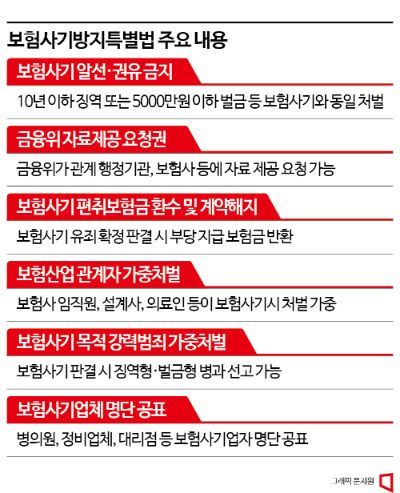
Ultimately, there are voices calling for the urgent implementation of the Special Act on Insurance Fraud Prevention to more thoroughly monitor and punish insurance brokers, medical institutions, and others. This bill stipulates that insurance industry stakeholders such as insurance planners and medical personnel will face increased penalties if convicted of insurance fraud, and that their names will be publicly disclosed. This means that anyone will be able to check the list of medical personnel and brokers involved in insurance fraud. After passing the Legislation and Judiciary Committee of the National Assembly's Political Affairs Committee earlier last month, the bill is scheduled to be submitted to the plenary session of the Political Affairs Committee, the Legislation and Judiciary Committee, and then the National Assembly plenary session.
Hwang Hyun-ah, a research fellow at the Korea Insurance Research Institute, explained, "The Special Act on Insurance Fraud Prevention includes provisions allowing imprisonment and fines to be imposed together upon insurance fraud convictions, and even imposes heavier penalties compared to general crimes. Although various issues will remain during the transitional period until then, the enforcement of the law is expected to play a significant role in reducing insurance fraud."
© The Asia Business Daily(www.asiae.co.kr). All rights reserved.
![Clutching a Stolen Dior Bag, Saying "I Hate Being Poor but Real"... The Grotesque Con of a "Human Knockoff" [Slate]](https://cwcontent.asiae.co.kr/asiaresize/183/2026021902243444107_1771435474.jpg)
















