IRA Response·Reducing Dependence on China
Posco Future M to Expand in Canada
LG Chem to Enter the US Market
"Considering Proximity to Clients"
Ecopro Focuses on Domestic Expansion
Domestic battery material and component companies are rushing to expand their scale. The goal is to respond to the U.S. Inflation Reduction Act (IRA) and increase the self-production ratio to reduce dependence on China.
The IRA defines cathode and anode materials as 'materials' and separators as 'components.' Components must be produced locally to qualify for electric vehicle tax credits. Materials can receive benefits if produced domestically in Korea or in countries with which the U.S. has a Free Trade Agreement (FTA). However, many domestic companies are moving to the U.S. or Canada.
Posco Future M, the only domestic anode material producer, is actively expanding its anode material and precursor factories, considered the 'weak link' in the Korean battery industry. China, which invested early in key raw materials, dominates both the anode material and precursor markets. Posco Future M plans to invest KRW 1.2 trillion with China’s Huayou Cobalt, the world’s largest cobalt producer, to build precursor and nickel production lines in Pohang, and invest KRW 500 billion independently to construct an anode material factory.
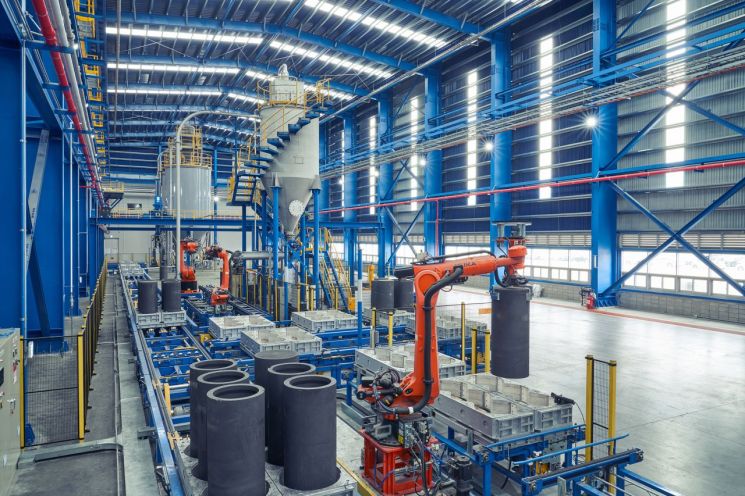
The anode material factory is scheduled for completion in 2025. Posco Future M currently mass-produces 74,000 tons of natural graphite anode material in Sejong and 8,000 tons of artificial graphite anode material in Pohang. By 2030, it aims to increase anode material production capacity to a total of 320,000 tons. Posco Future M also signed a KRW 1 trillion anode material supply contract from this year to 2028 with Ultium Cells, a joint venture between LG Energy Solution and GM. This is the first case of a Korean company exporting anode materials abroad.
The precursor factory, a core material of cathode materials and called the 'heart,' is scheduled for completion in 2027. Global mass production capacity will expand from the current 15,000 tons to a total of 440,000 tons by 2030. The self-production ratio will increase from 14% to 73%.
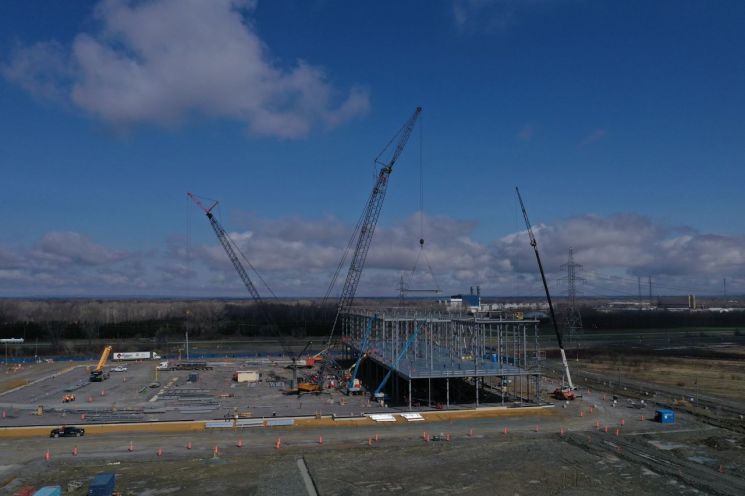 The construction site of the Ultium CAM cathode material plant with an annual production capacity of 30,000 tons, jointly built by POSCO Future M and GM in Becancour, Canada.
 [Photo by POSCO Future M]
Expansion of cathode materials is also underway. Global mass production capacity will increase from 105,000 tons per year to 610,000 tons by 2030. Cathode material factories are located in Gumi, Pohang, and Gwangyang in Korea, as well as in China. Following the Pohang factory with an annual capacity of 30,000 tons, which began construction in April, an additional high-nickel NCA dedicated cathode material factory with an annual capacity of 52,500 tons will be established in Gwangyang. The target completion is the second half of 2025. In Canada, a cathode material factory with an annual capacity of 30,000 tons is under construction, aiming for completion in 2024.
As the first battery material company, a joint venture called Ultium CAM was established with U.S. automaker General Motors (GM). The Canadian government provided investment incentives worth KRW 290 billion. A battery industry insider said, "Not only the IRA but also additional local subsidies act as merits," adding, "Depending on strategic decisions, there are cases where products not considered 'components' also expand overseas or domestically."
LG Chem, which has focused on cathode materials and precursors, is preparing to build a separator factory in the U.S. following China and Europe. At the Q2 earnings conference held at the end of last month, LG Chem stated, "Although it is difficult to specify customer names, we are discussing appropriate production scales with customers based on localizing separators in the U.S." Separators, defined as 'components' by the IRA, must be 100% localized by 2029.
LG Chem said, "If we finalize separator localization investment within this year and establish a local supply system by 2027, customers will have no problem maintaining IRA benefits."
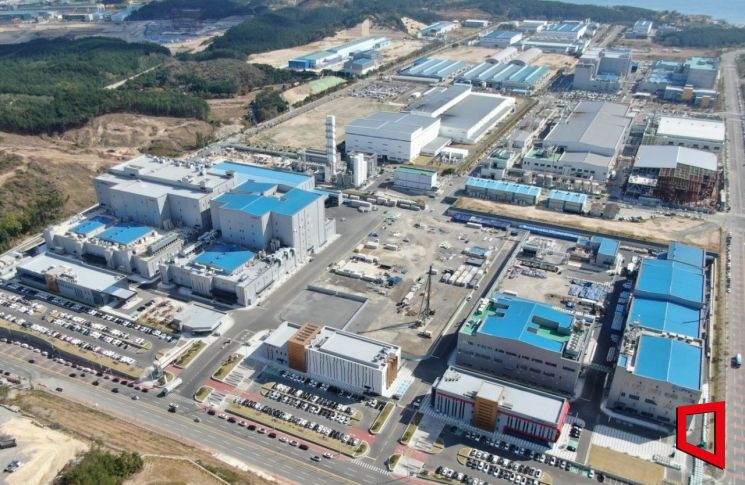
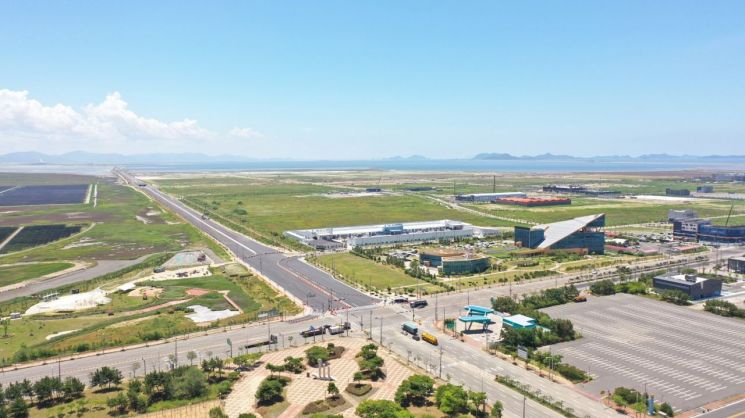 A view of the Saemangeum National Industrial Complex in Gunsan-si, Jeonbuk. LG Chem and Huayou Cobalt will invest a total of 1.2 trillion KRW by 2028 to build a precursor plant in Section 6 of the Saemangeum Industrial Complex.
 [Photo by LG Chem]
The joint separator factory between Japan’s Toray and LG Chem, which involved an investment of over KRW 1 trillion, began producing separators in Hungary in May. LG Chem said, "We are improving yield," and added, "From next year, we expect to expand volumes and improve profitability in both raw material and coating businesses due to external environmental changes such as the application of Foreign Entity of Concern (FEOC) to battery components and stabilization of raw material production."
Foreign Entity of Concern refers to institutions, organizations, or countries such as North Korea, China, Russia, and Iran that may threaten U.S. security and interests. The IRA stipulates that subsidies are excluded if key minerals or battery components sourced from Foreign Entities of Concern are used. This provision applies to battery components from 2024 and key minerals from 2025.
Including the domestic Cheongju factory, and factories in Hangzhou, China; Wroclaw, Poland; and Nyerges?jfalu, Hungary, LG Chem will produce 1.5 billion square meters of separators annually by 2027. Production capacity will increase further once the U.S. factory is established.
The cathode material business focuses on precursor internalization. Precursors, key materials for cathode materials, are made by combining nickel, cobalt, manganese, and aluminum. LG Chem plans to increase the internalization rates of nickel and lithium to 65% and 50%, respectively, by 2028.
To this end, a precursor factory with an annual capacity of 100,000 tons will be built in the Saemangeum National Industrial Complex. LG Chem will invest KRW 1.2 trillion by 2028 in partnership with China’s Huayou Cobalt. The Onsan precursor factory, a joint venture with Korea Zinc, is also under construction with an investment of KRW 200 billion, aiming to produce 20,000 tons annually starting next year. The Gumi factory for cathode materials was completed this year and has started production.
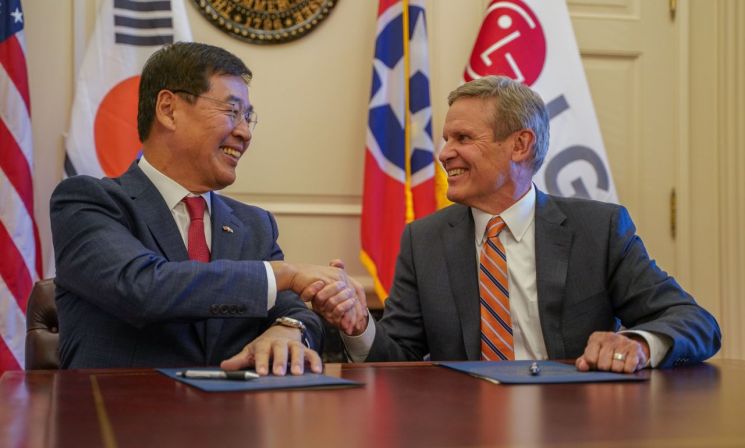 On November 22 last year, Shin Hak-cheol, Vice Chairman of LG Chem, and Bill Lee, Governor of Tennessee, USA, signed an MOU for the establishment of an LG Chem cathode material plant and shook hands.
 [Photo by LG Chem]
LG Chem is also building a cathode material factory in the U.S. with an investment of KRW 4 trillion and an annual capacity of 120,000 tons. It is the largest cathode material factory in the U.S., capable of producing batteries for 1.2 million high-performance pure electric vehicles. Mass production will begin by the end of 2025. Although cathode materials are classified as materials under the IRA and do not need to be produced in North America, LG Chem decided to manufacture products close to its U.S. automaker customers.
An industry insider said, "Automakers do not produce batteries themselves but directly purchase and secure minerals such as lithium and pass them to material companies, asking them to make products with these," explaining, "While other material companies also go to Canada, LG Chem chose the U.S. due to this reason." With aggressive expansion and investment, LG Chem’s cathode material and precursor production capacity will increase from 90,000 tons last year to 180,000 tons in 2024 and 470,000 tons in 2028.
Ecopro, which produces 'materials' such as cathode materials and precursors, is focusing on domestic expansion. Ecopro has the world’s largest cathode material production capacity (180,000 tons per year) and the largest domestic precursor production capacity (50,000 tons per year). By 2028, it plans to expand cathode material capacity to 710,000 tons annually. To this end, it will invest KRW 2 trillion over five years to establish a secondary battery cathode material campus in Pohang. Previously, in 2021, it completed the Pohang campus with a total investment of KRW 2.9 trillion.
Ecopro Materials, the largest domestic precursor producer, will increase nickel production from the current 20,000 tons to 60,000 tons by 2025, expanding precursor production from 50,000 tons to 110,000 tons.
Researcher Cho Cheol-hee of Korea Investment & Securities said, "The biggest beneficiaries of the fastest-growing U.S. electric vehicle market in the world are domestic battery companies." He analyzed, "In line with this, domestic battery material companies are also signing long-term supply contracts or joint ventures, so market share will increase regardless of short-term mineral price fluctuations."
© The Asia Business Daily(www.asiae.co.kr). All rights reserved.
![Clutching a Stolen Dior Bag, Saying "I Hate Being Poor but Real"... The Grotesque Con of a "Human Knockoff" [Slate]](https://cwcontent.asiae.co.kr/asiaresize/183/2026021902243444107_1771435474.jpg)













