Following the Busan spinning kick crime and the random stabbing incident at Sillim Station, another random stabbing rampage occurred in front of Seohyeon Station, fueling public demand for the reinstatement of the death penalty. However, since actual execution of the death penalty is difficult due to diplomatic reasons, the ruling party is accelerating discussions on 'life imprisonment without parole.'
On the 4th, Park Dae-chul, the Policy Committee Chair of the People Power Party, stated on his social media (SNS), "Immediately after the Sillim Station murder incident, our People Power Party held a closed party-government meeting to discuss related measures. To respond to increasingly heinous crimes, we also discussed the establishment of 'life imprisonment without parole.' Regarding this, since various opinions have been raised, it is necessary to first arrange a session to hear experts' opinions and gather public sentiment."
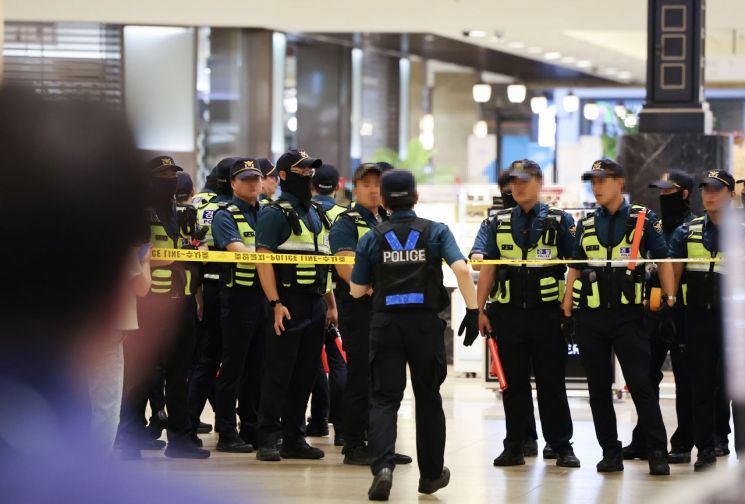
In light of several heinous crimes such as the random stabbing rampage at Seohyeon Station, public opinion is spreading in South Korea, where no executions have been carried out for the past 26 years, that executions should be resumed. Recent polls show that nearly 70% of the public favor retaining the death penalty. South Korea is a 'de facto abolitionist country' as it has not executed anyone since December 3, 1997.
However, actual execution of the death penalty is not easy. Even Han Dong-hoon, Minister of Justice who supports retaining the death penalty, said at the Legislative and Judiciary Committee on the 26th of last month, "The death penalty is very strong in diplomatic matters," adding, "If executions are carried out, diplomatic relations with the European Union (EU) could be seriously severed." This means alternatives must be found. One alternative considered is the 'life imprisonment without parole' mentioned by Chair Park. This avoids the ethical issues of 'carrying out executions' and prevents the possibility of heinous criminals who received life sentences committing retaliatory crimes after parole. It is also positive that many lawmakers from both the ruling and opposition parties have proposed similar bills, indicating little disagreement between the parties.
There are also calls for swift institutional reforms in preparation for the possibility that the Constitutional Court may rule the death penalty unconstitutional. The Constitutional Court ruled the death penalty constitutional in 1996 and 2010 and is currently conducting its third constitutional review on the death penalty.
© The Asia Business Daily(www.asiae.co.kr). All rights reserved.
![Clutching a Stolen Dior Bag, Saying "I Hate Being Poor but Real"... The Grotesque Con of a "Human Knockoff" [Slate]](https://cwcontent.asiae.co.kr/asiaresize/183/2026021902243444107_1771435474.jpg)
















