Last month, the inflation rate recorded 2.3%, marking the lowest level in 25 months, but the slowdown in dining-out prices still appears to be sluggish. Although petroleum prices, the main culprit of inflation, fell by more than 25% compared to a year ago, pulling down the overall inflation rate, there is still a significant gap between this and the actual consumer-perceived inflation.
According to Statistics Korea on the 3rd, out of 39 dining-out survey items last month, 30 items (76.9%) showed price increases compared to the previous month. Nearly 8 out of 10 items saw a greater price burden than a month ago. Representative items include lunch boxes (2.6%), pizza (1.2%), cafeteria meals (0.7%), samgyetang (ginseng chicken soup) (0.6%), duck meat (0.5%), and sweet and sour pork (0.5%). Among the surveyed items, 8 items including galbitang (beef rib soup), juk (porridge), and raw fish showed no change (0%), and only one item, beef (-0.1%), decreased compared to the previous month. While the consumer price inflation rate last month fell by 2.9 percentage points compared to January this year (5.2%), the dining-out price inflation slowed by only 1.8 percentage points during the same period.
The slow pace of dining-out price inflation is due to external factors such as international grain prices and labor costs. Recently, Russia, which is at war with Ukraine, declared the suspension of the Black Sea Grain Initiative, increasing pressure on grain prices again. As of the 25th of last month, wheat prices on the Chicago Mercantile Exchange futures market traded at $7.7725 per bushel (bu., approximately 27 kg), reaching the highest price in five months since February 21 this year. Experts believe there is potential for an additional 10-15% increase in grain prices.
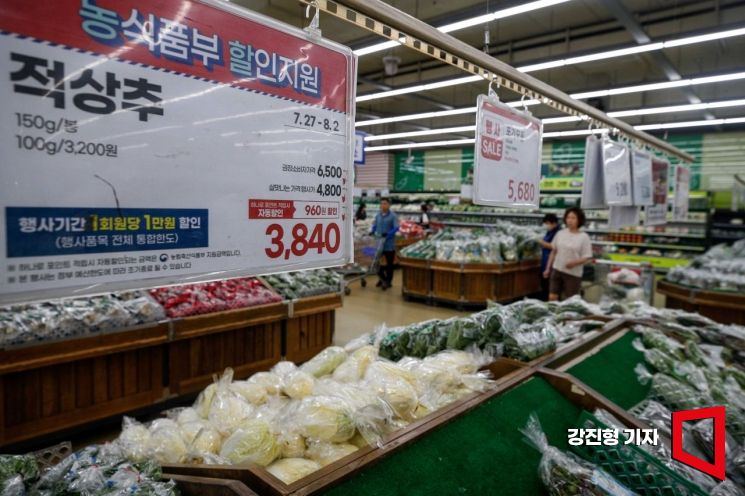 On the 2nd, customers shopping at Hanaro Mart Yangjae Branch in Seocho-gu, Seoul, where vegetable prices are rising due to recent heavy rains flooding the cultivation areas followed by a heatwave. Photo by Kang Jin-hyung aymsdream@
The recent sharp rise in prices of some vegetables such as spinach and lettuce due to heavy rains is also a burden. According to the Korea Agro-Fisheries & Food Trade Corporation (aT), as of the 1st, the wholesale price of spinach (standard grade) was 47,920 KRW for 4 kg, up 115.9% from 22,200 KRW a month ago. This is a 30.9% increase compared to a year ago. The problem is that the impact of the sharp rise in some vegetable prices is inevitably expected to affect inflation next month as well. Kim Bo-kyung, Economic Trend Statistics Officer at Statistics Korea, said, "Vegetable prices were partially reflected in July due to the heavy rain, and it seems they will continue to be reflected after August. It is difficult to predict the direction in August depending on supply or demand factors."
Rising labor costs are also cited as a factor slowing the pace of dining-out price inflation. With the minimum wage for next year set at 9,860 KRW, the labor cost burden on self-employed business owners is directly reflected in the rise of dining-out prices. In particular, since wages are applied uniformly without differentiation by industry, the average labor cost in the dining industry is about 15,000 KRW, approximately 50% higher than the minimum wage, which creates a significant burden. Professor Sung Tae-yoon of Yonsei University's Department of Economics said, "Dining businesses are a complex combination of food material costs, electricity fees, and labor costs. Therefore, dining-out prices do not immediately slow down as much as consumer prices do."
© The Asia Business Daily(www.asiae.co.kr). All rights reserved.
![Clutching a Stolen Dior Bag, Saying "I Hate Being Poor but Real"... The Grotesque Con of a "Human Knockoff" [Slate]](https://cwcontent.asiae.co.kr/asiaresize/183/2026021902243444107_1771435474.jpg)
















