Camping Enthusiasts Who Annoy Netizens by Reserving Spots
More Campers Hanging Laundry but Sleeping at Home
Recently, cases of tents and camping cars being left unattended for long periods in waterfront parks along urban streams and beaches have surged. Among these, a story about a camping car occupying three parking spaces for several days in a valley parking lot popular with tourists has drawn criticism from netizens.
On the 1st, an online community, Bobae Dream, posted an article titled "Camping Car Occupying Parking Spaces for Several Days."
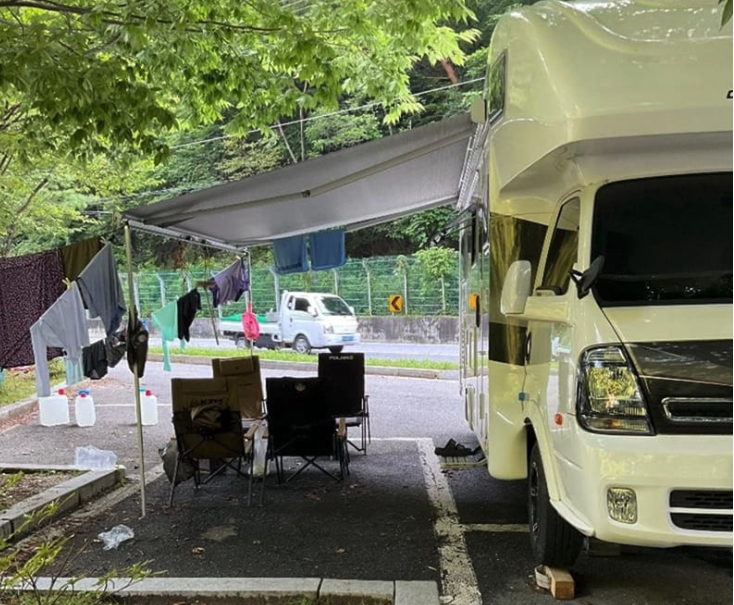 A story about a camper van occupying three parking spaces for several days in a valley parking lot popular with tourists has drawn criticism from netizens.
 [Photo by online community 'BobaeDream']
The author, Mr. A, said, "They have been occupying three spots for several days," adding, "This is a valley in Yeongwol, Gangwon-do, which many people visit, and the manager came to us asking if we knew the owner of that camping car and then left."
Photos shared with the story show a camping car parked across two spaces in the parking lot, with stones placed under the front wheels. Next to it, camping tables and chairs are set up with a privacy screen, and laundry is even hung out to dry.
Mr. A said, "I visited a few days ago, and the laundry was still there," adding, "It seems the owner camps here but sleeps at home. I ask camping car owners not to do this."
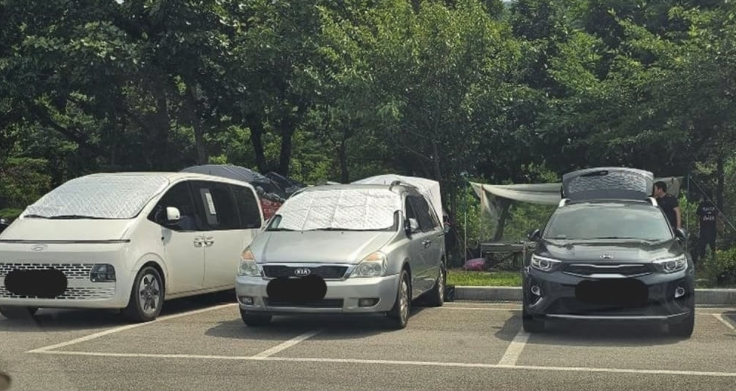 On the 1st, images of inconsiderate campers occupying a free public parking lot were posted on the BobaeDream Instagram account, sparking public outrage.
 [Photo by 'BobaeDream' Instagram]
Netizens who read the story reacted with comments such as, "The innocent manager has to keep checking and gets complaints from others?what kind of fault is that?" "Let's just reveal the license plate number," "They've set up a household," and "It's really a nuisance to do that in a popular tourist spot during peak season."
On the same day, Bobae Dream’s Instagram account also posted images of nuisance camping groups occupying free public parking lots, sparking public outrage.
The photos showed three vehicles parked side by side in the parking lot. All of them had camping equipment set up and were spending their vacation there. One vehicle was even parked across two spaces despite fitting comfortably in one.
Recent Legal Amendments Allow Immediate Removal of 'Occupied Tents'
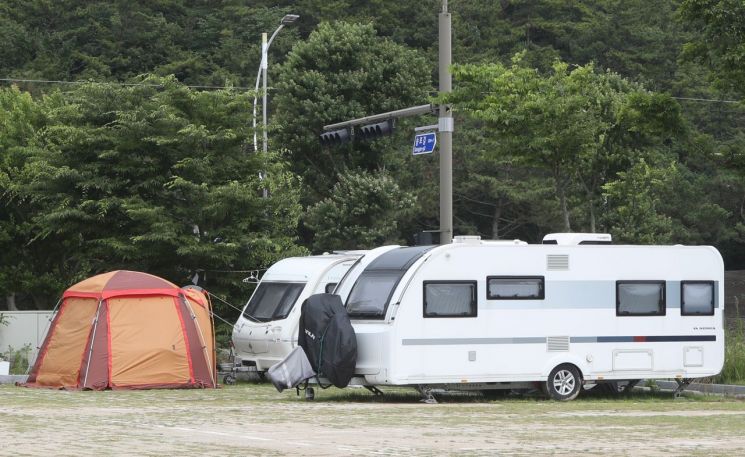 Camping cars are parked without permission in a public parking lot at a beach in Buan-gun, Jeollabuk-do.
 [Photo by Yonhap News]
With the number of people enjoying camping exceeding 5 million annually, issues related to 'occupied tents' and 'camping cars' have been continuously raised. However, due to the lack of relevant laws, local governments found it difficult to enforce regulations.
Following recent legal amendments, since the 28th of last month, local governments can immediately remove 'occupied tents' installed on beaches without confirming ownership. Some local governments have temporarily introduced paid parking at campsites and parking lots frequented by 'camping groups' and 'car campers' to prevent 'occupation.'
However, there are still no laws to regulate 'occupied camping' occurring on islands, coastal roads, and some campsites, causing ongoing inconvenience to citizens.
In particular, as problems increase with so-called 'camping car occupation' involving long-term parking in beachside parking lots and 'car campers' staying overnight in their vehicles, a bill allowing the forced removal of these vehicles has been proposed.
On the 2nd, Representative Kim Seung-nam (Democratic Party of Korea, Jeonnam Goheung-Boseong-Jangheung-Gangjin) introduced amendments to the Act on the Use and Management of Beaches and the River Act, focusing on these issues.
The bill adds 'camping vehicles' to the list of items that local governments can forcibly remove without administrative execution procedures, following 'occupied tents' on beaches.
This measure was prepared to strengthen local governments' management authority as 'occupied camping cars' have emerged as a social problem in waterfront parks with beaches and rivers due to the rapid increase in camping population. The bill also raises the fine for long-term parking or abandonment of camping cars from up to 100,000 won to up to 3 million won.
© The Asia Business Daily(www.asiae.co.kr). All rights reserved.



















