Establishment of 3 Core Clusters: Industrial Agglomeration, Component and Material Evaluation, and Fuel Cell Demonstration
Foundation for Becoming a Hub City with Korea's Only Power Generation Fuel Cell Complex and Localization of Key Components
Following Pohang City's final approval in the government's preliminary feasibility study for the ‘Hydrogen Fuel Cell Cluster,’ the expansion of the hydrogen industry ecosystem, which is gaining attention as a future energy innovation industry, and the revitalization of corporate activities are expected to gain significant momentum.
South Korea possesses the world's largest cumulative fuel cell installation capacity (859 MW). With the opening of the hydrogen power generation bidding market in June this year and the government's push to expand stable annual fuel cell installations by 200 MW, the outlook for hydrogen fuel cells as a future growth industry is very bright amid the era of ‘carbon neutrality’ and ‘hydrogen economy transition.’
Although the domestic fuel cell industry holds world-class complete product manufacturing, installation, and operation technologies, it has faced limitations in achieving high added value and cost reduction due to heavy reliance on imported core materials and components.
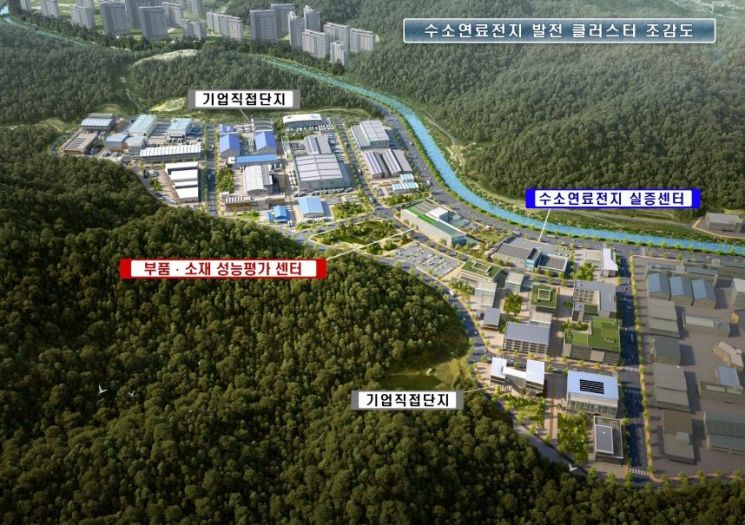
The ‘Pohang Hydrogen Fuel Cell Cluster’ is being established to overcome these limitations by securing production technologies for key materials and components and internalizing the supply chain to expand the related industry base. The cluster consists of three main cores: ▲Enterprise Agglomeration Core ▲Component Material Performance Evaluation Core ▲Fuel Cell Demonstration Core.
The ‘Enterprise Agglomeration Core’ will be developed on approximately 200,000㎡ within the Pohang Blue Valley National Industrial Complex to build an ecosystem through the agglomeration of hydrogen fuel cell companies and to foster an export forward base.
This site will be the only domestic power generation hydrogen fuel cell enterprise agglomeration space, gathering a total of 30 companies including anchor companies focused on finished products and cooperating small and medium-sized component and material companies, serving as a stepping stone for Pohang to leap forward as a hub city for the hydrogen fuel cell industry.
The ‘Component Material Performance Evaluation Core’ will be established on a 11,408㎡ site adjacent to the Enterprise Agglomeration Core. It will include a fuel cell component testing equipment building and corporate laboratory building linked to the Hydrogen Fuel Cell Certification Center, supporting localization through component performance evaluation and standardization of fuel cells.
A single fuel cell contains between 4,000 and over 10,000 components, making it burdensome for companies to build expensive testing equipment. Therefore, 20 types of 26 large-scale equipment capable of evaluating core components and materials, along with an integrated evaluation system, will be installed here to assist companies within the cluster in developing components and materials and to promote technology development through a technology cooperation network among industry, academia, and research institutes.
The ‘Fuel Cell Demonstration Core’ will be developed on an 8,500㎡ site, featuring a fuel cell demonstration building for residential and building-use fuel cell systems and an outdoor space for demonstrating large-capacity power generation fuel cell systems.
Currently, demonstration plans include 24 units of 7 types of fuel cell systems (with a capacity of 1.56 MW), designed to allow demonstrations up to 4 MW. In addition to promoting localization of core components through fuel cell demonstrations, efforts will be made in collaboration with Korea Hydro & Nuclear Power to establish long-term operation of fuel cell systems, develop a network for training fuel cell specialists, and advance fuel cell maintenance technologies.
The hydrogen fuel cell cluster construction project is overseen by the Ministry of Trade, Industry and Energy, with the Korea Energy Technology Evaluation Institute serving as the project management agency. To ensure successful project execution, Gyeongbuk Province, Pohang City, and Pohang Technopark will jointly form a cluster promotion team and an expert advisory committee composed of academia and research institutions.
Additionally, the ‘Pohang Hydrogen Fuel Cell Cluster Corporate Council (tentative name)’ will be operated as a focal point for creating an industry ecosystem centered on companies. The council will encourage corporate investment, hold regular meetings to share the latest fuel cell technology trends, and discuss cluster development strategies.
Mayor Lee Kang-deok stated, “Together with Gyeongbuk Province and Pohang TP, we will advance the hydrogen fuel cell industry ecosystem and establish governance for the hydrogen fuel cell cluster to develop the ‘Hydrogen Fuel Cell Cluster’ into a world-class fuel cell business model.”
© The Asia Business Daily(www.asiae.co.kr). All rights reserved.

















