Establishment of Generative AI Development Team and Recruitment
Aiming at Corporate Clients Seeking Productivity and Security
The enterprise generative artificial intelligence (AI) market is heating up. Beyond AI services accessible to everyone, such as OpenAI's ChatGPT and Google Bard, competition for enterprise-tailored services has officially begun. The three major domestic IT service companies have started hiring large-scale personnel and investing in infrastructure to target this market.
Samsung SDS recently announced in its Q2 earnings report that it plans to launch generative AI services specialized for enterprises within this year. The Cloud Service Division is leading the development, with company-wide participation. They also announced investments in graphics processing units (GPUs) and cloud infrastructure for this purpose. Starting with Samsung affiliates, they plan to identify customer demand and commercialize the business. Sung-Hyun Joon, Vice President and Head of Samsung SDS Cloud Service Division, said, "Customer interest in generative AI is very high," adding, "We are preparing services that leverage industry-specific expertise accumulated as a cloud management service provider (MSP) while ensuring security through the Samsung Cloud platform."
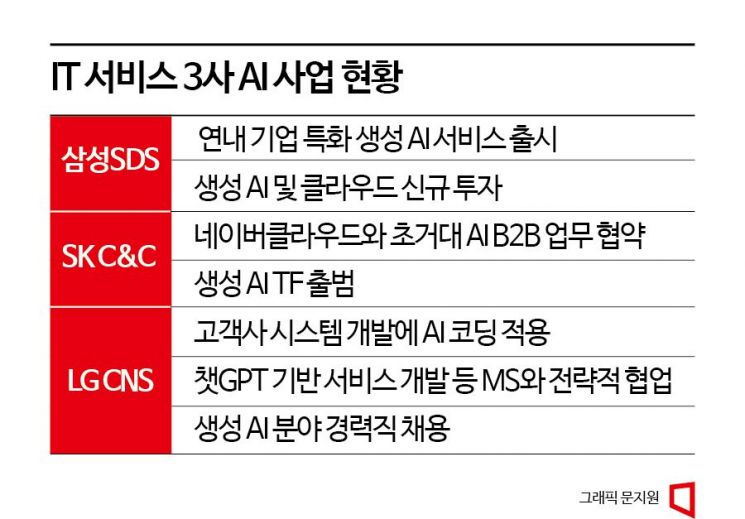
SK C&C has established a generative AI task force (TF) to develop AI services. Beginning with financial sectors such as call center automation, they are planning industry-specific services for retail, services, and more. Park Jun, Director of SK C&C Digital Tech Center, who has been discovering platform businesses, concurrently serves as the TF leader. They have also partnered with Naver Cloud. By combining Naver Cloud's massive AI 'HyperCLOVA X' with SK C&C's IT service execution experience, they are developing enterprise-customized AI systems.
LG CNS is also actively moving both internally and externally. Recently, they have begun triple-digit scale hiring in the fields of generative AI and cloud. Their role is to design, build, and operate AI models suitable for customer environments and to research and develop advanced AI technologies in the mid to long term. Externally, they have formed a partnership with Microsoft (MS). They are developing new services using OpenAI services provided on MS cloud 'Azure.' LG CNS is responsible for service development, while MS provides technical support and consultation. A representative example is ChatGPT-based 'AI coding.' Since ChatGPT is a generative AI trained only on publicly available data, it has limitations in coding specialized for enterprises. LG CNS provides prompts (commands) that reflect enterprise data, company system development environments, and coding standards. Through this, when a developer types 'Please code the user login function' on the code writing screen, the AI displays code that conforms to the company's standards. LG CNS also detects cases involving personal information in advance and processes them as pseudonymized data. The company explains that AI coding can increase development productivity by more than 30%.
The enterprise generative AI market is opening due to security issues. While enterprises are highly interested in adopting AI technology to improve productivity, they are concerned about security risks. To build customized solutions, internal data must be input, which raises concerns about information leakage. This is why IT service providers with extensive experience in enterprise solutions and security services are focusing on generative AI. According to a survey by market research firm Precedence Research, the enterprise AI market is expected to grow from $16.8 billion (approximately 21 trillion KRW) last year to $102.9 billion (approximately 131 trillion KRW) by 2030.
© The Asia Business Daily(www.asiae.co.kr). All rights reserved.

















