As the US New York stock market continues its relentless rally, some voices of concern have emerged, warning that a downturn may be imminent. This is due to persistent potential risks across the economy and the fact that August and September typically record the worst performance of the year for the New York stock market.
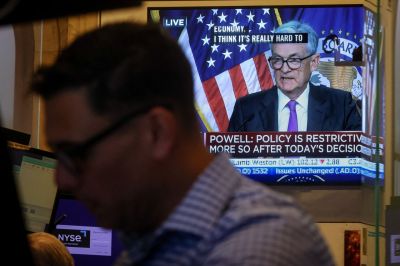
Bloomberg reported on the 30th (local time) that although the S&P 500 index, centered on large-cap stocks, has been rising for five consecutive months, some strategists are preparing for the possibility of selling. The report stated, "US stock market investors currently have almost no fear," adding, "The market is doing so well that it's time to start worrying."
This year, the S&P 500 index has risen nearly 20%. The tech-heavy Nasdaq index has surged by a whopping 37%. This is largely due to the AI rally fueled by the ChatGPT craze since the beginning of the year, and recently, inflation indicators have shown a clear slowdown, further strengthening investors' economic optimism. The US second-quarter GDP growth rate, announced last week, exceeded expectations at 2.4%, and the unemployment rate remains historically low. The core Personal Consumption Expenditures (PCE) price index for June, an inflation gauge closely watched by the Federal Reserve (Fed), rose 4.1% year-over-year, marking the lowest level since September 2021. These indicators inevitably increase expectations for a Goldilocks scenario. Bloomberg noted, "There is a reason for the S&P 500 rally," diagnosing that "inflation is gradually subsiding, and the economy is showing resilience despite aggressive tightening."
In the options market, call options betting on stock price increases far outnumber put options anticipating declines. The ratio of call options to put options has reached its highest level since December 2021. The Chicago Board Options Exchange (CBOE) Volatility Index (VIX), known as Wall Street's 'fear gauge,' has been well below its long-term average of 20 since March. As of the 28th, it had dropped to around 13.
However, Bloomberg also pointed out reasons to worry about the market going forward. First, looking at past cases, it is never easy to achieve a soft landing that lowers inflation without causing a recession. Considering the lag between the cumulative effects of tightening policies and their impact on the real economy, as well as the depletion of excess savings accumulated during the pandemic, the economic outlook for the second half of the year is not very bright. Since March last year, the Fed has raised the US benchmark interest rate 11 times, pushing it up to 5.25?5.5%.
Luca Paolini, Chief Strategist at Pictet Asset Management, pointed out that investors still underestimate the potential risks to the economy. He said, "(The market) has an incredible level of confidence that the Fed can lead the economy to a soft landing without a recession," adding, "If something goes wrong, it will be related to that."
Additionally, August and September are typically the worst months for the S&P 500 index during the year. This seasonal pattern could become an additional headwind. Bloomberg reported, "Looking at the S&P 500 over the past 30 years, September and August are the two worst months," noting that "August is on average the second worst month." MarketWatch also reported that August recorded the worst monthly performance since 1986 for the Dow Jones Industrial Average. Jeffrey Hirsch, editor of the Stock Traders Almanac, which has accurately predicted rallies since the financial crisis, pointed to the so-called FOMO (Fear of Missing Out) psychology driven by the fear of being left behind in a rising market, analyzing that "since all the FOMO players are in, it means the rally is due to stop."
Concerns about inflation remain. Although the recent trend shows a slowdown, inflation still far exceeds the 2% price stability target. High inflation particularly suggests that high interest rates will continue. Nitin Saxena, Head of US Equity Derivatives Research at Bank of America (BoA), warned, "There is a risk that the Fed will maintain higher interest rates for longer," adding, "This will ultimately break something." In addition, local media including The Wall Street Journal (WSJ) are closely monitoring the recent increase in speculative bets by investors, similar to just before past market crashes.
This week, entering August, key economic indicators such as the employment report, Job Openings and Labor Turnover Survey (JOLTS), and manufacturing and services Purchasing Managers' Indexes (PMI) will be released one after another, potentially impacting the Fed's future monetary policy decisions. Wall Street expects nonfarm payrolls to increase by 200,000 and the unemployment rate to be 3.6%, slightly slower than before. Earnings reports from companies including Apple, the largest by market capitalization, are also scheduled. Apple's stock price hit an all-time high of 195.83 on the 28th, approaching $200 per share. According to FactSet, 81% of S&P 500-listed companies that have reported earnings so far have exceeded expectations.
© The Asia Business Daily(www.asiae.co.kr). All rights reserved.

















