As the U.S. economy shows stronger growth than expected, there is an analysis that the timing of interest rate cuts may be delayed. If the Federal Reserve's (Fed) tightening stance continues, the Bank of Korea's originally anticipated timing for rate cuts in the second half of this year or the first half of next year could also be postponed.
On the 27th (local time), the U.S. Department of Commerce announced that the second-quarter gross domestic product (GDP) growth rate was 2.4% annually, surpassing both the first quarter's (2.0%) performance and market expectations (2.0%). Last week, new U.S. unemployment claims also hit a five-month low at 221,000, the lowest since February.
With solid economic indicators emerging one after another, the outlook that the U.S. economy will achieve a soft landing without recession has strengthened. Accordingly, the analysis that the Fed's tightening stance will continue for a considerable period is gaining traction.
Hee-chan Park, a researcher at Mirae Asset Securities, explained, "The expected inflation reflected in the U.S. bond market has risen to the highest level since the Silicon Valley Bank (SVB) collapse, indicating the need for additional tightening," adding, "There is a high possibility of cracks forming in the consensus that the Fed's rate hikes have ended."
Anna Wong, an economist at Bloomberg Economics, said, "The second-quarter GDP growth reflects economic strength that counters the Fed's efforts to lower inflation," and added, "If the recession expected this year is delayed, the Fed will likely have to raise rates further than currently anticipated."
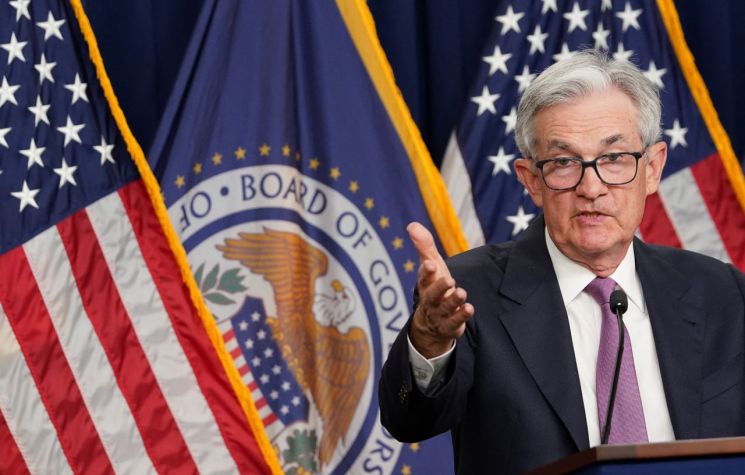
The market largely expects the Fed to hold rates steady after the 0.25 percentage point hike on the 26th, but Fed Chair Jerome Powell has left the door open for further increases, stating, "If the data supports it, raising rates again at the September meeting is certainly possible."
As the global economy shows signs of recovery, international oil prices are also on the rise. On the 27th (local time), the September delivery price of West Texas Intermediate (WTI) crude oil on the New York Mercantile Exchange closed at $80.09 per barrel, up $1.31 (1.66%) from the previous trading day. This marks the first time since April that prices have surpassed $80 per barrel.
Young-jin Ahn, a researcher at SK Securities, explained, "Chairman Powell said he does not expect a recession this year," adding, "Given this macroeconomic judgment, the direction of interest rates should weigh heavily on very limited declines."
Even if the U.S. does not raise rates further, maintaining high interest rates at the current level for a considerable period would make it difficult for the Bank of Korea to proceed with rate cuts.
Jae-kyun Lim, a researcher at KB Securities, explained, "Although the possibility of additional Fed hikes has weakened, the timing of rate cuts is also being delayed, and considering the foreign exchange market, it is difficult for the Bank of Korea to cut rates ahead of the Fed."
There is also analysis that the recent reform of the loan system by the Bank of Korea, which strengthens liquidity support for the banking sector, could be a factor delaying rate cuts.
On the 27th, the Bank of Korea announced a reform plan to promptly provide liquidity support if non-bank deposit-taking institutions such as Saemaeul Geumgo, Nonghyup, and mutual savings banks face funding issues, and to reduce funding burdens for banks by adjusting the applied interest rates of the existing standing loan system, the Fund Adjustment Loan.
Following financial instability caused by the Legoland incident in the fourth quarter of last year and the U.S. SVB incident earlier this year, some voices called for responding with rate cuts. However, the Bank of Korea is analyzed to have addressed the possibility of financial instability through loan system reforms rather than adjusting the base rate.
Researcher Lim explained, "Liquidity issues in the financial market are being resolved through liquidity supply, and the most important interest rate decisions in monetary policy will respond centered on inflation," adding, "By proactively responding to financial instability, the Bank of Korea has indicated it will maintain the rate freeze for a long period."
© The Asia Business Daily(www.asiae.co.kr). All rights reserved.


















