Overcoming 'Child School Violence Controversy,' Official Appointment Announced Two Months After Nomination
Accelerating Broadcasting Reform Including Strengthening Public Broadcasting and Financial Transparency
"There Must Be a Trusted Public Broadcaster"... Mention of Content Distribution Companies
On the 28th, President Yoon Suk-yeol nominated Lee Dong-gwan, the President's Special Advisor for External Cooperation, as the new Chairman of the Korea Communications Commission. This official appointment came about two months after rumors of his nomination circulated mainly within political circles. It is interpreted that the decision was made because the controversy over his child's school violence allegations was finally resolved and the Chairman position could no longer be left vacant for the prompt reform of broadcasting. Lee stated, "The government is deeply engaged in responding to the war against fake news," and added, "I will devote all efforts to restoring a fair media ecosystem."
Kim Dae-gi, Chief of Staff to the President, held a briefing at the Yongsan Presidential Office that morning and officially announced Lee's nomination, saying, "Based on his extensive experience in the media industry, diverse human relationships, and networking leadership, I believe he is the right person to promote the government's national agenda in the broadcasting and communications sector."
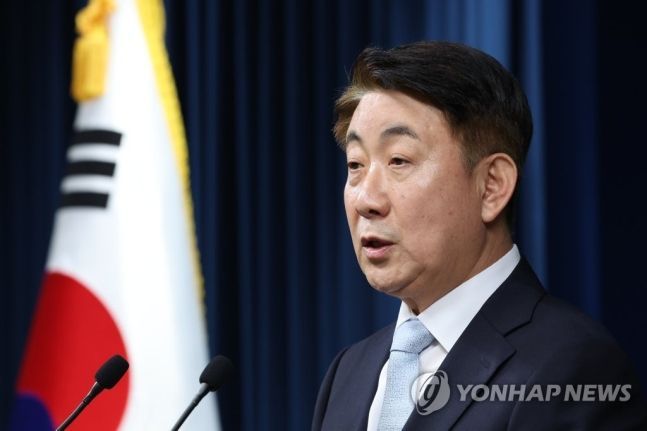 Lee Dong-gwan, the special presidential envoy for external cooperation, who has been nominated as the candidate for the Chairman of the Korea Communications Commission, is giving a greeting at the Presidential Office building in Yongsan, Seoul on the 28th.
 [Photo by Yonhap News]
Lee, a former reporter for the Dong-A Ilbo, served as the Blue House spokesperson, head of public relations, and presidential media special advisor during the Lee Myung-bak administration. During the last presidential election, he was the special media communication committee chair for the People Power Party's election campaign, later serving as a special advisor to President-elect Yoon, and then as the President's Special Advisor for External Cooperation. Accordingly, it is expected that once officially appointed as Chairman of the Korea Communications Commission, Lee will focus on key broadcasting reform tasks such as strengthening the public nature of public broadcasting and transparent management and disclosure of public broadcasting funds.
In particular, Lee must address the significant loss of trust in the Korea Communications Commission caused by controversies during the comprehensive programming channel reauthorization process involving former Chairman Han Sang-hyuk. Considering that the Presidential Office judged that Han was unfit to hold a ministerial-level public office and unusually detailed the reasons for his dismissal, Lee is also likely to initiate internal reforms to secure the Korea Communications Commission's 'political neutrality.' At that time, the Presidential Office explained, "As Chairman of the Korea Communications Commission, he violated his command and supervisory responsibilities and duties, causing an unprecedented situation where three people were arrested and prosecuted, and he himself committed a serious crime leading to criminal prosecution, making it impossible for him to perform his duties normally, resulting in his dismissal."
Lee also stated on the same day, "Governments and civic groups worldwide are currently engrossed in responding to the war against fake news," adding, "Above all, I will devote all efforts to restoring a fair media ecosystem and creating a free, well-ventilated, and communicative information distribution environment." Emphasizing trust and mentioning 'recognized public broadcasting' is also interpreted as his intention to maintain the Korea Communications Commission's political neutrality. Lee said, "Now, South Korea needs public broadcasters like the UK's BBC or Japan's NHK that receive international trust and recognition," and added, "We also need large content distribution companies like Netflix."
The Presidential Office expects no issues with the confirmation hearing. They believe the allegations of school violence involving Lee's child have been settled and stated, "Since the verification is already complete, he will present his role as Chairman of the Korea Communications Commission in detail to the public through the confirmation hearing." However, opposition parties such as the Democratic Party remain strongly opposed. Lee Jae-myung, leader of the Democratic Party, criticized the nominee at the party's Supreme Council meeting, saying, "He is a symbolic figure of MB's broadcasting oppression," and added, "There are various other problems, and the overwhelming majority of the public opposes him, so forcibly appointing him is an attitude that treats the people as subjects to be ruled." Park Kwang-on, floor leader of the Democratic Party, demanded, "Our party and the public have repeatedly stated that a symbolic figure of media control and broadcasting oppression is by no means suitable for a position that guarantees political neutrality and promotes broadcasting," and called for the withdrawal of the nomination.
In political circles, the nomination of the new Chairman of the Korea Communications Commission is seen as a signal for a sequential cabinet reshuffle. On the same day, President Yoon also approved the appointment of Kim Young-ho as Minister of Unification. The National Assembly held a confirmation hearing for Kim on the 21st, but the confirmation report was not adopted due to opposition from the Democratic Party. President Yoon requested the National Assembly to submit the confirmation report again on the 25th, but the adoption failed once more. However, according to the Confirmation Hearing Act, if the National Assembly does not submit the confirmation report within 20 days from the date the request is submitted, the President may request the National Assembly to submit the report within 10 days, and if the National Assembly still does not submit the report within this period, the President may appoint the nominee without the Assembly's consent.
The reshuffle of ministries other than the Ministry of Trade, Industry and Energy is expected to take place next week. The Ministry of Science and ICT and the Ministry of Environment are also being considered, and the replacement of Minister Lee Chang-yang of the Ministry of Trade, Industry and Energy is virtually confirmed. Ban Seon-gyu, Director of the Office for Government Policy Coordination, is the leading candidate to succeed as Minister of Trade, Industry and Energy. Ban has been mentioned as the new minister since the cabinet reshuffle at the end of June.
© The Asia Business Daily(www.asiae.co.kr). All rights reserved.
!["The Woman Who Threw Herself into the Water Clutching a Stolen Dior Bag"...A Grotesque Success Story That Shakes the Korean Psyche [Slate]](https://cwcontent.asiae.co.kr/asiaresize/183/2026021902243444107_1771435474.jpg)
















