10% Lifespan Extension with 12-Week Fusion
Longer Connection Period Increases Effect
"Human Fusion Is Unethical and Unrealistic"
Connecting the blood vessels of old and young mice resulted in a slower aging process in the old mice, with their lifespan increasing by up to 10%.
Anti-aging effects observed in tissues and cells even after 3 weeks of parabiosis
 Appearance of an experimental mouse. Not directly related to the content of the article. [Image source=Yonhap News]
On the 27th (local time), Professor James White and his research team at Duke University in the United States reported in the scientific journal Nature Aging that they confirmed these results through a parabiosis experiment surgically connecting the circulatory systems of young and old mice.
They also stated that the anti-aging effects in the old mice persisted long after the two animals were separated, and that the longer the circulatory systems were shared, the longer the anti-aging effects lasted.
Previous studies showed that old mice joined in parabiosis with young mice for 3 weeks exhibited anti-aging effects in their tissues and cells. After the experiment, the old mice showed improved activity and signs of rejuvenation in their tissues.
Professor White explained, "If such effects occur after 3 weeks of parabiosis, I was curious about what effects might appear if the period was extended to 12 weeks," adding, "We wanted to determine whether the effects of parabiosis are temporary or long-lasting."
Significant rejuvenation after 12 weeks of parabiosis, but "difficult to apply to humans"
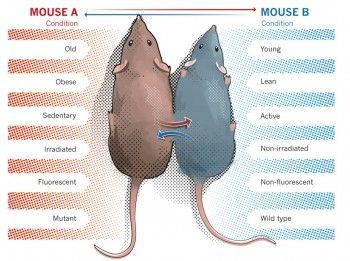
The research team surgically connected the circulatory systems of 4-month-old young mice and 2-year-old old mice, allowing them to share blood for 12 weeks. They then separated the mice and conducted a 2-month follow-up observation.
The lifespan of mice is about 3 years, so 12 weeks corresponds to approximately 10% of a mouse's lifespan. Also, 4-month-old and 2-year-old mice correspond to roughly 18 and 50 years old in humans, respectively, and the 12-week parabiosis period equates to about 8 years.
Follow-up observations showed that in the old mice, the epigenetic age of blood and liver tissues was significantly rejuvenated at the cellular level, and gene expression opposite to aging was observed.
Additionally, mice that underwent parabiosis showed improved physiological functions and lived about 10% longer than control mice that did not undergo parabiosis.
The research team claimed that these results provide evidence that parabiosis with a young individual can slow the aging process and extend the lifespan of an old individual. They explained that this is equivalent to a 50-year-old and an 18-year-old human sharing circulatory systems for about 8 years, resulting in an 8-year lifespan extension.
Professor White emphasized, "However, parabiosis in humans is neither practical nor ethical," and pointed out, "Other strategies such as calorie restriction are better than parabiosis for anti-aging effects in mice." In fact, results such as the rejuvenation of epigenetic age in blood and liver tissues at the cellular level are similar to the effects of calorie restriction.
He added, "These results show that the blood circulation of young mice improves the health and extends the lifespan of old mice, but we do not know which factors cause these effects," and stated, "Identifying these factors is important and is the next research goal."
"Wanting to be young" Millionaire who transfused young blood halts experiment
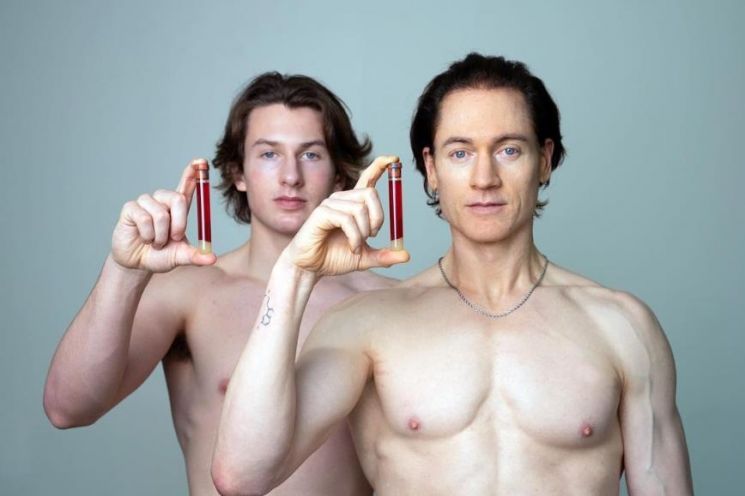
Meanwhile, Brian Johnson, a 40-something millionaire in the United States, sparked controversy by injecting plasma from young people, including his 17-year-old biological son, once a month for 6 months as a rejuvenation treatment.
However, he recently announced that "there were no significant benefits" and reportedly stopped the experiment. It is also known that, unlike animal experiments where subjects are continuously exposed to all components of young blood, the plasma Brian injected lacked cellular components and the transfusion frequency may not have been optimized, among other limitations.
© The Asia Business Daily(www.asiae.co.kr). All rights reserved.



















