Financial Services Commission Proposed 'Debtor Protection Act'
Debt Adjustment Rights and Late Interest Reduction
National Assembly Shows Little Interest... Bill Passage Delayed
Golden Opportunity for Vulnerable Groups to Recover May Be Missed
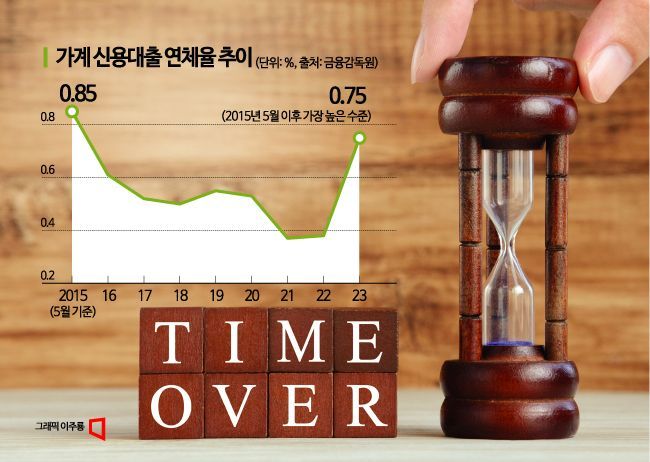
The delinquency rate for personal unsecured loans has reached its highest level in eight years. It was the highest among all loan sectors, including corporate and household loans.
Delinquency Concentrated on Individuals
According to the "Status of KRW Loan Delinquency Rates at Domestic Banks as of the End of May" released by the Financial Supervisory Service on the 27th, the delinquency rate for unsecured loans in May was 0.75%, the highest since May 2015 when it was 0.85%. This indicates that the number of people at risk of becoming credit delinquents has increased amid the economic downturn.
The next riskiest category after unsecured loans was loans to individual business owners. The delinquency rate for individual business owner loans in May was 0.45%, the highest since November 2016 (0.46%). The delinquency rate increased by 0.25 percentage points in just one year, showing a rapid rise. It appears that the financial situation of self-employed individuals worsened further after COVID-19 support ended.
A financial authority official explained, "Self-employed individuals tend to take out both unsecured loans and individual business owner loans, so when their businesses face difficulties, delinquency rates in both sectors rise. The delinquency situation is much worse than that of corporate loans or mortgage loans, which are secured personal loans."
Debtor Protection Law Needed to Prevent Mass Bankruptcies
The Financial Services Commission emphasizes that the 'Personal Finance Debtor Protection Act' (hereinafter referred to as the Debtor Protection Act) must be implemented to prevent mass bankruptcies among individual debtors. The Debtor Protection Act was created by the Financial Services Commission in the second half of last year as a measure to prepare for rising delinquency rates among personal debtors when bank loan interest rates surged.
The financial authorities proposed this bill in December last year, but it has never been properly discussed in the National Assembly. Although it was listed as a major task in the economic policy direction for the second half of this year announced by the Ministry of Economy and Finance in July, the National Assembly has shelved it, leaving the bill unable to move forward.

The core content of this bill is to provide vulnerable groups with debts of 30 million KRW or less the opportunity to request debt adjustment and to alleviate the burden of delinquency interest. The right to request debt adjustment allows delinquent borrowers who cannot repay their debts on time to first request banks for debt adjustments such as extension of repayment period, installment repayment, repayment deferral, or debt reduction. Banks receiving such requests must stop collection efforts and notify the debtor of the decision on debt adjustment within 10 business days.
Alleviating the burden of delinquency interest means charging delinquency interest only on the overdue amount. A Financial Services Commission official explained, "For example, if a debtor borrowed 1 million KRW with principal and interest installment repayment and fails to repay 100,000 KRW due this month, delinquency interest will be charged only on that 100,000 KRW, reducing the debtor's interest burden." Currently, delinquency interest is charged on the entire principal and interest amount due once a delinquency occurs.
Excessive collection efforts will also be prevented for all debtors. Under the collection volume control system, collection contacts cannot exceed seven times in seven days. Debtors can also request debt collectors not to contact them during specific times or by certain methods or means.
A financial industry official said, "This bill must pass to help individual debtors recover, especially when delinquency rates are rising sharply like now. Protecting vulnerable debtors is a matter on which there should be no disagreement between political parties. If the National Assembly does not expedite discussions, the golden time to protect individual debtors will be lost."
© The Asia Business Daily(www.asiae.co.kr). All rights reserved.


















