As public opinion for the execution of death sentences against heinous criminals rises following incidents such as the Shinlim-dong stabbing spree, "life imprisonment without parole" is emerging as an alternative. However, there are criticisms that the sentencing of life imprisonment itself for heinous criminals is rare and may instead provoke more debates surrounding human rights, making it less effective as an alternative.
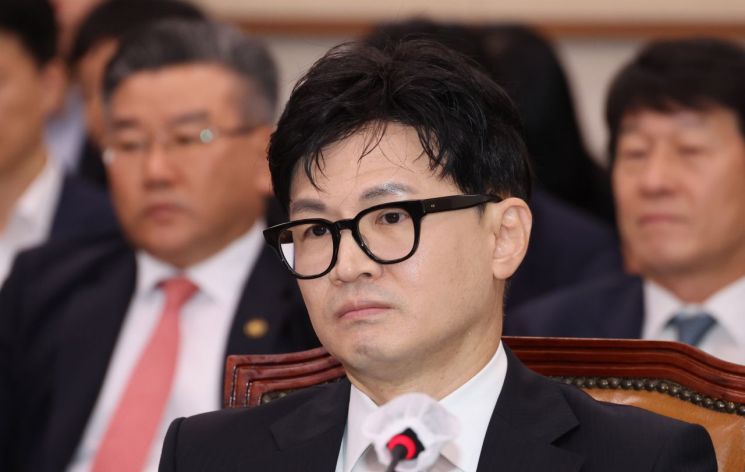
On the 26th, Han Dong-hoon, Minister of Justice, attending the plenary session of the National Assembly's Legislation and Judiciary Committee, responded to a question from Jo Jung-hoon of the Transition Era party regarding the death penalty by saying, "The death penalty is an area that requires philosophical consideration." He added, "(The Constitutional Court's) decision on the unconstitutionality of the death penalty is imminent. Our society must find a way forward after the decision." Regarding the introduction of life imprisonment without parole into the Criminal Act, he said, "I sympathize with the intent," and "It is a meaningful option that can be seriously considered." He further stated, "There is a need for a method to permanently isolate monsters who are unacceptable to society."
Life Imprisonment Without Parole... Effectiveness ‘Questionable’
Currently, South Korea is classified as a "de facto abolitionist country" regarding the death penalty. No executions have been carried out since December 3, 1997. The Constitutional Court is preparing for its third ruling on the death penalty. The previous two rulings upheld its constitutionality. If the Constitutional Court declares unconstitutional provisions such as Article 41, Clause 1 of the Criminal Act, which defines the death penalty as a type of punishment, or Article 250, Paragraph 1, which stipulates the death penalty for murder, some death row inmates could be resentenced to life imprisonment through retrials. This is the background for calls for life imprisonment without parole as a necessity in the current situation where the death penalty has become virtually ineffective.
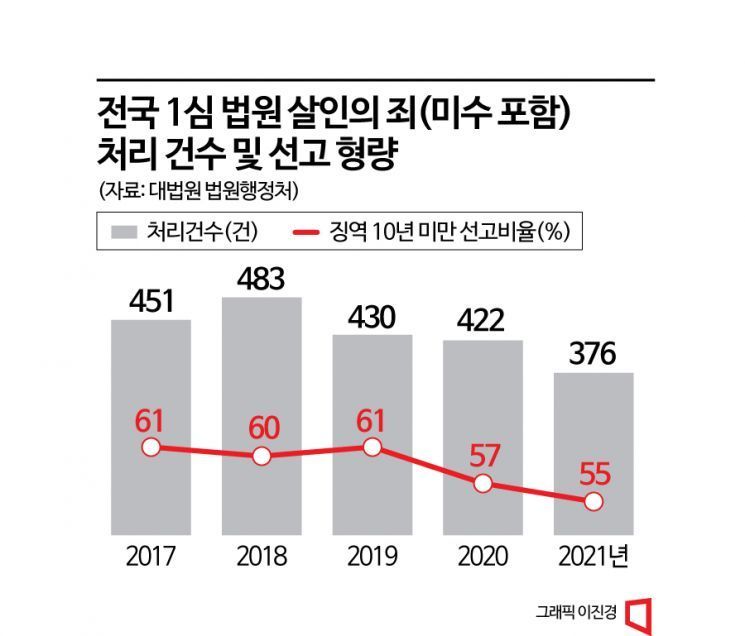
However, there are also criticisms that its effectiveness would be diminished. First, there is much controversy surrounding the sentences handed down to heinous criminals. Under current law, the maximum fixed-term imprisonment is 30 years, which can be extended up to 50 years through aggravated punishment, but more than half of murder defendants receive sentences of "less than 10 years" in trials. According to the Supreme Court’s Judicial Administration Office, in 2021, among 376 first-instance murder cases (including attempted murder) nationwide, 55% were sentenced to less than 10 years in prison. The proportion of life imprisonment sentences also decreased from 4% in 2017 to 1% in 2021.
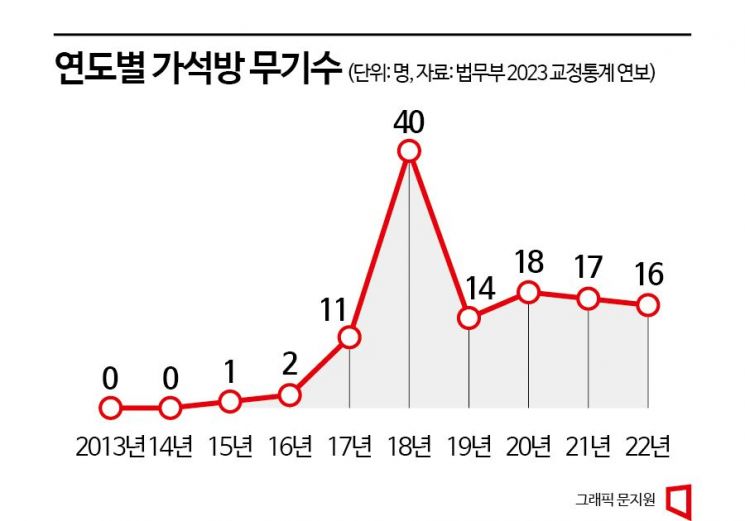
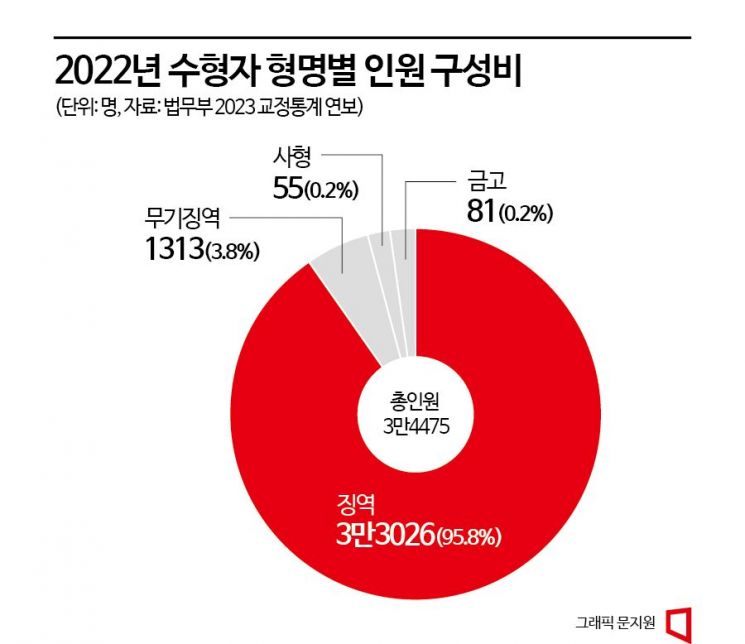
According to the '2023 Correctional Statistics Yearbook' recently released by the Ministry of Justice, among the total 34,475 inmates last year, 55 were death row inmates (0.2%), and 1,313 were sentenced to life imprisonment (0.8%). The number of life-sentenced prisoners granted parole has recorded double digits annually since 2017. Under current law, life imprisonment inmates become eligible for parole after serving 20 years and being judged to have clearly repented. However, for fixed-term imprisonment, parole eligibility requires serving one-third of the sentence and having less than 10 years remaining. This creates a paradox where inmates with worse crimes (life sentences) have a higher chance of parole.
Experts: “Parole Conditions for Life Imprisonment Should Be Strengthened First”
There are also concerns that this will only cause more social controversy surrounding the human rights of heinous criminals. On the 13th, the Supreme Court overturned and remanded a lower court ruling that sentenced a man in his 20s, charged with murder, to death, judging that choosing the death penalty to achieve the effect of life imprisonment without parole cannot be justified. The second trial court originally stated, "Unlike life imprisonment, which becomes eligible for parole after a certain period, the death penalty requires continuous detention in correctional facilities without pardon or commutation, thus effectively functioning as an absolute life sentence," and sentenced the defendant to death. The Supreme Court ruled that even if the death penalty is effectively abolished in Korea, such a judgment cannot be justified. Since life imprisonment without parole denies the possibility of rehabilitation itself, European countries such as the UK and Switzerland generally do not adopt life imprisonment without parole.
Therefore, there is also a diagnosis that strengthening parole conditions for life-sentenced prisoners should take priority. Seung Jae-hyun, Senior Research Fellow at the Korea Institute of Criminology and Justice, said, "If the issue is finding an alternative to the death penalty, parole for life-sentenced prisoners should not be faster than for fixed-term prisoners," and added, "The legal provisions should be amended so that parole is possible after 40 years, not the current 20 years, for life-sentenced prisoners." The idea is that by significantly extending the mandatory incarceration period and operating a "life sentence with parole" system that allows parole only after reaching old age, it is possible to reduce social anxiety about heinous criminals while not giving up on the possibility of rehabilitation.
© The Asia Business Daily(www.asiae.co.kr). All rights reserved.
![Clutching a Stolen Dior Bag, Saying "I Hate Being Poor but Real"... The Grotesque Con of a "Human Knockoff" [Slate]](https://cwcontent.asiae.co.kr/asiaresize/183/2026021902243444107_1771435474.jpg)


















