The Supreme Court overturned and remanded the second trial's ruling on the 27th, which had sentenced the wife to 30 years in prison for killing her husband by feeding him food and water mixed with nicotine concentrate, allegedly aiming for her husband's assets and death insurance money. The reason was that the evidence submitted by the prosecution was insufficient to prove that the wife killed her husband by feeding him nicotine, and there were doubts about the wife's motive for murder.
The Supreme Court's Third Division (Presiding Justice No Jeong-hee) dismissed the prosecution's appeal on the acquittal part in the appeal trial of A, who was charged with murder and computer-related fraud, but accepted A's appeal, overturned the original ruling, and sent the case back to the Suwon High Court.
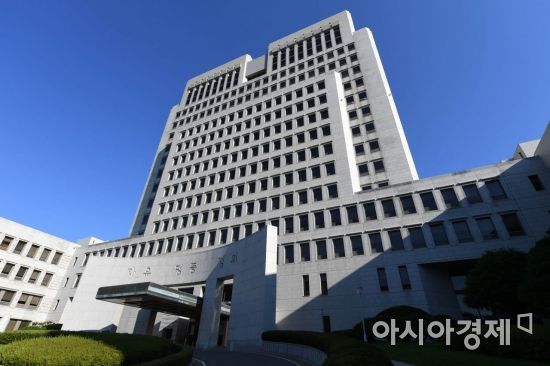
The court stated, "There is an illegality affecting the judgment by misunderstanding the legal principles regarding the degree of proof required in criminal trials, failing to conduct necessary hearings, or exceeding the limits of free evaluation of evidence contrary to logic and experience, in the original ruling that recognized the defendant guilty of handing the victim cold water mixed with nicotine concentrate and causing the victim's death."
The court added, "The indirect evidence presented for the guilty part is not sufficient as positive evidence supporting the charges, and there remain doubts that make it hesitant to be convinced of guilt. Since additional hearings seem possible regarding these doubts, it is difficult to maintain the original court's conclusion as is."
Unlike the lower courts, the court judged that the autopsy results and expert opinions on the deceased husband only serve as evidence that the cause of death was acute nicotine poisoning and that the husband was presumed to have ingested a large amount of nicotine orally after visiting the emergency center, but do not prove the charge that "A mixed nicotine concentrate in cold water and made her husband drink it."
Regarding the motive for murder, the court also found that additional hearings are necessary to determine whether maintaining an extramarital relationship or economic purposes constitute sufficient motives.
A was prosecuted for feeding her husband B a misutgaru (grain powder) drink, white porridge, and water mixed with nicotine concentrate three times in May 2021, causing his death. After her husband's death, she was also charged with using her husband's mobile phone to borrow 3 million won to prepare a deposit for a house to live with her lover.
A met B, who ran a Japanese restaurant in Suwon in 2008, married him in May 2010, and gave birth to a son in 2014. From 2015, A lived with her husband and son in Hwaseong. She began dating C, whom she met at a volunteer group meeting in 2018, and maintained an extramarital relationship with him until the time of the incident.
From around 2020, A allowed C to stay and live at her workshop, and they traveled to Japan together three times. After the incident surfaced, forensic analysis of A's phone confirmed that from May 9, 2019, to August 2, 2021, they exchanged an average of 194 KakaoTalk messages per day. Two months before B's death, around March 14, 2021, B, aware of his wife's affair with C, sent messages implying suicide to attract her attention and caused a suicide commotion, but A did not end the affair.
According to the prosecution, A, who usually smoked electronic cigarettes, made payments totaling 407,000 won five times at a tobacco product store between August 2020 and May 2021. During the investigation, the store owner testified that A initially purchased liquid nicotine in plastic containers but later mainly bought AP nicotine products in boxes. The owner also said that at A's request, although illegal, about five drops of pure nicotine concentrate were added.
Nicotine solution used in electronic cigarettes is made by diluting nicotine concentrate, which is a highly toxic substance. Commercially available liquid nicotine contains nicotine content of 2% (20mg/ml) or less, and conventional cigarettes typically contain 1.6-2% (16-20mg/ml) nicotine. However, nicotine concentrate distributed illegally online contains over 99% purity, with 990mg/ml nicotine.
On the morning of May 26, 2021, A fed B a drink made of misutgaru mixed with honey and milk and a hamburger before he went to work. When B called complaining of stomach pain after going to work, A reassured him by saying, "The honey's expiration date was until 2016. Sorry," implying that the stomachache was caused by spoiled honey, even though she knew the honey in the misutgaru was not spoiled.
The prosecution judged that although A fed B the misutgaru drink mixed with nicotine concentrate, B only showed symptoms of heartburn and did not die. On the same evening, when B refused to eat due to stomach discomfort, A made white porridge with nicotine concentrate and fed it to him. When B still did not die, on the early morning of May 27, 2021, between 1:30 and 2:00 a.m., she made him drink cold water mixed with a large amount of nicotine concentrate, causing his death.
The National Forensic Service determined B's cause of death as acute nicotine poisoning. The autopsy found a large amount of nicotine in B's stomach contents, and his blood nicotine level was at a lethal concentration. The National Forensic Service estimated the time of death between 2:30 and 3:30 a.m. on May 27, 2021.
The first trial court found most of the prosecution's charges guilty and sentenced A to 30 years in prison.
The court judged that A likely considered her husband B, who even staged a suicide commotion to interfere with her extramarital relationship with C, as an obstacle, and given their financial difficulties, the economic motive related to B's assets and death insurance money was sufficient. The court also found it hard to find any cause other than oral intake of nicotine for the large amount of nicotine found in B's body, who had quit smoking after their son was born.
A denied the charges at trial, suggesting that B might have taken his own life, but this was not accepted.
The court concluded, "It is reasonable to believe that the food given to the victim by the defendant on three occasions contained nicotine, and that the victim died due to the nicotine in the cold water last given by the defendant."
Regarding sentencing, the court pointed out: ▲ The crime's nature is extremely bad and highly blameworthy because A maintained an extramarital relationship despite having a spouse, deliberately fed food containing nicotine concentrate to kill her husband to obtain death insurance money, and then fraudulently borrowed money under her deceased husband's name; ▲ The deceased husband lived diligently, repaying A's loan debts or working part-time to support the family, but died leaving their beloved young son due to A's planned crime; ▲ B's father, who lost his son and grandchild at one time a family member, suffered an irreparable wound; ▲ Above all, the shock and pain the young son will face growing up after losing his father due to his mother's crime are unimaginable. Considering these circumstances, it is appropriate to keep the defendant isolated from society for a long time to live with sincere repentance and atonement."
The second trial court acquitted A of the charges related to feeding misutgaru drink and white porridge containing nicotine concentrate, overturning the first trial's ruling, but upheld the guilty verdict for feeding cold water mixed with nicotine concentrate and sentenced her to 30 years in prison, the same as the first trial.
Regarding sentencing, the second trial court reiterated the reasons pointed out by the first trial court and stated, "Nevertheless, the defendant has consistently denied the murder charge up to this appeal. Considering these circumstances, it is appropriate to impose a heavy sentence on the defendant."
© The Asia Business Daily(www.asiae.co.kr). All rights reserved.

















