Research Team Led by Professor Hong Jongseop at Yonsei University
Mechanism Identified and Solution Confirmed
Domestic researchers have found a clue to solving the thermal runaway phenomenon of lithium-ion batteries, which is the cause of electric vehicle fires.
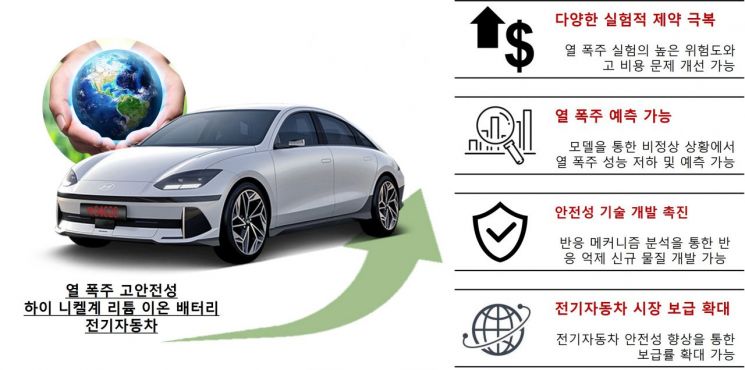
The National Research Foundation of Korea announced on the 26th that Professor Hong Jong-seop's research team at Yonsei University has developed a core technology to improve the safety of high-nickel cathode-based lithium-ion batteries, which are widely used as secondary batteries for electric vehicles due to their high energy density, and to enhance the reliability of electric vehicles.
Lithium-ion batteries have improved the driving range of electric vehicles with high efficiency, but there is a high risk of thermal runaway when mechanically or electrically abused. In addition, during thermal runaway, various side reactions accompanied by gas generation occur, leading to explosions that threaten the safety of drivers and vehicles. In particular, the thermal instability of high-nickel cathode materials is one of the main causes of thermal runaway. However, until now, research on side reactions at the battery cathode has not been actively conducted for cathodes with nickel content above 80%. During thermal runaway, various side reactions occur inside the battery while the materials are in physical contact. However, until now, there has been a limitation in that phenomena occurring at each electrode were considered individually without experiments on combinations of these materials.
The research team conducted thermal decomposition experiments on a total of 15 combinations of materials for the four components of lithium-ion batteries?cathode, anode, electrolyte, and separator?to elucidate the thermal runaway reaction mechanism of lithium-ion batteries using high-nickel cathode materials. They also confirmed different reaction temperatures and heat generation amounts during thermal decomposition experiments depending on the combination of battery components. Reflecting the reduction of active materials and electrolyte accordingly, they developed a reliable thermal runaway reaction model capable of simulating heat, volume, and pressure at different temperatures.
The thermal runaway reaction mechanism and model proposed by the research team can predict cell performance degradation and thermal runaway under various abnormal conditions. This is expected to overcome various constraints of large-area battery experiments and promote technological advancements to enhance battery safety.
Professor Hong said, "Using the mechanism and thermal runaway reaction model developed in this study, we plan to apply and verify predictions of cell performance degradation and thermal runaway caused by separator melting under various abnormal conditions," adding, "We expect that solving the thermal runaway problem will contribute to improving electric vehicle safety and expanding the electric vehicle market."
The results of this study were published on the 3rd in the international journal in the field of reaction engineering, Chemical Engineering Journal.
© The Asia Business Daily(www.asiae.co.kr). All rights reserved.
![Clutching a Stolen Dior Bag, Saying "I Hate Being Poor but Real"... The Grotesque Con of a "Human Knockoff" [Slate]](https://cwcontent.asiae.co.kr/asiaresize/183/2026021902243444107_1771435474.jpg)
















