To prevent tenant damages caused by not receiving their full jeonse deposit back due to ‘reverse jeonse’?where the jeonse price has dropped compared to the previous contract?loan regulations will be eased solely for the purpose of returning jeonse deposits. Homeowners using return loans will face restrictions on purchasing new homes, and if violated, the entire loan will be recalled and mortgage loans will be prohibited for three years.
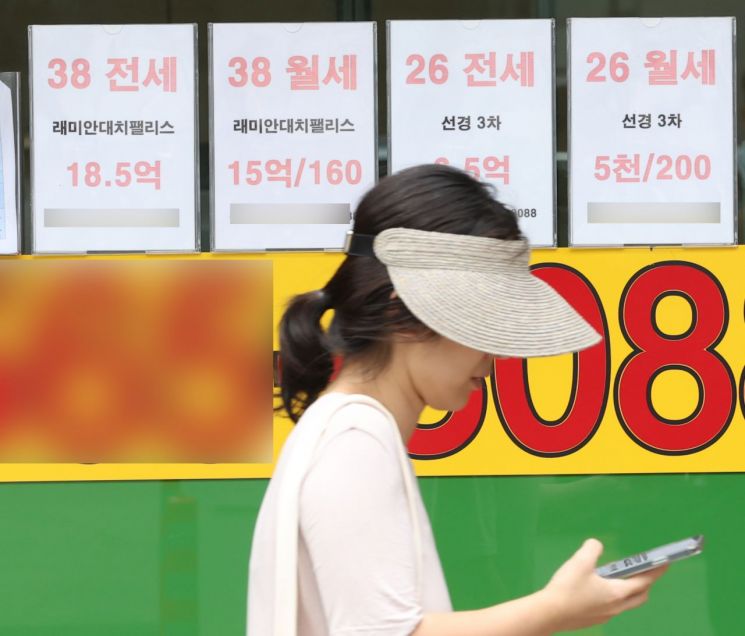
Support Provided Even Without Immediate Successor Tenant... Full Loan Recall if Loan Used to Purchase Home
As a follow-up measure to the '2023 Second Half Economic Policy Direction,' the government announced that starting from the 27th, loan regulations for jeonse deposit return loans?used by homeowners borrowing from banks (excluding internet banks) to cover the difference in jeonse deposits (previous jeonse deposit minus new jeonse deposit)?will be temporarily eased for one year. Accordingly, individuals will be subject to a relaxed Debt-to-Income (DTI) ratio of 60% instead of the previous Debt Service Ratio (DSR) of 40%. The Rental Income Ratio (RTI) will be adjusted from 1.25?1.5 times to 1.0 times.
This measure responds to the ongoing decline in jeonse prices since the end of last year, which has caused homeowners to be unable to return deposits to tenants, restricting residential mobility and increasing concerns over unreturned deposits.
The support targets cases where lease contracts were signed before July 3, prior to the announcement of the reverse jeonse return loan regulation easing, and where return demands arise by the end of this month due to lease expiration or other reasons. The government plans to apply the relaxed loan regulations not only when homeowners secure a successor tenant and borrow the deposit difference but also when they fail to find a successor tenant, thereby supporting the return of deposits.
However, if a successor tenant is found within one year and the corresponding jeonse deposit is received, the loan amount must be repaid immediately. Additionally, if the homeowner moves in as a self-occupant (moving in personally after the existing tenant vacates), the ability to return the current residence’s jeonse deposit will be strictly assessed before supporting the return loan. In such cases, the homeowner must move in within one month after loan execution and reside for at least two years.
The government will strictly manage to ensure that the jeonse deposit difference is not used for other purposes. It will verify whether the homeowner has any alternative means to return the deposit besides the loan and will directly pay the loan amount to the current tenant to prevent the homeowner from using the funds for anything other than returning the jeonse deposit.
To prevent misuse of the loan for investment purposes, homeowners are prohibited from purchasing new homes during the loan period. If a home purchase is detected, the entire loan will be recalled and mortgage loans will be banned for three years. If the tenant is using a jeonse loan, the loan amount will be directly deposited into the bank, and the remaining amount will be paid to the tenant.
Protection measures have also been established to prevent the risk of non-return of jeonse deposits by successor tenants from expanding. First, the government will provide the loan regulation easing benefits on the condition that the homeowner takes protective measures for the successor tenant. Homeowners wishing to apply for the eased regulations must first sign a lease contract with the successor tenant that includes a special clause for subscribing to jeonse deposit return insurance. Banks will execute loans on the premise that this lease contract (special clause) is faithfully fulfilled. Homeowners must subscribe to the jeonse deposit return insurance or pay the premium within three months after the successor tenant moves in; failure to comply may result in full loan recall and other sanctions.
A new insurance product will also be temporarily operated. This product protects the jeonse deposits of successor tenants in homes subject to the regulation easing, has no deposit limit, and is subscribed to by tenants (with premiums paid by homeowners). It will be available immediately from the 27th. A product for homeowners to subscribe directly will be launched in August.
A government official stated, "The reverse jeonse issue can exacerbate difficulties in the rental market due to delayed return of deposits and tenant relocation, so the loan regulation easing for jeonse deposit returns is a temporary measure to minimize market shocks. We will strictly manage institutional safeguards such as verifying homeowners’ repayment ability and tenant protection measures to ensure these actions do not lead to side effects like increased household debt or heightened risk of non-return by successor tenants."
Experts Say Concerns Over Jeonse Deposit Non-Return Alleviated... Landlords Without Remaining Loan Capacity Should 'Sell'
Experts evaluated the measure positively, noting that tenants in reverse jeonse homes will worry less about deposit non-return.
Ham Young-jin, Head of the Zigbang Big Data Lab, said, "Although the reverse jeonse return loan regulation easing is a one-year temporary policy, it is expected to somewhat reduce reverse jeonse risks in areas with apartment oversupply or where jeonse contract renewal rights are concentrated. It especially considers various scenarios such as having a successor tenant, not having one immediately, or self-occupancy, and lowers the risk of non-return by successor tenants by making ‘jeonse deposit return insurance subscription’ a special clause."
Lee Eun-hyung, Research Fellow at the Korea Institute of Construction Policy, said, "The purpose of this measure is not to artificially stimulate the market but to minimize the adverse effects of reverse jeonse caused by economic fluctuations. The effect of this loan regulation easing will be that the market remains calm as if nothing happened."
However, concerns about institutional blind spots were also raised. Ham noted, "To receive a reverse jeonse return loan, homeowners must mandatorily subscribe their successor tenants to the special jeonse deposit return insurance from the three guarantee companies for the loan to be executed. There is an institutional blind spot where landlords whose tenant deposits plus senior claims (senior mortgages and senior tenant deposits) exceed 90% of the home price cannot receive this loan."
Nonetheless, this was seen as an unavoidable measure to prevent household debt expansion risks and ensure the safety of new tenants’ deposit returns. Research Fellow Lee said, "This loan regulation easing comes with several restrictions. For landlords who do not have remaining loan capacity to the extent that they do not qualify for this measure?meaning they are in a situation of reckless investment?selling their property is a choice consistent with market economics."
© The Asia Business Daily(www.asiae.co.kr). All rights reserved.
![From Bar Hostess to Organ Seller to High Society... The Grotesque Con of a "Human Counterfeit" [Slate]](https://cwcontent.asiae.co.kr/asiaresize/183/2026021902243444107_1771435474.jpg)
















