Bang Gi-seon, the 1st Vice Minister of the Ministry of Economy and Finance, stated on the 26th, "We will reexamine the low birthrate policy from the ground up and focus on selection and concentration."
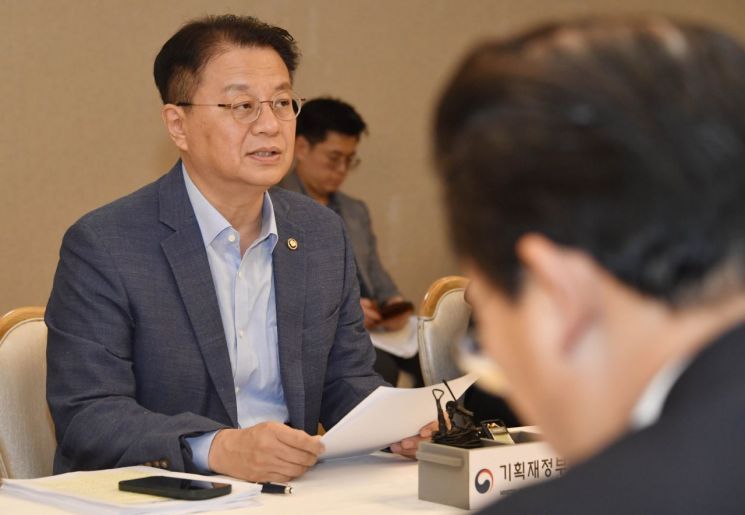
Vice Minister Bang said at the 'Low Birthrate Response Policy Opinion Gathering Meeting' held at the Government Seoul Office that morning, "There is currently unprecedented public interest and concern regarding Korea's ultra-low birthrate and rapid population structure changes," adding, "We will seek a groundbreaking policy shift that breaks away from the existing framework."
The meeting was organized to listen to opinions and suggestions from private experts and the youth, based on the awareness that a creative and innovative policy shift beyond the existing framework is necessary to respond to the severe population crisis.
The government announced the 'Low Birthrate and Aging Society Policy Tasks and Promotion Directions' at the Low Birthrate and Aging Society Committee in March and launched the Population Policy Planning Group, an intergovernmental permanent consultative body for responding to the population crisis, last month. The planning group has set a policy to strengthen policy linkage and inter-ministerial cooperation in preparation for entering a super-aged society from 2025.
Last year, Korea's total fertility rate was 0.78, marking the lowest record for five consecutive years since 2017. This is less than half of the OECD's 2021 average total fertility rate of 1.58, making it the lowest among member countries. Already in 2020, the number of deaths (310,000) exceeded the number of births (270,000), making the national population cliff visible.
Experts attending the meeting emphasized that a rebound in the birthrate is possible through effective national policy intervention, as seen in advanced countries. They particularly proposed support for safe childbirth for pregnant women in crisis and expanding corporate disclosure or information transparency regarding work-family balance. Professor Lee Sam-sik of Hanyang University's Department of Public Policy suggested, "Support measures should be prepared to ensure safe childbirth for pregnant women in crisis and to resolve income discontinuity in families with short birth intervals."
The opinions and proposals discussed at the meeting will be consulted with relevant ministries through sectoral working groups within the inter-ministerial Population Policy Planning Group. They plan to reflect these in the revised 4th Basic Plan for Low Birthrate and Aging Society to be prepared in the second half of this year.
© The Asia Business Daily(www.asiae.co.kr). All rights reserved.
![Clutching a Stolen Dior Bag, Saying "I Hate Being Poor but Real"... The Grotesque Con of a "Human Knockoff" [Slate]](https://cwcontent.asiae.co.kr/asiaresize/183/2026021902243444107_1771435474.jpg)











