Announcement of Public Participation Discussion Results on Assembly and Demonstration System Improvement
Recommendation for System Improvement to the Office for Government Policy Coordination and National Police Agency
Restrictions on Mobility Rights Violations and Loudspeaker Noise Generation
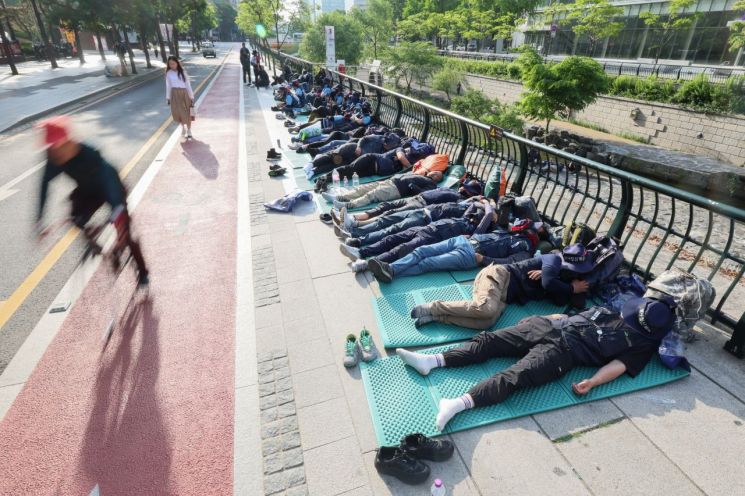
The Presidential Office is set to strengthen the requirements for sanctions on assemblies and demonstrations. They plan to amend related laws to restrict assemblies during peak commuting hours when public transportation is heavily used, as well as late-night and early-morning assemblies that infringe on rest rights, and also to enhance crackdowns and penalties for illegal assemblies and demonstrations. This move takes into account public backlash against the overnight 'sit-in assembly' held by the Construction Union of the Korean Confederation of Trade Unions (Minju Nochong) in downtown Seoul last May. However, specific times and locations for banning assemblies will be thoroughly discussed.
On the 26th, Kang Seung-gyu, Senior Secretary for Civil Society at the Presidential Office, held a briefing at the Yongsan Presidential Office on the results of the public participation debate on improving the assembly and demonstration system, stating, "The Presidential Office's National Proposal Review Committee has decided to recommend such system improvements to the Office for Government Policy Coordination (Public Order Establishment TF) and the National Police Agency based on diverse public opinions."
During this public debate, a total of 182,704 votes were cast, with 71% (129,416 votes) supporting the strengthening of requirements and sanctions. The debate was held over three weeks from June 13 to July 3, showing a high level of interest, more than three times the total votes (58,251) for the previous agenda item on 'separate collection of KBS license fees.' This is interpreted as reflecting strong public interest due to the constitutional rights involved and the direct impact on daily life.
In the free discussion through bulletin board comments, about 130,000 diverse opinions were raised. A common consensus, regardless of support or opposition, was that 'assemblies and demonstrations' should be respected as constitutional rights. Opinions were also expressed on whether system improvements are needed to harmonize the constitutional rights to pursue happiness and privacy with peaceful coexistence.
Most notably, the majority of participants, about 108,000 cases (82%), expressed the need for system improvements to protect daily life and maintain public order due to damages caused by excessive assemblies and demonstrations. Only about 15,000 cases (12%) argued for maintaining the current system or easing assembly and demonstration requirements, citing concerns about infringement on the 'freedom of assembly and association.'
Based on this, the Presidential Office's National Proposal Review Committee ordered the preparation of amendments to relevant laws and implementation plans for follow-up measures regarding ▲ obstruction of commuting by interfering with public transportation and occupying major roads ▲ noise caused by loudspeakers that harm public health, rest, and learning and even cause illnesses ▲ late-night and early-morning assemblies that pose significant risks to public order ▲ assemblies near residential areas and schools that harm public health, rest, students' right to learn, and safety. In particular, reflecting criticism that crackdowns and penalties on illegal assemblies and demonstrations are insufficient, they instructed securing the effectiveness of enforcement by supplementing deficiencies in penalty provisions during the law amendment and implementation plan process.
The Presidential Office's direct involvement in revising the Assembly and Demonstration Act stems from the overnight 'sit-in assembly' held by the Construction Union of Minju Nochong in downtown Seoul, including Gwanghwamun and Sejong-daero, on May 16-17. According to the Presidential Office, numerous complaints have since called for stricter regulations to correct assembly and demonstration practices. President Yoon Seok-yeol also stated, "The government will not overlook, ignore, or tolerate any illegal acts."
Government-level actions have already begun. The government is preparing a bill to amend the Assembly and Demonstration Act to significantly strengthen noise standards for assemblies and demonstrations, and there is a possibility that restrictions on assemblies on major roads, which had become ineffective under the previous Moon Jae-in administration, will also be addressed. The People Power Party has taken a stance to clarify ambiguous regulations such as 'before sunrise or after sunset' through amendments to eliminate legislative gaps.
On this day, the Presidential Office also addressed concerns about duplicate voting and organized encouragement raised during the previous public participation debate on the 'separate collection of KBS license fees.' They explained that to participate in the public debate, both members and non-members must verify their identity through real-name authentication and simple SNS authentication, making large-scale abuse that could affect voting results impossible. A Presidential Office official said, "Since anyone can participate in the debate, it is never conducted with a predetermined conclusion in mind," adding, "Saying that only certain forces participate in the debate undermines the opinions of the many citizens who sincerely participated."
The fourth public participation debate to be held next has been selected with the theme of 'Improvement of various administrative automobile displacement standards such as automobile tax.' Currently, automobile property value is assessed based on engine displacement when determining automobile tax or eligibility for basic living benefits, but proposals have been made for improvements considering changes in the times and technological advancements.
© The Asia Business Daily(www.asiae.co.kr). All rights reserved.

















