Constitutional Court: "Minister Lee Did Not Violate the Law"
"Constitutional Court's Impeachment Dismissal Decision Separate from Prosecution Investigation"
Proving 'Legal Responsibility' at the Working-Level Is Key
The Constitutional Court dismissed the impeachment trial against Lee Sang-min, Minister of the Ministry of the Interior and Safety, who was impeached for responsibility over the October 29 Itaewon disaster, with a unanimous decision by all justices, drawing attention to the prosecution's investigation related to the disaster.
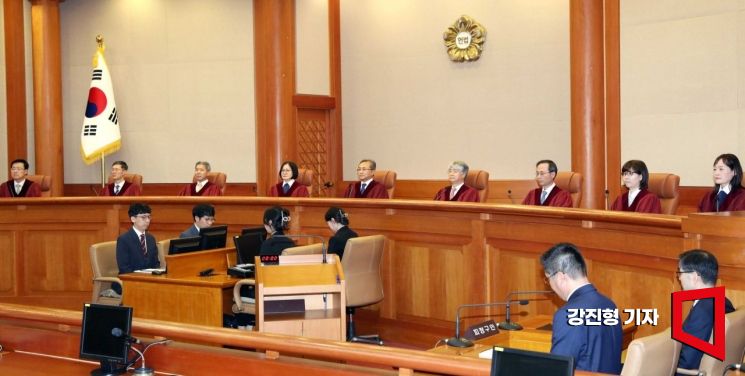 Chief Justice Yoo Nam-seok of the Constitutional Court and the constitutional justices are seated on the afternoon of the 25th at the Grand Bench of the Constitutional Court in Jongno-gu, Seoul, to deliver the impeachment trial verdict against Minister of the Interior and Safety Lee Sang-min for inadequate response to the Itaewon disaster. Photo by Kang Jin-hyung aymsdream@
On the 26th, legal circles both inside and outside the judiciary analyzed that the Constitutional Court's unanimous dismissal of Minister Lee's impeachment, regardless of the justices' inclinations, would influence the prosecution's judgment in the ongoing investigation of the Itaewon disaster. The Constitutional Court stated, "Minister Lee cannot be exempt from responsibility for the social disaster and loss of life," but also judged, "From the perspective of the Constitution and laws, it is difficult to see that he violated the Disaster and Safety Management Act and the National Public Officials Act by failing to fulfill his constitutional duty to protect the people." In particular, the Court defined the Itaewon disaster as "not caused or exacerbated by a single cause or specific individual," and concluded, "The government's failure to develop integrated response capabilities for large-scale disasters was a comprehensive factor, so responsibility cannot be placed on Minister Lee."
The issue is whether this judgment by the Constitutional Court could also affect the prosecution's investigation of the police leadership. In legal circles, the prevailing analysis is that the Constitutional Court's decision on Minister Lee and the prosecution's investigation of the police leadership are separate matters. The Court explained, "The impeachment trial procedure originally aims to secure the normative power of the Constitution by holding public officials legally accountable for their duties. Even if the respondent, as the head of the Ministry of the Interior and Safety responsible for disaster management, failed to make optimal judgments and responses during disaster response, holding him responsible for inadequate disaster response is not consistent with the normative nature of the impeachment trial procedure," concluding, "It is difficult to attribute responsibility to the respondent from a normative perspective."
The impeachment trial is a procedure to determine whether an impeached public official violated the Constitution or laws in the course of performing their duties. In this case, the Constitutional Court's conclusion was that no legal violation could be recognized against Minister Lee regarding preventive measures, post-disaster response, or statements made after the disaster occurred. Ultimately, this means it is difficult to hold Minister Lee legally responsible for the Itaewon disaster, and experts analyze that it was structurally difficult to legally hold the minister accountable from the start. However, since the Court stated that "there was no clear regulatory basis for safety management and manuals for a festival without an organizer, and various government agencies failed to develop integrated response capabilities for large-scale disasters, which collectively contributed to the disaster," it is expected to have an indirect impact on the prosecution's investigation and trial.
Currently, the prosecution has indicted six people, including Park Hee-young, Mayor of Yongsan District, Seoul, and Lee Im-jae, former Chief of Yongsan Police Station, on charges such as professional negligence resulting in death or injury. As the trial has prolonged beyond the six-month detention limit for first-instance court detention, all six defendants were released while still under trial, and the prosecution has yet to decide whether to indict the police leadership, including Kim Kwang-ho, Chief of Seoul Metropolitan Police Agency. A senior prosecutor said, "Disasters occur as a combination of negligence, and the key issue is whether responsibility for negligence can be assigned," adding, "The level of responsibility varies depending on the position of the supervisor." While the minister cannot be free from responsibility for social disasters and resulting casualties, the Constitutional Court judged that he cannot bear legal responsibility, meaning it does not imply that officials at the working level are exempt from responsibility.
A lawyer who is a former deputy chief prosecutor said, "The core of disaster accident investigations is assigning responsibility when there was awareness of risk and a possibility to foresee and avoid it but no action was taken," and predicted, "At the level of the police chief or district mayor, they received reports and could foresee how crowded the area would be, so it seems difficult to avoid responsibility." The lawyer added, "However, it may be harder to prove negligence as you go higher up the chain. It is easier to hold those who must take direct action responsible for negligence, but if the working-level staff did not act in a way that would make their superiors responsible, it is difficult to hold the higher-ups specifically accountable."
© The Asia Business Daily(www.asiae.co.kr). All rights reserved.

















