IMF July World Economic Outlook Released
South Korea Growth Forecast Downgraded from 1.5% to 1.4%
Only South Korea Declines Amid Global Economic Recovery
The International Monetary Fund (IMF) has lowered South Korea's growth rate forecast for this year from 1.5% to 1.4%. This is the same level as Japan, which is considered a symbol of low-growth countries since the "lost 30 years." Contrary to the government's prediction of sangjohago (low in the first half and high in the second half), South Korea's growth outlook is becoming increasingly bleak.
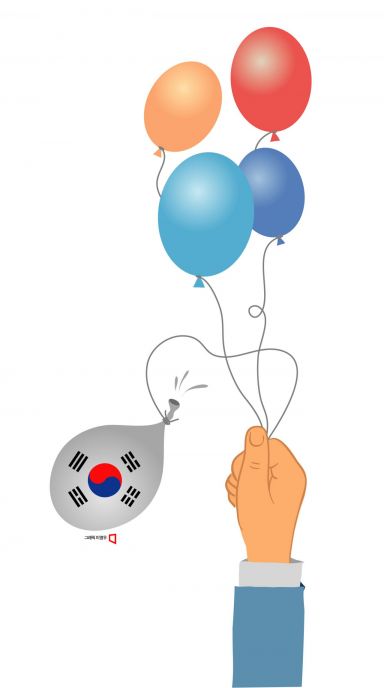
According to the Ministry of Economy and Finance, the IMF announced its "July World Economic Outlook" on the 25th (local time) and lowered South Korea's growth forecast for this year by 0.1 percentage points. When the forecast was made in April last year, South Korea's growth outlook was 2.9%, but it has shrunk by more than half after being revised downward five consecutive times. Only three countries, including South Korea, Germany (-0.2 percentage points), and Saudi Arabia (-1.2 percentage points), have seen their growth forecasts worsen compared to before.
Unlike South Korea, where the low-growth phase is intensifying, the global economy is recovering faster than expected. The IMF expects the world economy to grow by 3.0% this year. This is 0.2 percentage points higher than the 2.8% growth forecast made in April. Advanced countries such as the United States (0.2 percentage points), the United Kingdom (0.7 percentage points), and Italy (0.4 percentage points) also raised their growth forecasts. In particular, Japan, which had the worst growth except for war-torn Russia, improved its outlook from 1.0% in 2022 to 1.4%.
The IMF evaluated that the resolution of the U.S. debt ceiling negotiations and the calming of the Silicon Valley Bank (SVB) crisis have eased financial market instability. It analyzed that the end of COVID-19 led to a rapid increase in service consumption such as tourism, driving the global recovery. The United States, the United Kingdom, and Japan recorded better-than-expected consumption and investment performance in the first quarter, and demand recovery in the tourism industry was observed in Italy and Spain.
However, the IMF expressed concerns that many risk factors still remain. It recommended maintaining a tightening stance, noting that although inflation is declining, core inflation remains high. It also emphasized the need to strengthen management and supervision of financial market risks, secure medium- to long-term fiscal soundness, increase labor market flexibility, and achieve carbon neutrality.
Meanwhile, other domestic and international institutions continue to lower South Korea's growth forecasts. The Organisation for Economic Co-operation and Development (OECD) adjusted South Korea's growth forecast from 1.6% to 1.5%, and the Asian Development Bank (ADB) revised it from 1.5% to 1.3%. Moody's and Fitch predict 1.5% and 1.2%, respectively. The global credit rating agency Standard & Poor's (S&P) has the lowest forecast at 1.1%. Domestically, the Ministry of Economy and Finance expects 1.4%, and the Bank of Korea forecasts 1.4% growth.
© The Asia Business Daily(www.asiae.co.kr). All rights reserved.
![Clutching a Stolen Dior Bag, Saying "I Hate Being Poor but Real"... The Grotesque Con of a "Human Knockoff" [Slate]](https://cwcontent.asiae.co.kr/asiaresize/183/2026021902243444107_1771435474.jpg)

















