Professor Dongwook Lee of the Department of Energy and Chemical Engineering at UNIST has developed a pressure-sensitive adhesive that rapidly recovers from repetitive deformation while maintaining high adhesion strength.
This technology is expected to be applied in electronic products requiring high flexibility and rapid recovery characteristics, such as foldable displays.
Pressure-sensitive adhesives are materials that adhere when light pressure is applied. Adhesion strength and deformation recovery of adhesives are known to be properties that are difficult to achieve simultaneously, like two sides of the same coin.
To overcome this, previous studies improved recovery characteristics through crosslinking reactions that chemically bond molecules in pressure-sensitive adhesives, but this resulted in reduced adhesion strength, limiting practical use.
The research team synthesized a new crosslinker mimicking the molecular structure of polyurethane, which is frequently used in fields requiring flexibility, and applied it to the adhesive.
The developed pressure-sensitive adhesive not only exhibited excellent adhesion strength but also demonstrated very fast and superior recovery characteristics under repetitive deformation, overcoming the limitations of existing crosslinking systems.
Additionally, the developed adhesive showed lower strain in folding tests compared to adhesives with commonly used crosslinkers. When the crosslinker content was increased, it maintained 94% of its original shape even after 100,000 folding tests, demonstrating high stability.
Furthermore, the developed adhesive exhibited excellent light transmittance, a crucial requirement for display adhesives, and maintained transmittance even after deformation, proving its superiority.
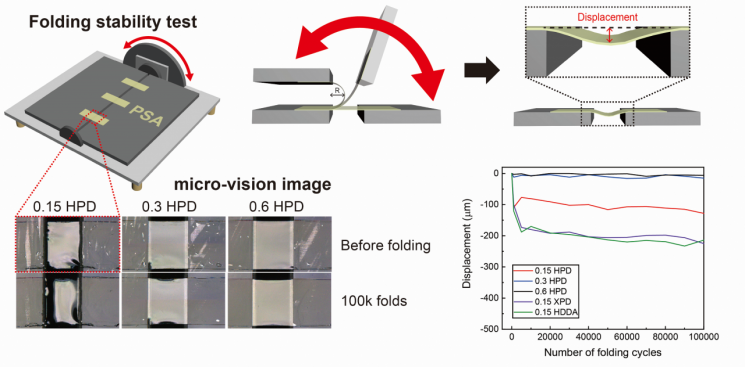 Comparison of folding stability of pressure-sensitive adhesives made with conventional crosslinker (HDDA) and newly synthesized crosslinkers (HPD, XPD), and comparison of folding stability of pressure-sensitive adhesives according to crosslinker content.
First author Researcher Hyunok Park stated, “By introducing a crosslinker with a new structure, we developed a pressure-sensitive adhesive that simultaneously possesses excellent adhesion and recovery properties,” adding, “This surpasses the limitations of existing adhesive systems and will contribute to future adhesive research and further aid the development of flexible electronic devices.”
Professor Dongwook Lee of the Department of Energy and Chemical Engineering explained, “The developed adhesive’s properties can be controlled by adjusting the crosslinker content according to the intended use. For fields requiring low adhesion and high recovery, the crosslinker content can be increased, and conversely, for other cases, it can be decreased to produce adhesives with various performance characteristics as needed.”
This research was conducted with support from the Ministry of Science and ICT, the National Research Foundation of Korea, the Korea Evaluation Institute of Industrial Technology, the Defense Acquisition Program Administration, and Ulsan National Institute of Science and Technology. The research results were published online on July 12 in Advanced Functional Materials, a prestigious journal in the field of materials science.
© The Asia Business Daily(www.asiae.co.kr). All rights reserved.

















