The life expectancy of South Korean citizens was found to be 83.6 years, the second longest among the countries of the Organisation for Economic Co-operation and Development (OECD). Life expectancy refers to the number of years a newborn is expected to live from the year of birth. On the other hand, the suicide mortality rate was the highest.
The Ministry of Health and Welfare announced on the 25th the detailed analysis of major fields and indicators of the 'OECD Health Statistics 2023,' revealing the level and status of South Korea's healthcare and those of other countries. The OECD Health Statistics include comprehensive data on health status, health risk factors, healthcare resources, healthcare utilization, and long-term care.
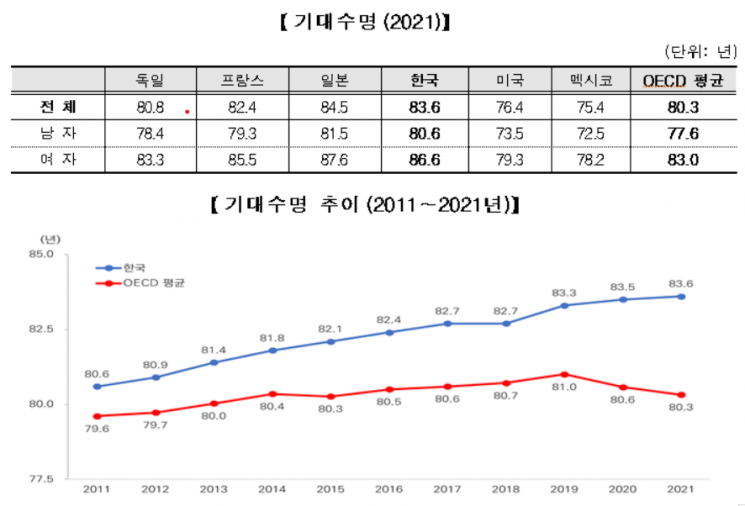
South Korea's life expectancy (83.6 years) was 3.3 years longer than the OECD average (80.3 years). With improvements in living environments and advancements in medical services, South Korea's life expectancy increased from 80.6 years in 2011 to 83.6 years in 2021. South Korea ranks among the top OECD countries in life expectancy. By country, Japan had the longest life expectancy (84.5 years as of 2021). France (82.4 years) and Germany (80.8 years) also had high life expectancies, while the United States (76.4 years) and Mexico (75.4 years) were lower.
South Korea's avoidable mortality rate (as of 2020) was 142.0 per 100,000 population, lower than the OECD average of 239.1. Avoidable mortality rate refers to deaths that can be prevented through disease prevention activities (preventable deaths) and timely treatment services (treatable deaths). By country, Japan had the lowest rate at 134.0, followed by South Korea, Germany (195.0), the United Kingdom (222.0), the United States (336.0), and Mexico (665.0). Over the past decade, South Korea's avoidable mortality rate has decreased by an average of 5% annually, dropping from 228.0 in 2010 to 177.0 in 2015 and 142.0 in 2020.
South Korea's suicide mortality rate (as of 2020, per 100,000 population) was 24.1, the highest among OECD countries. This is more than twice the OECD average (11.0%). Following South Korea were Japan (15.4), the United States (14.1), Germany (9.7), the United Kingdom (8.4), and Mexico (6.3).
South Korea's infant mortality rate (as of 2021) was 2.4 per 1,000 live births, 1.6 lower than the OECD average of 4.0.
The smoking rate among South Koreans aged 15 and older (15.4%) and annual per capita alcohol consumption (7.7 liters) were at OECD average levels (smoking rate 15.9%, alcohol consumption 8.6 liters). By country, the United States (8.8%) and Mexico (8.6%) had lower smoking rates, while France (25.3%) and Japan (16.7%) had higher rates. The proportion of overweight and obese population (36.7% among those aged 15 and older), a major cause of chronic diseases, was the second lowest among OECD countries (average 57.5%), following Japan (27.2%). However, South Korea's overweight and obese population ratio has gradually increased from 30.7% in 2011 to 34.5% in 2016 and 36.7% in 2021.
The healthcare workforce was relatively low compared to other countries. The number of clinical doctors (including oriental medicine doctors) per 1,000 population was 2.6, the second lowest among OECD countries after Mexico (2.5), with the OECD average at 3.7. The number of clinical nursing staff (8.8 per 1,000 population) was also below the OECD average of 9.8. The number of medical devices such as magnetic resonance imaging (MRI) machines (35.5 per million population) and computed tomography (CT) scanners (42.2 per million population) was higher than the OECD average (MRI 19.6, CT 29.8). The number of hospital beds (12.8 per 1,000 population) was about 2.9 times higher than the OECD average (4.3).
South Korea had the highest number of outpatient visits per capita (15.7 visits annually) among OECD countries. Current medical expenditure was 9.3% of gross domestic product (GDP), slightly lower than the OECD average of 9.7%. The per capita pharmaceutical sales amount was 785.3 US$ PPP (purchasing power parity reflecting price levels of each country), higher than the OECD average of 594.4 US$ PPP. The proportion of long-term care recipients among the elderly population aged 65 and over (8.1% home care, 2.6% institutional care) was lower than the OECD average (10.2% home care, 3.5% institutional care).
© The Asia Business Daily(www.asiae.co.kr). All rights reserved.
![Clutching a Stolen Dior Bag, Saying "I Hate Being Poor but Real"... The Grotesque Con of a "Human Knockoff" [Slate]](https://cwcontent.asiae.co.kr/asiaresize/183/2026021902243444107_1771435474.jpg)
















