Bank of Korea Announces Preliminary Real GDP for Q2
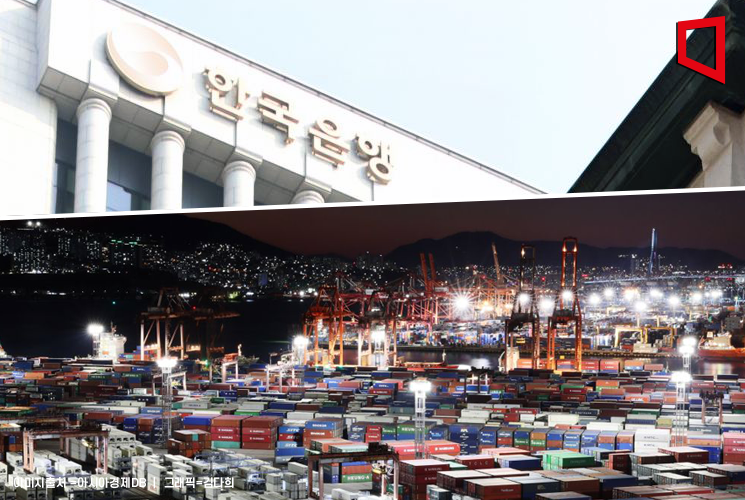
In the second quarter of this year, South Korea's real Gross Domestic Product (GDP) grew by 0.6%, continuing its growth trend for two consecutive quarters.
However, despite the real GDP growth, real Gross Domestic Income (GDI) remained stagnant due to worsening terms of trade.
The Bank of Korea announced on the 25th that the preliminary real GDP growth rate for the second quarter (compared to the previous quarter) was 0.6%.
Quarterly real GDP recorded growth rates of 0.7% in the first quarter of last year, 0.8% in the second quarter, and 0.2% in the third quarter, but turned negative at -0.3% in the fourth quarter due to a sharp decline in exports. However, this year, it has continued to grow consecutively in the first quarter (0.3%) and the second quarter.
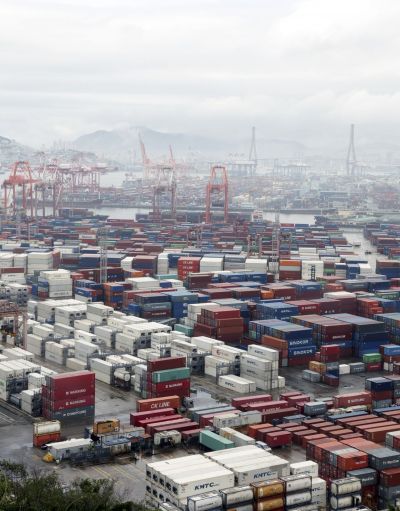 Container unloading operations are underway at Busan Port's Sinsundae and Gamman docks.
 [Image source=Yonhap News]
Earlier, the Bank of Korea had forecasted an annual growth rate of 1.4%, with 0.8% growth in the first half and 1.8% growth in the second half of this year.
Looking at expenditure items, private consumption decreased by 0.1% as consumption of goods remained at the previous quarter's level but consumption of services such as food and accommodation declined. Government consumption decreased by 1.9% due to reduced in-kind benefits from social security such as health insurance benefits, and construction investment fell by 0.3%, mainly in civil engineering construction.
Facility investment also decreased by 0.2%, as machinery increased but transportation equipment declined.
Exports decreased by 1.8%, with increases in semiconductors and automobiles offset by declines in petroleum products and transportation services. Imports fell by 4.2%, mainly due to decreases in crude oil and natural gas.
Despite decreases in both private and government consumption and investment, real GDP grew by 0.6%, which is interpreted as an increase in net exports due to a larger decrease in imports than exports compared to the first quarter.
By economic activity, manufacturing increased by 2.8%, driven by growth in computers, electronics, and optical equipment. The service sector grew by 0.2%, as declines in wholesale, retail, and accommodation and food services were offset by increases in transportation.
On the other hand, the electricity, gas, and water supply sector decreased by 6.0%, due to reductions in water supply, sewage and waste treatment, and raw material recycling, and the construction sector fell by 3.4%, mainly in civil engineering construction.
In the second quarter, real Gross Domestic Income (GDI) remained at the previous quarter's level (0.0%) despite the increase in real GDP, due to worsening terms of trade.
The contribution to GDP growth was -0.1 percentage points from private consumption, -0.4 percentage points from government consumption, and -0.1 percentage points from construction investment. Net exports rose from -0.2 percentage points in the first quarter to 1.3 percentage points in the second quarter.
© The Asia Business Daily(www.asiae.co.kr). All rights reserved.


















