Innovative Technology Penetrates Everyday Life
Seocho-gu Office OK Civil Service Center's Civil Service Guide Robot 'Haengboki'
Seongdong-gu to Install Civil Service Processing Guide Robots Within the Year
Elderly Care Robots Becoming Increasingly Common
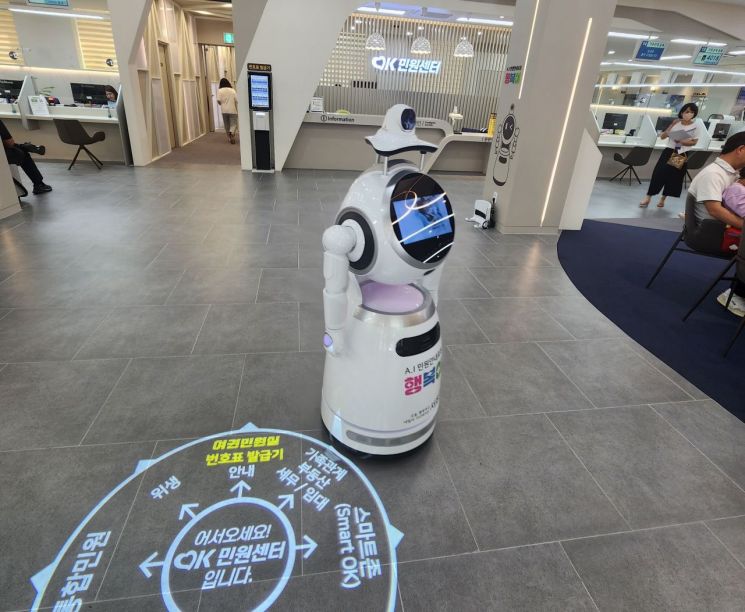 The artificial intelligence (AI) civil service guidance robot 'Haengboki' at Seocho-gu Office OK Civil Service Center is wandering around the civil service center.
 [Photo by Minjin Kim enter@]
#Just a 30-second walk from Exit 12 of Yangjae Station on Subway Line 3. Among the 25 district offices in Seoul, Seocho District Office boasts a prime location, and upon entering the OK Civil Service Center (one-stop civil service office), the AI civil service guide robot ‘Haengboki’ was the first thing to catch the eye. Although it is not yet at the stage of making ‘eye contact’ or providing one-on-one service with visitors, Haengboki has become the mascot of the OK Civil Service Center, which reopened last week after about a month of remodeling.
On the 24th, at Seocho District Office, the AI civil service guide robot Haengboki was autonomously navigating the civil service counters, guiding visitors. The Seocho Civil Service Center is a fairly large facility of 1,076㎡ where various civil services such as resident registration certificates and various permits are handled in one place.
Innovative technologies like robots and AI, which are changing the world, are also being introduced into local government civil service processing and services, permeating various aspects of our daily lives. With the advancement of high-tech industries, cases applying these technologies to civil service administration are rapidly increasing.
Seongdong District plans to introduce robots capable of guiding visitors inside the government building and assisting with civil service processing by the end of this year at the earliest, showcasing administrative services utilizing advanced technology. The robots planned by Seongdong District will be capable of engaging in everyday conversations with visitors. The district aims to complete robot development by next month and conduct a pilot introduction in September. They are collaborating with private companies specializing in robot supply and application development.
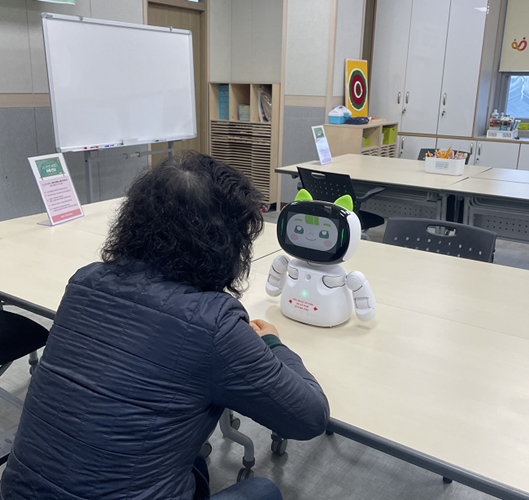
The most widely used field currently is care services. Due to the increase in the elderly population and welfare for vulnerable groups, adoption is growing. Dobong District began operating a smart care pilot service in April by distributing the care robot ‘Dasom’ to 40 households of elderly people living alone who experience high levels of depression and loneliness. Dasom is equipped with basic conversational functions as a companion, medication alarm functions to remind users when to take medicine, and the ability to play various content such as music and videos.
The robot is equipped with an emergency call function. If a risk signal is detected for the elderly or if they request help with phrases like "Help me" or "Save me," the robot connects to guardians or a control center. Jongno District has also started caring for elderly people living alone through AI companion robots, and Gwanak District has supported the AI care robot ‘Kimi’ for 54 households of elderly people aged 80 or older living alone, enabling them to request help in emergencies.
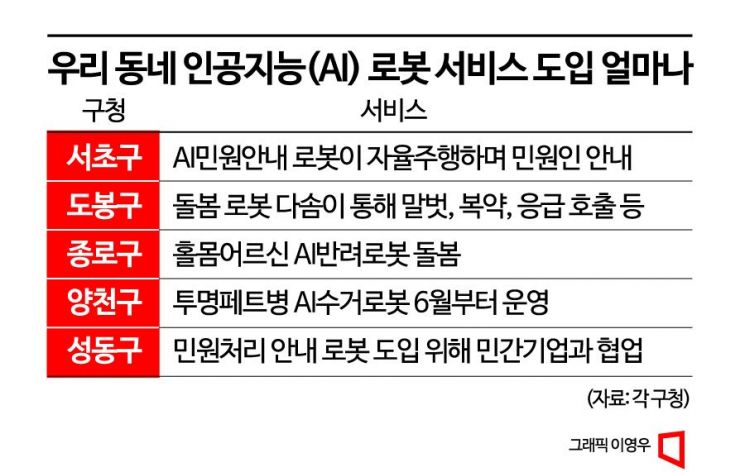
Yangcheon District began operating 15 transparent PET bottle AI collection robots last month at 13 locations with high foot traffic, including Paris Park and the Sinwol 5-dong and Sinjeong 6-dong community centers. These unmanned robots equipped with AI technology automatically sort and collect transparent PET bottles and return cash in the form of points based on the number of bottles deposited. However, only transparent PET bottles with labels removed should be inserted.
Some local governments use CCTV robots to check for abnormalities in sewage drainage. Before the recent monsoon season, Gwanak District used CCTV robots to maintain sewage facilities in its jurisdiction.
However, the enthusiasm for robots is not unique to local governments. The use of robots in care and civil service fields is already widespread in private companies, and the introduction of related services by local governments is, in a way, a natural progression.
On the 23rd, Seoul City announced a comprehensive plan for fostering the robot industry and stated that it will invest a total budget of 202.9 billion KRW over four years from this year to 2026 to popularize robot services. This plan includes the introduction of care robots, transport robots, patrol robots, social robots, as well as policies to nurture robot companies.
© The Asia Business Daily(www.asiae.co.kr). All rights reserved.



















