National Assembly Ethics Review Advisory Committee Reports 11 Virtual Asset Holders
Relies on Voluntary Reporting, Unable to Verify Hidden Holdings
Loopholes in Implementation Timing of Public Officials' Asset Declarations
Controversy is spreading as it has been confirmed that 11 members of the National Assembly, including independent lawmaker Kim Nam-guk, have invested in virtual assets. Some argue that even lawmakers who have faithfully reported their virtual asset holdings in accordance with the legislative intent of the full survey on lawmakers' virtual assets are being treated as unscrupulous politicians.
According to political circles on the 24th, following Kim Nam-guk's 'coin controversy' in May last year, the National Assembly amended the National Assembly Act to require all lawmakers to submit their virtual asset holdings to the National Assembly Ethics Review Advisory Committee by the end of last month. This was to determine any conflicts of interest.
The advisory committee, upon receiving the reports, stated, "A total of 11 lawmakers reported holding virtual assets," adding, "Some lawmakers have potential conflicts of interest." In particular, among the 11, People Power Party's Minister of Unification Kwon Young-se and Democratic Party's Kim Hong-gul attracted extraordinary attention. It is known that over the past three years, Kwon Young-se conducted more than 400 virtual asset transactions, and Kim Hong-gul more than 100, with cumulative purchase amounts exceeding 1 billion KRW. Both have explained that there is no conflict of interest and that their investments ranged from tens of millions to hundreds of millions of KRW.
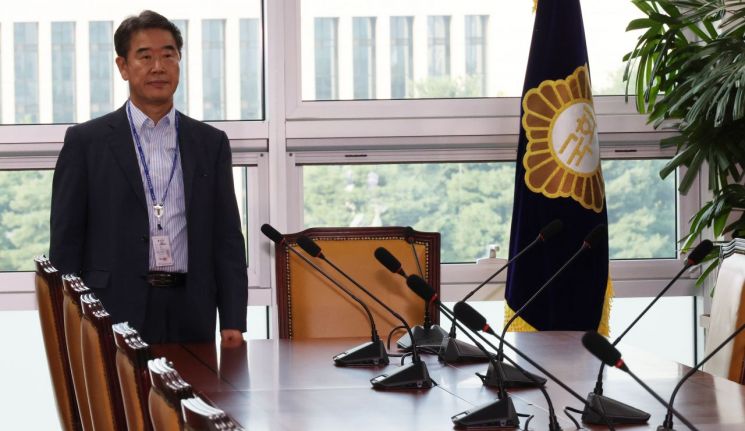 Yoo Jae-pung, Chairman of the Ethics Review Advisory Committee of the National Assembly Ethics Special Committee, is attending the advisory committee meeting held at the National Assembly on the 20th.
 [Image source=Yonhap News]
The complaints of feeling 'unfairly treated' arise from the judgment that those who faithfully reported their virtual asset holdings this time have suffered losses.
In fact, lawmaker Kim Hong-gul responded, "Only a small number of lawmakers who reported faithfully are now in a position to worry about unnecessary misunderstandings and have to explain themselves," adding, "I deeply regret the reports from the National Assembly Ethics Advisory Committee that will discourage voluntary asset and property reporting." He emphasized that it was purely for investment purposes and that they have been subjected to public criticism despite not breaking any laws.
In reality, the virtual asset-related reports submitted to the advisory committee this time are not mandatory and have no penalty provisions, relying on voluntary submissions. There is no way to verify if holdings are concealed.
It is expected to be difficult to properly review this in next year's property reports as well. Although the National Assembly Act to prevent conflicts of interest in virtual assets and the inclusion of virtual assets in high-ranking officials' property reports were passed in last year's plenary session, there are still blind spots. The Public Officials Ethics Act was passed in May, but its enforcement date is set as 'six months after promulgation' in the supplementary provisions. If virtual assets are disposed of before the law takes effect, i.e., before the end of the year, the virtual assets held will not be disclosed in the property reports. Civic groups such as the People's Solidarity for Participatory Democracy pointed out, "If virtual assets are disposed of before the law takes effect, there will be no virtual assets to register in the 2024 regular property change report conducted annually at the end of the year." Due to such concerns, in May, People Power Party floor leader Yoon Jae-ok stated, "I think a provision should be included in the supplementary provisions to allow the registration of lawmakers' virtual asset details as of the end of last year within a short period, one or two months," but the amendment has not even been proposed yet.
Regarding this, the National Assembly also passed a resolution for the Anti-Corruption and Civil Rights Commission (ACRC) to conduct a full survey of lawmakers' virtual asset holdings, but the investigation has not even started. An ACRC official explained, "Consent forms related to the personal information of all lawmakers are required, but they have not yet been submitted," adding, "Since the ACRC is an administrative investigation agency, not a law enforcement agency, investigations cannot proceed without personal information consent forms." According to political circles and the ACRC, the Democratic Party and the Justice Party have submitted consent forms, but the People Power Party has not yet submitted theirs.
© The Asia Business Daily(www.asiae.co.kr). All rights reserved.
!["The Woman Who Threw Herself into the Water Clutching a Stolen Dior Bag"...A Grotesque Success Story That Shakes the Korean Psyche [Slate]](https://cwcontent.asiae.co.kr/asiaresize/183/2026021902243444107_1771435474.jpg)
















