Korean Educational Development Institute Survey Results Announced
Concerns Over Decline in Public Education Quality
The atmosphere regarding the profession of teaching, once preferred and highly regarded, has recently been changing. The proportion of adults who view it positively when their children aspire to become teachers is the lowest in eight years.
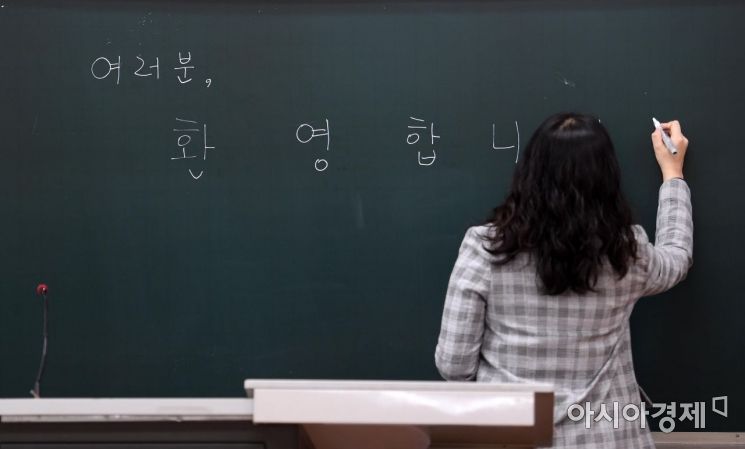 The homeroom teacher is writing encouraging messages for the students on the blackboard ahead of in-person classes. Photo by Hyunmin Kim kimhyun81@
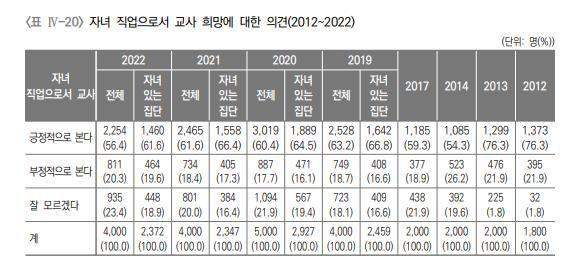
According to an online survey conducted last year by the Korea Educational Development Institute (KEDI) targeting 4,000 adults nationwide aged between 19 and 74, 56.4% responded positively to their children becoming elementary, middle, or high school teachers. KEDI has conducted the same survey with this question in 2012?2014, 2017, and 2019?2022, and this is the lowest figure since 2014 (54.3%).
Among households with children, the positive response rate was higher at 61.6%, but this is also the lowest since 2014 (57.5%).
On the other hand, the proportion of those who view it negatively has been increasing for three consecutive years since 2020. The rate, which was 17.7% in 2020, steadily rose and exceeded 20% for the first time last year.
Although more than half of adults still view their children choosing teaching as a hopeful career positively, the downward trend breaking the 60% mark is attributed to the decline in teachers' authority. It is evaluated that while students' human rights have been excessively emphasized, teachers' authority has relatively diminished.
Kim (38), who is raising a second-grade elementary school son in Ansan, Gyeonggi Province, said, "Teaching others must be rewarding, but these days, with many issues like infringement of teachers' authority and child abuse, I would be concerned if my child said they wanted to become a teacher." He added, "Isn't this the era where kids turn on their cell phone cameras when a teacher tries to scold them?"
Teacher A from an elementary school in Jeju said, "Even 10 years ago, when I was a novice teacher, there were issues with teachers' authority, but now it has become much worse." He confessed, "There are many cases where we cannot even assign diary writing (because it is considered an invasion of privacy), and after scolding students, I am very scared that it might be considered child abuse."
Experts point out that if the decline in teachers' authority leads to talented individuals avoiding the teaching profession, the damage will inevitably affect the students.
Professor Park Nam-gi of Gwangju National University of Education said, "In the past, teaching was favored by parents because it had vacations, was respected, and had decent pay, but nowadays teachers have become emotional laborers, so parents tell their children to look for other jobs." He added, "The quality of education ultimately depends on the quality of teachers, and if talented individuals avoid the teaching profession, many difficulties will arise."
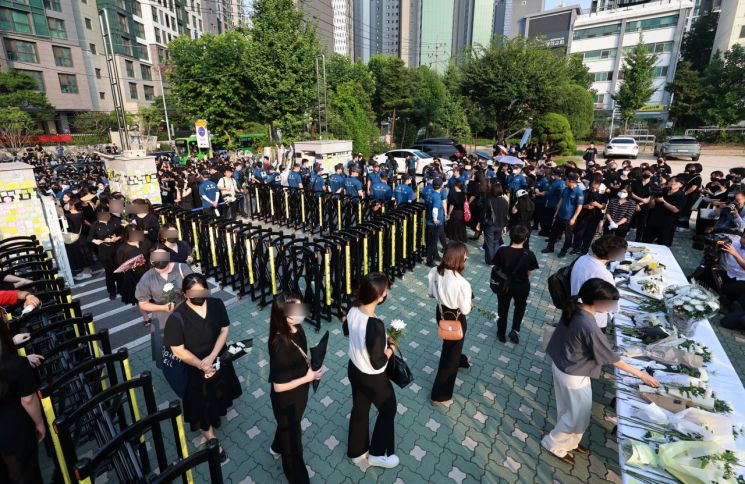 On the afternoon of the 20th, mourners are paying tribute to the late teacher A at a temporary memorial space set up at Seoi Elementary School in Seocho-gu, Seoul.
 [Photo by Yonhap News]
After it became known that Teacher A, a first-grade homeroom teacher at Seo-i Elementary School in Seocho-gu, Seoul, took an extreme step, the long-neglected issue of declining teachers' authority has come to the forefront. Since the enactment of the Student Human Rights Ordinance nationwide 13 years ago in 2010, corporal punishment and dress code regulations, which were traditionally practiced, have been banned, and as society has gradually become more individualized, teachers' authority has started to decline.
© The Asia Business Daily(www.asiae.co.kr). All rights reserved.



















