SSBN Kentucky Departs Korean Peninsula Without Joint Exercises
The US strategic nuclear submarine (SSBN) Kentucky, which visited Korea for the first time in 42 years, departed on the morning of the 21st.
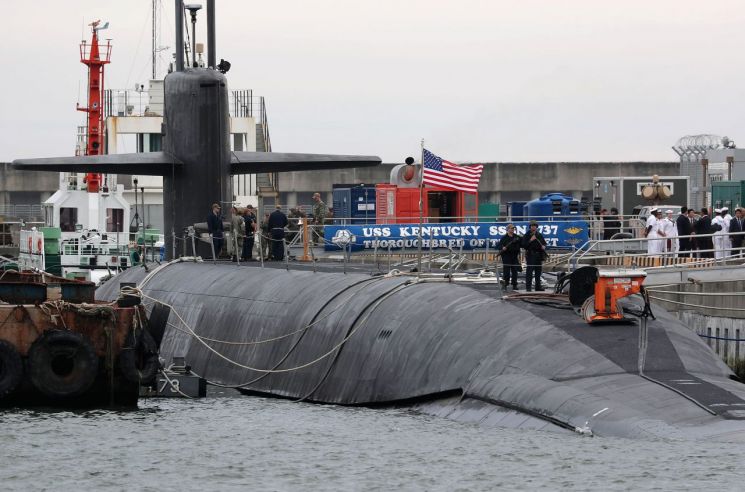
The Kentucky arrived at Busan Naval Base on the 18th, the day the Korea-US new extended deterrence consultative body, the Nuclear Consultative Group (NCG), held its inaugural meeting. This was the first SSBN visit to Korea since the Robert E. Lee (SSBN 601) visited in March 1981. President Yoon Suk-yeol visited the Kentucky on the 19th, becoming the first foreign head of state to do so.
It is known that the Kentucky did not conduct joint exercises with the South Korean military during its 3-night, 4-day visit. A Ministry of National Defense official told reporters that day, "SSBNs generally do not participate in joint exercises." The destination of the Kentucky after leaving Korea has not been disclosed. A US Forces Korea official said, "The location or destination of strategic assets such as SSBNs cannot be confirmed."
The Kentucky is an Ohio-class submarine (18,750 tons) operated by the US with only 14 vessels. It is 170 meters long and 12 meters wide, making it one of the largest SSBNs in the world. It can carry about 20 Trident II D5 submarine-launched ballistic missiles (SLBMs) with intercontinental ballistic missile (ICBM)-level range. SSBNs are considered the core of US nuclear forces due to their ability to operate ballistic missiles equipped with nuclear warheads and their stealth, which allows them to approach close to the enemy without being detected.
Experts believe that the fact that North Korea cannot detect the location of the stealthily submerged SSBN creates a powerful deterrent effect.
North Korea reacted sensitively, firing two short-range ballistic missiles at dawn the day after the Kentucky's arrival, and on the previous day, issuing a statement in the name of the Minister of Defense threatening that "increased visibility of the deployment of strategic assets, including strategic nuclear submarines, may fall under the conditions for the use of nuclear weapons as stipulated in our national nuclear force policy laws."
© The Asia Business Daily(www.asiae.co.kr). All rights reserved.
![Clutching a Stolen Dior Bag, Saying "I Hate Being Poor but Real"... The Grotesque Con of a "Human Knockoff" [Slate]](https://cwcontent.asiae.co.kr/asiaresize/183/2026021902243444107_1771435474.jpg)
















