Producer Prices in June Down 0.2% from Previous Month
Decline Led by Petroleum, Chemicals, and Other Manufactured Goods
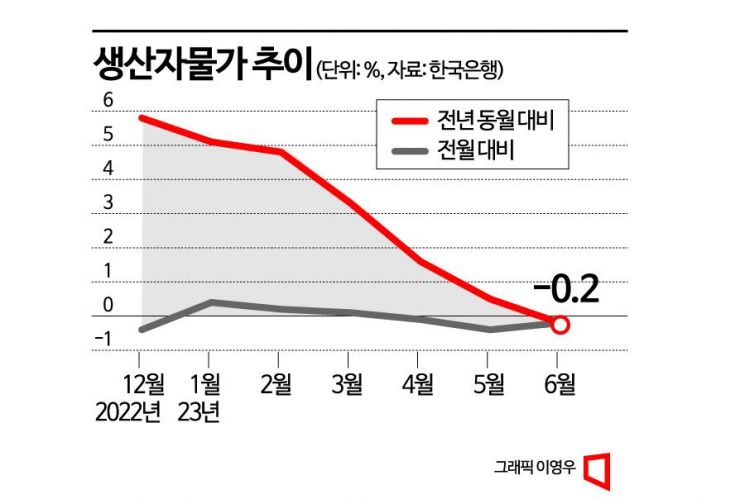
Due to the decline in international oil prices, the producer price inflation rate turned negative for the first time in 2 years and 7 months. Since producer prices affect consumer prices with a time lag, this is expected to act as a downward factor for consumer prices in the future.
According to the Bank of Korea on the 21st, the producer price index last month fell by 0.2% compared to the same month of the previous year. This is the first time the producer price inflation rate has recorded a negative figure since November 2020 (-0.3%).
The producer price index has shown a slowing trend for 12 consecutive months after recording a 10% increase in June last year. Producer prices recorded 5.1% in January, 4.8% in February, 3.3% in March, and 1.6% in April this year, slowing to the 0% range at 0.5% in May, and turned negative in June.
Seo Jeong-seok, head of the price statistics team at the Bank of Korea, explained, "The producer price in June fell by 0.2% year-on-year due to the base effect from last year's sharp rise in international oil prices, which expanded the decline in manufactured goods."
The month-on-month change rate of producer prices also fell by 0.2% last month, continuing a downward trend for three consecutive months. It maintained a negative trend with -0.1% in April, -0.4% in May, and -0.2% in June.
Looking at the recent trend in producer prices, agricultural, forestry, and fishery products all declined, with agricultural products (-1.4%), livestock products (-0.9%), and fishery products (-0.2%) falling, resulting in a 1.3% decrease compared to the previous month.
Manufactured goods also fell by 0.6% month-on-month, with coal and petroleum products (-3.7%), chemical products (-1.3%), and primary metal products (-0.7%) all declining.
On the other hand, electricity, gas, water, and waste services rose by 1.8% compared to the previous month, with electricity (2.8%) and city gas (1.0%) increasing. The service sector rose by 0.1% month-on-month, with financial and insurance services (0.6%) and restaurant and accommodation services (0.1%) increasing.
The domestic supply price index, which measures price changes of goods and services supplied domestically, fell by 1.3% compared to the previous month. This was due to declines in raw materials (-7.5%), intermediate goods (-1.0%), and final goods (-0.3%).
The total output price index for June, which adds exports to domestic shipments, also fell by 0.8% compared to May. Although services (0.1%) rose, the decline in manufactured goods (-1.5%) and agricultural, forestry, and fishery products (-1.3%) had an impact.
Seo said, "The producer price index in June fell for the third consecutive month as electricity and gas rose but manufactured goods such as petroleum products, chemical products, and primary metal products declined," adding, "It will act as a downward factor for consumer prices with a time lag in the future."
Regarding the outlook for producer prices in July, he said, "Recently, oil prices have rebounded, and agricultural product prices are rising due to heavy rains," adding, "The producer price index may fluctuate depending on whether oil prices and public utility fees increase further, so we need to watch closely."
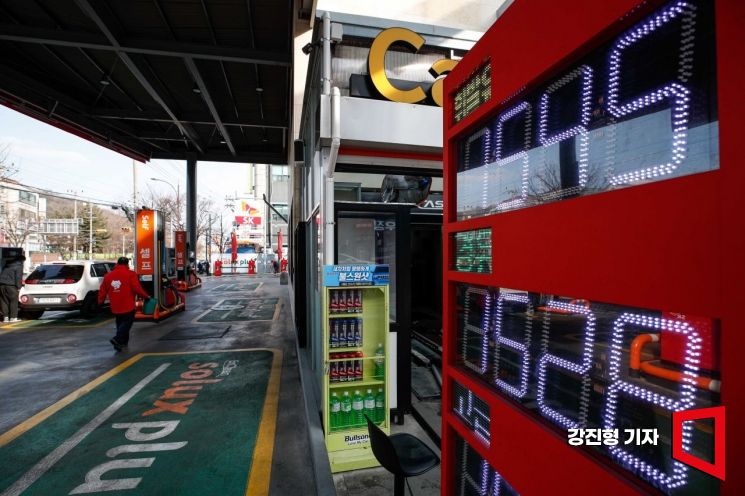 On the 15th, gasoline was being sold at 1,545 KRW per liter and diesel at 1,528 KRW per liter at a gas station in Incheon. The price of diesel, which was previously more expensive than gasoline, has recently narrowed to the lowest difference of the year due to the rise in gasoline prices and the fall in diesel prices. Photo by Jinhyung Kang aymsdream@
© The Asia Business Daily(www.asiae.co.kr). All rights reserved.
![Clutching a Stolen Dior Bag, Saying "I Hate Being Poor but Real"... The Grotesque Con of a "Human Knockoff" [Slate]](https://cwcontent.asiae.co.kr/asiaresize/183/2026021902243444107_1771435474.jpg)

















