The Seoul Metropolitan Government Employees' Union (Seogongno) demanded an increase in the starting salary for Grade 9 public officials, stating that "the salary for new public officials is even below the minimum wage." Seogongno claimed in a statement on the 20th that "the government is encouraging public service attrition."
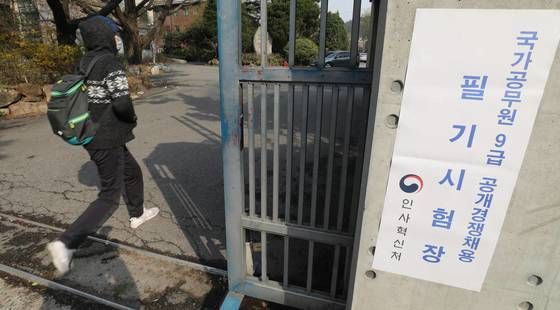 Examinees are entering Gyeongbok High School in Jongno-gu, the venue for the Grade 9 civil service written exam.
 [Photo by Yonhap News]
On the 19th, the minimum wage for next year was set at 9,860 won (monthly basis 2,060,740 won), a 2.5% increase from this year. Based on 209 working hours per month, this translates to approximately 2,060,740 won monthly.
As a result, there is considerable dissatisfaction within the public service community that the starting salary for lower-level public officials is even lower than the private sector minimum wage.
According to the Ministry of Personnel Management, the monthly salary for a Grade 9 public official at step 1 is 1,770,800 won based on the basic salary, and for a Grade 7 public official at step 1, it is 1,962,300 won. For Grade 9 step 1, when adding the fixed meal allowance of 140,000 won and the position allowance of 175,000 won, the total monthly salary is 2,085,800 won. Last year, the salary level of public officials compared to the private sector dropped to 82.3%, the lowest ever recorded.
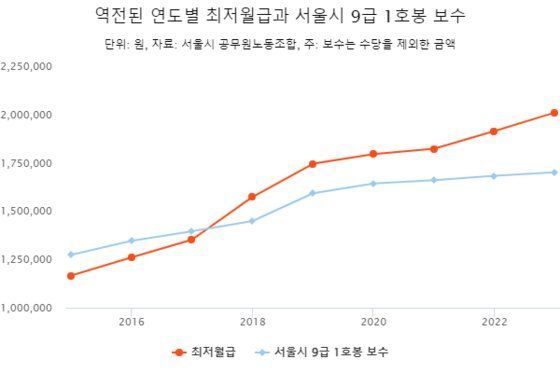
Seogongno argued that the salary for Grade 9 public officials in Seoul in their first year (step 1) is below the minimum wage. As of 2023, the monthly salary for Grade 9 step 1 in Seoul is 1,700,800 won. Seogongno also stated, "The salary gap between lower-level new public officials and the minimum wage is widening over time."
In fact, until 2017, the monthly salary for Grade 9 step 1 (1,395,800 won) was higher than the minimum wage (1,352,230 won), but it reversed afterward. Last year, the monthly salary was about 240,000 won less than the minimum wage.
However, public officials receive up to 18 types of allowances separately. Grade 9 step 1 receives a position allowance (155,000 won), fixed meal allowance (140,000 won), and holiday leave allowance (168,700 won), and during Lunar New Year and Chuseok, they receive an additional 60% of their monthly salary as holiday leave allowance. If they work overtime, the hourly overtime pay is 9,160 won.
Regarding this, Seogongno stated, "20-30% of the salary is deducted for health insurance premiums, income tax, and other taxes and public charges," and "due to the illusion that public officials have high average salaries, the low salary issue of lower-level public officials is not receiving attention."
The National Government Employees' Union and the Korea Government Employees' Union Federation claim that dissatisfaction is growing among generations born from the early 1980s to the early 2000s who entered public service due to low salary levels.
Last year, among Seoul local government officials with less than five years of service, 281 voluntarily resigned, about twice the number from three years ago (157). This year, the competition rate for the Grade 9 public official open recruitment exam was 22.8 to 1, the lowest level in the past 10 years. Ten years ago, in 2014, the competition rate for Grade 9 public officials was 64.6 to 1.
Seogongno demanded, "Those entering public service, classified as relatively high-level human resources, are leaving in despair because they receive a monthly salary lower than the minimum wage," and called for "adjusting the Grade 9 step 1 monthly salary to match the minimum wage."
There is also a forecast that it will be difficult to raise the public officials' salary increase rate as the Yoon Seok-yeol administration emphasizes sound fiscal management and strengthens austerity policies.
On the other hand, the wage gap among public officials is likely to deepen. The government has allowed each ministry to autonomously set salaries to attract talented personnel to the public sector. Accordingly, the Ministry of Personnel Management decided on the 10th to abolish the salary cap for appointed public officials at Grade 4 and above.
© The Asia Business Daily(www.asiae.co.kr). All rights reserved.
![User Who Sold Erroneously Deposited Bitcoins to Repay Debt and Fund Entertainment... What Did the Supreme Court Decide in 2021? [Legal Issue Check]](https://cwcontent.asiae.co.kr/asiaresize/183/2026020910431234020_1770601391.png)