Seoul St. Mary's Hospital Professor Park Soon-chul's Team
Successful Treatment with 't-Branch' Stent
Mr. A (male, in his 70s) is a patient who underwent open surgery several years ago for an abdominal aortic aneurysm. Recently, a new aneurysm developed in the abdominal aorta where the visceral arteries branch off. An aneurysm was also present in the thoracic aorta near the heart.
In Mr. A's case, endovascular treatment for the aorta was difficult, so a traditional open surgery was necessary. The surgery required opening both the abdomen and chest. The entire section of the aorta with the aneurysm had to be replaced with an artificial graft, and the arteries leading to the visceral organs also needed to be individually anastomosed with artificial grafts, requiring a lengthy operation. However, due to the patient's advanced age and coexisting heart and kidney diseases, there was a risk of complications.
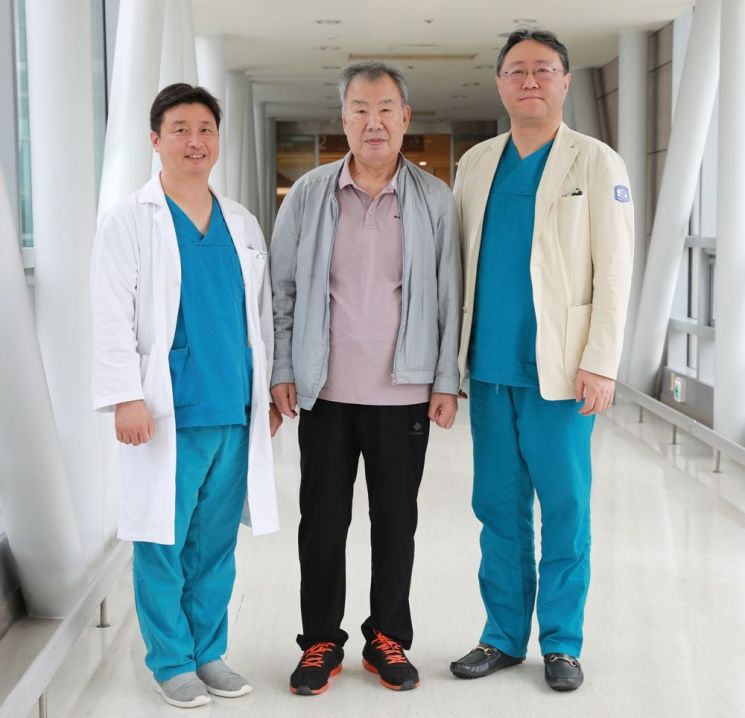 Professor Park Soon-cheol (from the left) of Seoul St. Mary's Hospital, a patient in their 70s with an aortic aneurysm, and Professor Kim Jang-yong are taking a commemorative photo.
An aortic aneurysm is a vascular disease in which a part of the aorta gradually balloons like a balloon and suddenly ruptures when the pressure increases. The main cause of abdominal aortic aneurysms is vascular aging, and the incidence is increasing with population aging. Most cases grow without symptoms, so they are often discovered incidentally.
The team of Professors Park Soon-cheol and Kim Jang-yong (Vascular and Transplant Surgery) and Cheon Ho-jong (Radiology) at the Aortic and Peripheral Vascular Center of the Cardiovascular and Cerebrovascular Hospital at The Catholic University of Korea Seoul St. Mary's Hospital reviewed treatment using the rare medical device 't-Branch stent-graft (Zenith, COOK Medical)'. Since the patient was elderly and had previously undergone open surgery for an abdominal aortic aneurysm, there were concerns about the new stent procedure. They decided on the less invasive 'endovascular aortic stent-graft insertion' and thoroughly planned the procedure beforehand, applying patient-tailored treatment.
The 't-Branch stent-graft insertion procedure' requires precise intervention for each important visceral branch artery (including the celiac artery, superior mesenteric artery, and bilateral renal arteries?a total of four arteries), demanding a higher level of skill than other procedures. The team succeeded in the procedure within three hours.
Professor Park Soon-cheol, director of the Aortic and Peripheral Artery Center, explained, "The t-Branch stent-graft procedure is still in the early stages in Korea, with about 10 cases performed so far, but with the success of this procedure, we will actively apply patient-tailored interventions for patients who are difficult to treat surgically in the Department of Vascular and Transplant Surgery."
© The Asia Business Daily(www.asiae.co.kr). All rights reserved.

















