On the 20th, the Fair Trade Commission sanctions 32 companies for bid-rigging in the National Vaccination Vaccine Project
The Fair Trade Commission imposed corrective orders and fines totaling 40.9 billion KRW on 32 companies, including Green Cross and Yuhan Corporation, for bid-rigging in national vaccination vaccine projects. These companies colluded over a long period by recruiting sham bidders and pre-determining winning bid prices in the bidding processes for government-funded influenza vaccines, hepatitis vaccines, and others.
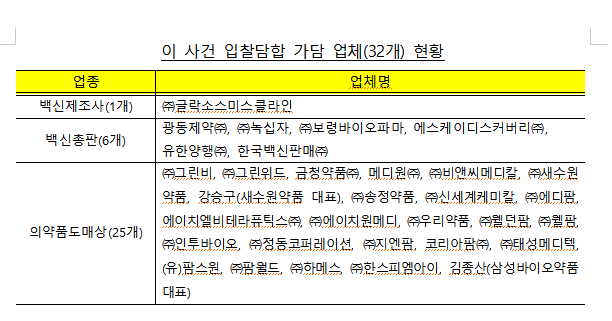 The Fair Trade Commission imposed fines totaling 40.9 billion KRW and corrective orders on 32 companies involved in bid-rigging in national vaccination vaccine projects.
According to the Fair Trade Commission on the 20th, a total of 32 vaccine-related businesses?including one vaccine manufacturer (GlaxoSmithKline), six vaccine distributors (Kwangdong Pharmaceutical, Green Cross, Boryung Biopharma, SK Discovery, Yuhan Corporation, Korea Vaccine Sales), and 25 pharmaceutical wholesalers?were found to have colluded in the vaccine bidding projects ordered by the Public Procurement Service (from February 2013 to October 2019) by pre-selecting the winning bidder, recruiting sham bidders, and sharing bid prices.
A vaccine manufacturer is a company that actually produces vaccines. Vaccine distributors are companies that have joint sales contracts with vaccine manufacturers. Pharmaceutical wholesalers are companies that receive vaccines from these entities and distribute them to hospitals, clinics, and public health centers. The vaccines involved in the collusion were all part of the national immunization program funded by the government, including well-known vaccines such as influenza, hepatitis, tuberculosis, cervical cancer, acute otitis media, and pneumococcal vaccines for pneumonia, totaling 24 types.
The collusion in the vaccine bidding market occurred over a long period. Han Ki-jung, Chairman of the Fair Trade Commission, explained, “Businesses wishing to participate in the collusion did not even need to struggle to find sham bidders,” adding, “They could easily recruit sham bidders with just one phone call.” There was also no need to painstakingly discuss bid prices. Even without explicit communication, the expected winning bidder would bid close to 100% of the base price recommended by the Public Procurement Service to win the contract with a higher amount, while the sham bidders would bid a few percentage points higher to avoid winning.
The Fair Trade Commission explained that this collusion prevented the efficient execution of government budgets. Among the 147 contracts awarded, 117 cases?about 80%?had a winning bid rate of 100% or more compared to the base price, which is an unusually high level compared to the typical lowest-price bidding winning rates.
© The Asia Business Daily(www.asiae.co.kr). All rights reserved.
![User Who Sold Erroneously Deposited Bitcoins to Repay Debt and Fund Entertainment... What Did the Supreme Court Decide in 2021? [Legal Issue Check]](https://cwcontent.asiae.co.kr/asiaresize/183/2026020910431234020_1770601391.png)















