KIOST Identifies Cause of Remote Correlation
Points to 'Pakistan Heavy Rainfall' as Main Culprit
A domestic research institute has identified the cause of the longest-ever marine heatwave in the East China Sea.
The Korea Institute of Ocean Science and Technology (KIOST, President Kang Do-hyung) discovered a 62-day-long marine heatwave in the East China Sea, including parts of the southwestern waters of Jeju Island in 2022, and pointed to the "Pakistan heavy rainfall event," which strongly developed the global circulation teleconnection, as the cause.
Teleconnection refers to a pattern of mid-latitude atmospheric waves in the Northern Hemisphere generated by internal processes of the climate system. When convective activity develops in Pakistan and northwest India during summer, it induces high-pressure circulation in the East Asian region.
Dr. Jung Jin-yong’s research team at KIOST’s Ocean Dynamics Enhancement Research Division, supported by the Ministry of Oceans and Fisheries, conducted the "Establishment of Advanced Marine Science Bases in Jurisdictional Waters and Convergent Research." Together with Professor Choo Jung-eun’s team from the City University of Hong Kong, they identified the causes of the 2022 East China Sea marine heatwave step by step.
According to the study, in the early stage of the marine heatwave, low-salinity water inflow from the Yangtze River was the main cause, while from the mid-stage of the heatwave development onward, atmospheric flows formed in the high-pressure zone related to the global circulation teleconnection pattern played an important role.
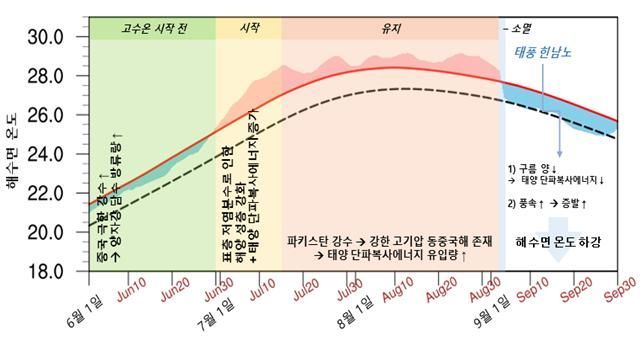 Summary diagram of the occurrence, maintenance, and dissipation process of the 2022 East China Sea marine heatwave.
The research team found that the 2022 Pakistan heavy rainfall influenced atmospheric flows, creating an environment where high pressure developed over the Korean Peninsula, leading to a marine heatwave in the East China Sea, known as the "ocean heatwave," which lasted for the longest period on record. They published these findings in a scientific paper.
The average sea surface temperature in the East China Sea during July and August last year was 28.4℃, setting a new record high. In June of the same year, the discharge volume of low-salinity water from the Yangtze River was the second highest ever recorded.
The high-temperature, low-salinity freshwater discharged from the Yangtze River was identified as a major factor accelerating the rise in sea surface temperature in the East China Sea.
This result was analyzed based on information collected through simultaneous ocean-atmosphere observations at the Ieodo Ocean Research Station, operated by the National Oceanographic Research Institute, which was completed by KIOST.
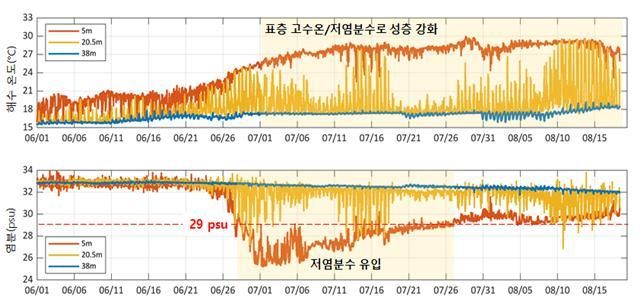 Sea temperature (above) and salinity (below) observation data collected at the Ieodo Ocean Research Station in 2022.
This shows that natural disasters caused by climate change, such as the Pakistan heavy rainfall, can lead to marine and meteorological disasters in waters around the Korean Peninsula through teleconnections in global circulation.
KIOST expects significant environmental changes in the East China Sea this year due to El Ni?o and plans to conduct thorough monitoring at the Ieodo Ocean Research Station going forward.
President Kang Do-hyung stated, "To protect the safety and property of the public, research on marine heatwaves around the Korean Peninsula must be strengthened," adding, "KIOST plans to establish the 'Korean Coastal Disaster Response System (K-Ocean Watch)' to provide early forecasts and warnings for marine disasters and accidents worsened by climate change."
© The Asia Business Daily(www.asiae.co.kr). All rights reserved.


















