China Competing with the US for 1st and 2nd Place
Game Market Size Expected to Reach 72 Trillion Won by 2027
China's Overseas Game Sales Surpass 21 Trillion Won
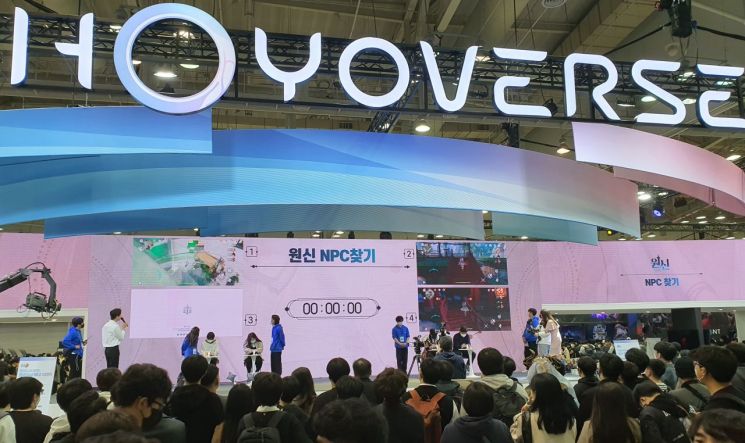 At the international game exhibition 'G-STAR 2022,' visitors are crowding around the Chinese game company HoYoverse's booth.
The voice of China is growing louder in the global gaming industry. With over 700 million gamers, China has long been merely a target for foreign game companies. However, having nurtured its domestic gaming industry through strong regulatory policies, China is now set to expand into overseas markets.
Overtaking the U.S. Is Just a Matter of Time
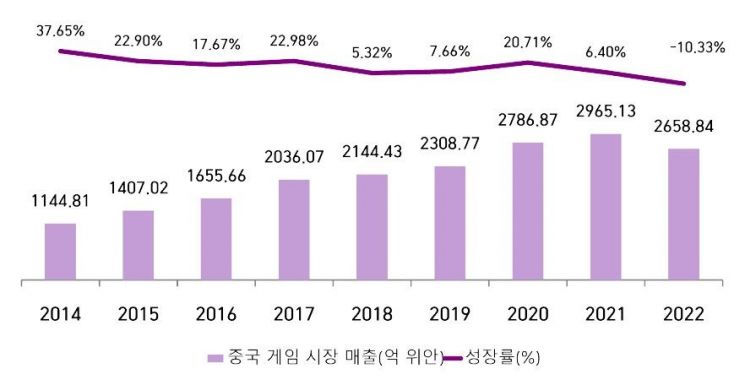
China competes with the U.S. for the top spot in the global gaming market. The China Audio-Video and Digital Publishing Association's Game Committee reported that last year, the Chinese gaming market was worth 265.8 billion yuan (approximately 46.62 trillion KRW). This figure represents a decline of over 10% compared to the previous year due to COVID-19 and gaming regulations. Nevertheless, it remains the second-largest market after the U.S., which generated $54.1 billion (about 68.49 trillion KRW) in revenue last year.
The prevailing analysis is that it is only a matter of time before China's gaming market catches up with the U.S. During the COVID-19 pandemic, as the number of gamers surged rapidly, China implemented stringent regulatory policies. Games were treated as "spiritual opium," with restrictions on gaming time and a halt on most new game releases by game companies. However, since the end of last year, this stance has reversed 180 degrees. China has begun actively fostering its gaming industry by not only allowing new game releases but also lifting the restrictions previously imposed on foreign game companies.
Data analytics firm Niko Partners predicts that by 2027, the Chinese gaming market will exceed $57 billion (about 72.1 trillion KRW). Although China's population is declining, the number of gamers is gradually increasing, expected to reach 730 million?twice the entire population of the U.S.
Expansion of Game Company Investments and Acquisitions... Chinese Games Earning Revenue Overseas
Chinese game companies have grown primarily within their domestic market until recently. Due to lower quality, they were not recognized in overseas markets. However, the Chinese government has enhanced the competitiveness of domestic game companies through a closed "pan-ho" (game service license) policy.
Just a decade ago, Korean games effectively dominated the Chinese market. In response, China halted or delayed issuing pan-ho licenses for foreign games, including Korean ones, citing reasons such as the need to upgrade addiction prevention systems. Meanwhile, Chinese game companies improved their development capabilities by imitating Korean games or acquiring well-known foreign game companies. The recent resumption of issuing licenses for Korean games after nearly four years since March 2017 is interpreted as a sign of confidence in domestic games.
Chinese game companies have also made significant overseas investments. Tencent, a leading Chinese game company, began investing in Riot Games in 2011 and has expanded its investments annually. Last year, Tencent acquired the British game company Sumo Group for $1.27 billion (about 1.6 trillion KRW). It also invested approximately $319 million (about 400 billion KRW) in Ubisoft, increasing its stake to 11%. As of 2021, Tencent holds over 100 game titles.
Fueled by aggressive market expansion, Chinese games' overseas revenue soared to 21.88 trillion KRW last year. This figure far surpasses South Korea's total gaming revenue of 21.18 trillion KRW for the same period.
The gaming industry expects the Chinese government to take a more proactive role in fostering the gaming industry. For the first time, eSports was officially included as a medal event at the Hangzhou Asian Games scheduled for September this year. This is seen as an opportunity to increase government and public interest in gaming.
© The Asia Business Daily(www.asiae.co.kr). All rights reserved.


















