Data Three Acts Enable Use of Pseudonymized Information in Industry
Yet Institutions Still Reluctant to Provide Data
Government Continues to Deliberate
Founded in 2017, genome analysis company iCrozin recently succeeded in developing technology that accurately predicts and diagnoses chronic diseases using genome analysis technology. After simple specimen collection through clinics and hospitals and requesting analysis from the company, personalized health information is provided within 4 to 6 weeks based on genomic information.
A pharmaceutical company requested ‘market trend survey’ data from the Health Insurance Review and Assessment Service for market research on chronic disease treatments such as hypertension and hyperlipidemia. However, they did not receive data containing sales figures of competing companies’ treatments. A representative from Company A said, “(Because of this) many pharmaceutical companies have no choice but to use solutions provided by private data service companies that are tens of times more expensive than public data.”
Three Years Since the Enforcement of the ‘Data 3 Acts’... Stark Differences in the Biohealth Industry
Data is called the ‘crude oil’ of the Fourth Industrial Revolution. To respond to this, the revised ‘Data 3 Acts (Personal Information Protection Act, Information and Communications Network Act, Credit Information Act)’ were implemented three years ago to allow easier use of data in new industries such as biohealth, but there are still stark differences in utilization. The Data 3 Acts allow pseudonymized information to be used for scientific and industrial research without the consent of the data subject. In the pharmaceutical industry, health insurance claims data, health checkup data, hospital medical records, prescriptions, and pharmaceutical sales data can now be utilized. The potential uses of healthcare data are limitless. When pharmaceutical companies develop new drugs, they can analyze side effects of existing drugs through data to produce better medicines. Also, in clinical trials for rare disease treatments, healthcare data can replace patient control groups, significantly reducing costs and time. Healthcare data is also used in medical artificial intelligence (AI) and medical device development. Ultimately, this can help reduce future national medical expenses.
However, the pharmaceutical industry says, “There are still too many barriers that make it difficult to apply healthcare data in the field.” Healthcare data providers are largely divided into public institutions (National Health Insurance Service, Health Insurance Review and Assessment Service, Korea Disease Control and Prevention Agency, etc.) and private institutions (hospitals). They view the industry’s commercial use of healthcare data with suspicion and hesitate to provide high-quality data.
First, clinical trial data, which is important for drug development, is held by many individual hospitals, but they are reluctant to allow its use by the industry. The costs related to hospital personnel involved in providing data and concerns about patient lawsuits outweigh the expected benefits. Also, the format of clinical data varies from hospital to hospital, making it difficult for the industry to utilize the data without standardized models.
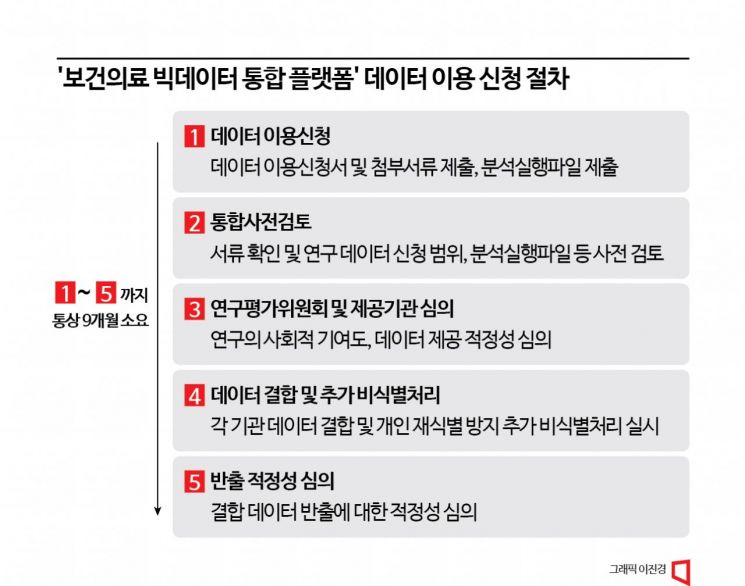
The same applies to public healthcare data provided by the government. The ‘Healthcare Big Data Integrated Platform,’ which provides healthcare data from nine institutions including the Health Insurance Review and Assessment Service and the National Health Insurance Service, is in operation, but it takes a long time to receive data. When a pharmaceutical company applies to use data, it goes through integrated preliminary review → research evaluation committee and provider institution review → data integration and additional de-identification → export appropriateness review. It is said that this process takes nine months to complete. A representative from Company B said, “The pharmaceutical environment is rapidly changing, but it takes nearly a year just to secure data for market research. The numerous review processes need to be reduced.”
Biohealth Industry = The Second Semiconductor... Considering Ways to Utilize Data in the Industry
The government is also striving to find ways to activate the use of healthcare data in the industry. In February, the government presented a goal to remove various barriers as part of its plan to nurture the biohealth industry as the ‘second semiconductor.’ By utilizing data, it aims to reduce the time and cost of new drug development and place Korea among the world’s top six pharmaceutical bio countries.
The government plans to launch a national integrated bio big data project next year, aiming to build healthcare data on a scale of one million people, and revise related guidelines within the year to expand the scope of data utilization. Also, public institutions may be required to provide healthcare data more actively to companies in the future, as a new evaluation criterion related to the provision of pseudonymized information has been added to public institution assessments.
There are also calls for the activation of intermediary platforms that can connect hospitals, which are private providers of healthcare data, with the industry. A pharmaceutical company representative said, “It is difficult for data users in the industry to access information about what kinds of healthcare data hospitals have and whether the data formats can be applied in the industry.” A Ministry of Health and Welfare official said, “Healthcare data must be actively used in the industry to foster the biohealth industry. We will seek ways to improve various issues that hinder industrial use.”
© The Asia Business Daily(www.asiae.co.kr). All rights reserved.
!["The Woman Who Threw Herself into the Water Clutching a Stolen Dior Bag"...A Grotesque Success Story That Shakes the Korean Psyche [Slate]](https://cwcontent.asiae.co.kr/asiaresize/183/2026021902243444107_1771435474.jpg)

















