Ministry of Environment, Happy City, Chungbuk Province, and Cheongju City Accountability
Proving Management Defects as Key Cause of Accident
Can the flooding accident at Gungpyeong No. 2 Underpass (Gungpyeong Underpass) in Osong-eup, Heungdeok-gu, Cheongju-si, Chungbuk be punished under the Serious Citizen Disaster Act? As the search operation concludes and the investigation into the accident responsibility intensifies, attention is focused on whether this tragedy will become the first case punished under the Serious Citizen Disaster Act.
The Serious Citizen Disaster Act applies when, according to the Serious Accident Punishment Act, among users of public facilities, ▲one or more deaths occur, ▲10 or more injured require treatment for two months or longer due to the same accident, or ▲10 or more people suffer from diseases requiring treatment for three months or longer due to the same cause.
In other words, the conditions are whether the facility qualifies as a public facility and the scale of the damage.
Experts generally agree that the Gungpyeong Underpass accident meets the criteria for a serious citizen disaster. According to the Serious Accident Punishment Act and the Facility Safety Act's public facility regulations, an "underpass tunnel section extending 100 meters or more" qualifies as a public facility, and Gungpyeong Underpass is a 685-meter-long, four-lane underpass, thus meeting this criterion.
Additionally, since 14 people died and 9 were injured in this accident, it also meets the damage scale requirements for a serious citizen disaster.
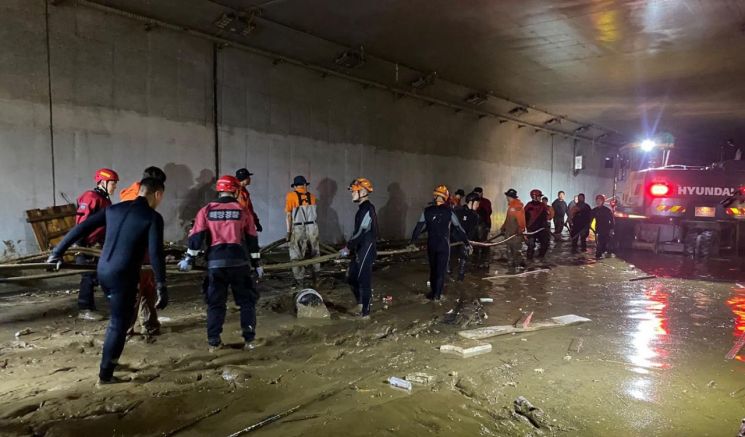 On the 17th, members of the Central Maritime Special Rescue Unit of the Korea Coast Guard, along with fire departments and related agencies, conducted a search for missing persons in the Gungpyeong 2 underpass in Osong-eup, Cheongju, Chungbuk, which was flooded due to heavy rain.
 [Image provided by the Korea Coast Guard, Yonhap News]
Therefore, there is growing expectation that this tragedy will be the first case punished under the Serious Citizen Disaster Act. In April, the collapse of Jeongja Bridge in Bundang, Seongnam-si, Gyeonggi Province, was also expected to be classified as a serious citizen disaster, but the judgment has been delayed due to the time-consuming investigation.
The key issue is whether management defects or faults can be proven. The causes related to management defects in this tragedy are "the collapse of a temporary embankment built for the nearby Miho River bridge construction" and "lack of traffic control." If management defects related to these two causes are proven, the law can be applied to the responsible minister, local government head, or public institution head in charge.
Regarding the collapse of the temporary embankment, the Administrative City Construction Agency and the Ministry of Environment, which manages the river, are likely to be held responsible. The Administrative City Construction Agency partially dismantled the existing embankment and built a temporary embankment for the Miho River bridge construction, and when this embankment collapsed, 60,000 tons of water poured into the underpass. The permit authority for river occupation lies with the Geumgang River Basin Environmental Office under the Ministry of Environment.
Regarding the failure to control traffic despite a flood warning issued four hours before the accident, responsibility can be attributed to Chungbuk Province and Cheongju City. Lawyer Son Ik-chan, active in the Movement Headquarters for Creating a World Without Serious Accidents, explained on MBC Radio on the 19th, "According to the Facility Safety Act, if there is a serious defect in a facility making safe use difficult, the management entity must restrict or prohibit use, and the responsible entity for this road is Chungbuk Province," adding, "However, under the Disaster and Safety Management Act, the head of the local government acts as the disaster safety control tower."
He further added, "It remains to be seen whether more responsibility will be placed on the formal road management entity (Chungbuk Province) or on Cheongju City, which has relatively easier access to information."
There is also analysis that the police will find it difficult to avoid responsibility. The police, who received a 112 emergency call requesting urgent control of Gungpyeong Underpass before the accident, mistakenly dispatched to Gungpyeong No. 1 Underpass about 1.2 km away from Gungpyeong No. 2 Underpass, and reportedly arrived at the scene around 9 a.m., 20 minutes after the accident, according to the Prime Minister's Office. However, on the 21st, the Office for Government Policy Coordination announced that it had obtained evidence suggesting the police did not actually dispatch to the underpass and is investigating.
Seung Jae-hyun, senior research fellow at the Korea Institute of Criminology and Justice Policy, appeared on YTN's "News Rider" and said, "While the management responsibility for the underpass clearly lies with the local government, controlling it is naturally the police's role," adding, "Since the national police and fire services are crucial in protecting citizens' lives, it will be difficult for them to evade responsibility in this matter."
© The Asia Business Daily(www.asiae.co.kr). All rights reserved.

















