G20 Finance Ministers and Central Bank Governors Meeting
Choo: "Fiscal Policy Coordination Crucial for Tackling High Inflation"
Consensus Fails Amid Ukraine War Disputes
Deputy Prime Minister and Minister of Economy and Finance Choo Kyung-ho emphasized that the South Korean government's policy of minimizing expenditures contributed to lowering the inflation rate during meetings with the finance and monetary chiefs of the Group of Twenty (G20). He also expressed the position that debt issues of vulnerable countries must be resolved in international financial matters. However, despite this being the last G20 finance ministers' meeting before the summit, the meeting failed to produce a joint communiqu? due to conflicts among member countries over the Ukraine war.
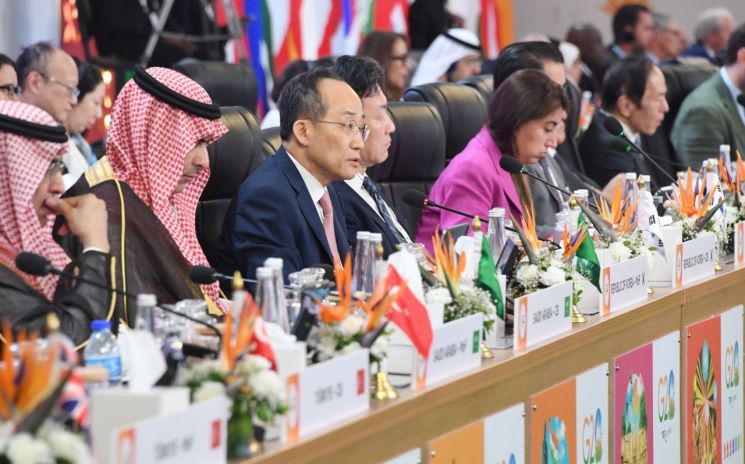 Deputy Prime Minister and Minister of Economy and Finance Choo Kyung-ho is speaking at the G20 Finance Ministers and Central Bank Governors Meeting held at the Mahatma Mandir Convention Center (MMCC) in Gandhinagar, India, on the 17th (local time).
Deputy Prime Minister Choo attended the G20 Finance Ministers and Central Bank Governors Meeting held from the 17th to the 18th in Gandhinagar, India, and stated, “In responding to high inflation, coordination between monetary policy and fiscal policy is important.” He further explained, “The South Korean government's efforts to minimize the increase in fiscal spending and policies to prevent excessive transmission of rising international raw material prices domestically were among the factors that lowered the Korean consumer price index to 2.7%.”
This meeting was convened to summarize discussions in the financial sector ahead of the G20 summit scheduled for September in New Delhi, India. The meeting was attended by finance ministers and central bank governors from G20 member and invited countries, as well as representatives from the International Monetary Fund (IMF) and the World Bank (WB).
Deputy Prime Minister Choo welcomed international cooperation such as the Indo-Pacific Economic Framework (IPEF) aimed at enhancing supply chain resilience during the first session on the global economy and health sector. He stated that South Korea would also participate based on its advanced manufacturing technology. He also explained that the South Korean government is preparing the “Basic Act on Supply Chains” to strengthen supply chain security, which is currently under discussion in the National Assembly.
Regarding the international financial system, for which South Korea and France serve as co-chairs of the working group, Choo urged resolving the debt issues of vulnerable countries in his keynote speech. He emphasized the swift implementation of “low-income country debt restructuring,” which maximally cancels vulnerable countries' debts, and proposed sharing creditor information among member countries to increase debt transparency. He also appealed for support of the “G20 Debt Note,” a report on vulnerable country debt issues.
Joint Communiqu? Again Fails over Blame for Ukraine War
Regarding the IMF quota, which must be agreed upon by the end of this year, Choo argued that “the economic growth of high-growth countries such as South Korea should be more accurately reflected.” The quota refers to the IMF member countries' contributions, which determine voting rights. South Korea's quota is 1.81%, with voting rights at only 1.73%.
Deputy Prime Minister Choo stressed the importance of the role of multilateral climate funds regarding the Green Climate Fund, which South Korea hosts the secretariat for, stating, “Responding to climate change involves enormous funding and risk.” He urged active participation in replenishing the Green Climate Fund's resources, which expire in October.
However, the meeting failed to produce a joint communiqu?. This was due to significant differences in positions among member countries over condemning the Ukraine war and assigning responsibility for the global economic downturn. Since the outbreak of the Ukraine war in February last year, the G20 has failed to issue a joint communiqu? at all finance ministers' meetings.
According to major foreign media, in this meeting as well, the United States, the United Kingdom, Germany, and France demanded a firm condemnation of Russia, which initiated the Ukraine war. In contrast, Russia and China expressed opposing views. Some member countries reportedly criticized Russia's suspension of participation in Black Sea grain trade.
© The Asia Business Daily(www.asiae.co.kr). All rights reserved.

















