Unusually Early Morning Short-Range Ballistic Missile Launch
Flight Over 550km, Impact in East Sea
American Defector to North Korea During Panmunjom Tour the Previous Day
North Korea fired two short-range ballistic missiles (SRBMs) into the East Sea early on the 19th. This appears to be a strategic move to gain the upper hand amid expected negotiations for the repatriation of a U.S. service member who illegally crossed into North Korea during a tour of the Panmunjom Joint Security Area (JSA) the previous day.
The Joint Chiefs of Staff stated, "Our military detected two short-range ballistic missiles launched by North Korea from the Sunan area into the East Sea between 3:30 a.m. and 3:46 a.m. today," adding, "North Korea's ballistic missiles flew approximately 550 km each before landing in the East Sea."
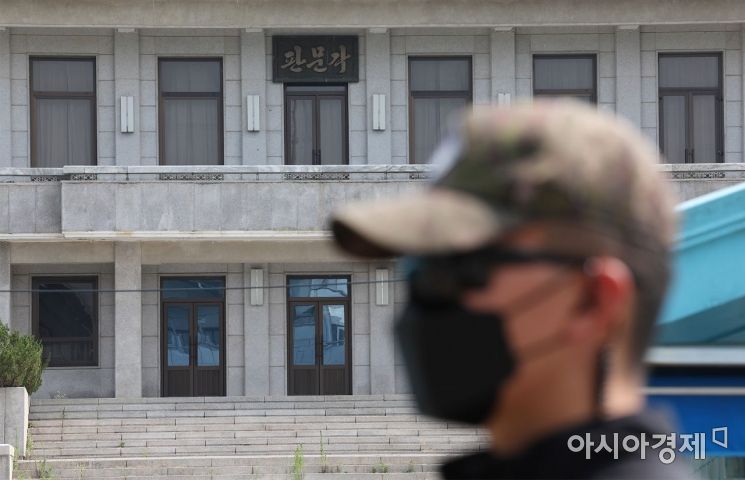 As tours of the Joint Security Area (JSA) in Panmunjom have resumed, a sense of silence hangs over Panmunjom in Paju, Gyeonggi Province on the 19th. Photo by Joint Press Corps
This missile launch marks one week since North Korea fired the solid-fueled intercontinental ballistic missile (ICBM) ‘Hwasong-18’ on the 12th. Moreover, launching at dawn is unusual. The ballistic missile launch is interpreted as a response to the recent establishment meeting of the new U.S.-South Korea extended deterrence consultative group (NCG) held the previous day, as well as the port call of the U.S. strategic nuclear submarine USS Kentucky (SSBN-737) in Busan, demonstrating nuclear deterrence capabilities.
The range of the ballistic missiles launched by North Korea on this day was about 550 km, nearly matching the straight-line distance from Sunan, North Korea, to Busan (554 km according to Google Maps). This is why analysts believe it was meant to showcase the capability to strike SSBNs with surprise attacks. The SSBN carries 20 submarine-launched ballistic missiles (SLBMs), and its visit to South Korea is the first in 42 years since 1981 during the Cold War.
Earlier, Kim Yo-jong, deputy director of the Workers' Party of North Korea, issued a statement on the 17th, a day before the first NCG meeting, saying, "The more the U.S. strengthens its extended deterrence system and expands its military alliance, the further it pushes us away from the talks they desire," expressing opposition to the U.S.-South Korea extended deterrence enhancement.
NCG Inaugural Meeting and U.S. Strategic Nuclear Submarine Port Call Seem to Spark Retaliation
North Korea is expected to continue additional military provocations to gain leverage in negotiations over the repatriation of the U.S. service member who crossed into North Korea. Previously, the United Nations Command announced that an American who was touring the Panmunjom Joint Security Area illegally crossed the Military Demarcation Line into North Korea. From North Korea’s perspective, which had warned of military offensives in response to the NCG launch and deployment of U.S. strategic assets, the ‘American detainee’ card is an additional bargaining chip.
North Korea also left room for dialogue with the U.S. In her statement, Kim Yo-jong emphasized, "We have no interests whatsoever in talks with the U.S.," but added, "The more the U.S. strengthens its extended deterrence system, the further it pushes us away from the talks they desire." This can be interpreted as presenting conditions under which North Korea might come to the negotiation table, subtly leaving a faint possibility for dialogue despite harsh rhetoric.
To proceed with negotiations, the U.S. is expected to deploy the commander of U.S. Forces Korea, who also serves as the commander of the United Nations Command. Apart from military approaches, there is also a possibility of pursuing talks with North Korea through diplomatic channels. In such a case, North Korea could respond to talks under the pretext of humanitarian cooperation.
Possibility of Additional Provocations to Gain Leverage in U.S. Forces Korea Repatriation Negotiations
In fact, negotiations between North Korea and the U.S. have taken place during past repatriations of Americans who went to North Korea. In December 2009, Korean-American human rights activist Robert Park, who illegally entered North Korea, was released after 42 days. At that time, North Korea-U.S. relations were gradually thawing, with a letter from President Barack Obama delivered to Kim Jong-il, so it is analyzed that North Korea sought to quickly resolve issues that could hinder the warming mood.
Earlier, in March 2009, two American journalists detained while reporting near the North Korea-China border were released after former U.S. President Bill Clinton visited North Korea in August of the same year and met with Kim Jong-il. This was a period when North Korea needed justification to release the American journalists, and the U.S. needed to maintain various efforts toward North Korea, aligning the interests of both sides.
Professor Yang Moo-jin of the University of North Korean Studies suggested that North Korea might use the U.S. service member who crossed into North Korea as a propaganda tool initially and then as bait for negotiations in the mid-term. He said, "The U.S. faces a dilemma between strengthening extended deterrence against North Korea and protecting its citizens," and added, "Until the issue is resolved, South Korea’s North Korea policy will inevitably be affected."
There are cautious speculations that high-level contacts could lead to a dialogue phase triggered by repatriation negotiations, but the general response is skeptical. The key issue is the defector’s (North Korea-bound) ‘intention to defect.’ If the individual voluntarily crossed the Military Demarcation Line, the U.S. would have no grounds to demand repatriation. Even if this crossing was a sudden act, it is unlikely that North Korea, pressured by U.S.-South Korea cooperation, would willingly return the American.
Moon Sung-mook, director of the Unification Strategy Center at the Korea Institute for National Unification, said, "The top priority is to understand the ‘background of the American’s crossing of the Military Demarcation Line.’ While it is difficult to make assumptions, the possibility of North Korea-U.S. contacts developing into denuclearization negotiations is low," he assessed.
© The Asia Business Daily(www.asiae.co.kr). All rights reserved.

















