Minimum Wage for 2024 Set at 9,860 Won, Up 2.5%
Small and Medium Enterprises and Small Business Industry Express "Regret"
The 2024 minimum wage has been decided at 9,860 won, a 2.5% increase from this year, which has drawn regret from small and medium-sized enterprises (SMEs) and small business sectors. The industry's stance was that the decision should have been made at a freeze level, considering the payment capacity of vulnerable small SMEs and small business owners. In particular, disappointment was significant among SMEs and small business owners as the expected sector-specific application, which was anticipated to be introduced this time, was canceled. Although the final proposal of 9,860 won, presented by the employer representatives representing the business community, was adopted, there are even appeals that employment will have to be reduced next year as the current minimum wage level is already reaching a limit that is difficult to bear.
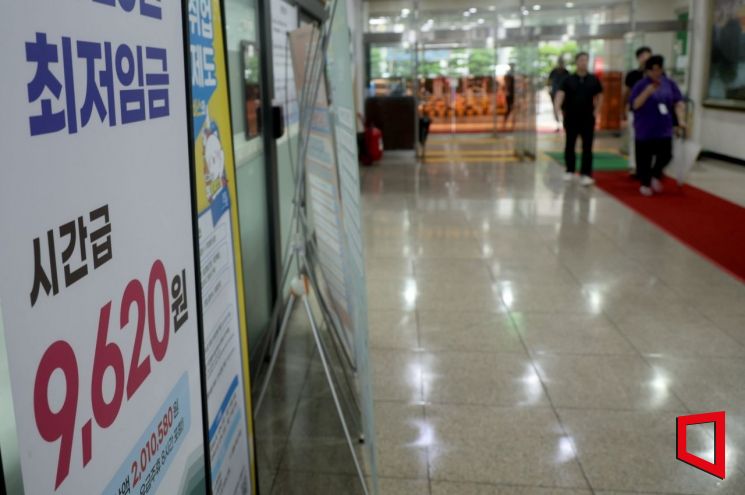 Workers are passing in front of a banner displaying this year's minimum wage amount, erected in front of the Seoul Western Employment Welfare Plus Center. Photo by Younghan Heo younghan@
On the 19th, the Korea Federation of Small and Medium Business issued a statement saying, "This minimum wage decision is an irresponsible act that ignores the desperate cries of small business owners, the main payers," and added, "Small business owners are at a level where it is no longer possible to maintain employment." The Federation further stated, "The Minimum Wage Commission has carried out a 'speeding increase' by raising the minimum wage by as much as 52.4% over the past seven years," and "The result of this excessive increase has led to employment reduction, and there is a high likelihood that this will worsen next year." According to a survey conducted by the Federation, the average annual operating profit growth rate of small business owners over the past few years was 1.6%, whereas the labor cost increase rate reached 3.7%. As of early this year, small business owners are already paying more in labor costs than their operating profits.
Concerns about employment reduction due to the minimum wage increase are also rising. In the Federation's survey, 58.7% of small business owners anticipated reducing new hires, 44.5% expected to cut existing staff, and 42.3% planned to shorten working hours of current employees to sustain their businesses if the minimum wage increased. A rapid survey on the minimum wage conducted by Korea Credit Data targeting small business owners also showed that 65% responded they would reduce employment next year.
The situation is similar for SMEs. A recent survey by the Korea Federation of SMEs showed that 7 out of 10 SMEs intended to reduce employment if the minimum wage increased. More than half of the respondents cited 'minimum wage increase' as the main factor worsening management and employment conditions. Accordingly, the SME sector also expressed regret over this decision. They believe that the economic downturn due to the low stock market phase, public utility fee hikes, and soaring production costs caused by high inflation, which have caused many SMEs to struggle in management, were not sufficiently reflected. The SME sector has also been appealing daily to maintain the minimum wage at the current level for corporate survival and job creation.
If the minimum wage increase is applied, labor shortages are expected immediately in service sectors that directly affect ordinary people, such as supermarkets, convenience stores, and gas stations. Song Yoo-kyung, chairman of the Korea Supermarket Cooperative Federation, said, "The high minimum wage burden will cause consumer inconvenience due to service reductions such as adjusted business hours." The already difficult situation of manufacturing companies may worsen further. Eun Jong-mok, director of the Korea Welding Industry Cooperative, lamented, "Increases in electricity and gas fees are major cost drivers, making the management situation of small and medium manufacturers difficult," and added, "Price inflation greatly affects not only workers' lives but also corporate management, making it difficult to bear even the current minimum wage level."
© The Asia Business Daily(www.asiae.co.kr). All rights reserved.

















