As concerns over an economic recession grow, the Chinese government hastily introduced policies to expand domestic consumption, promote employment, and increase income. The measures include expanding purchases of home appliances and furniture, as well as encouraging interior construction. However, the market remains skeptical, saying it is difficult to change the current trend.
On the 18th, Jin Xiandong, head of the Policy Research Office at the National Development and Reform Commission, China's macroeconomic authority, stated at a press conference, "We will introduce policies in areas such as stabilizing bulk stock consumption, promoting automobile and electronic product consumption, expanding rural consumption, and improving the consumption environment."
After Disappointing Q2 GDP Growth and Other Results,
Increasing Sales of Home Appliances and Furniture, Encouraging Interior Construction
Director Jin emphasized, "Through the 'Interdepartmental Joint Meeting for Deepening Income Distribution System Reform,' we will systematically promote income distribution," adding, "We will strengthen support for key groups (youth) and increase the income of low-income earners."
Regarding the record-high youth unemployment rate of 21.3% announced the previous day, he said, "We clearly recognize that there are relatively many internal and external uncertainties and instabilities affecting employment, and that key groups such as university graduates are facing significant employment pressure." He continued, "We will establish a reasonable wage growth mechanism to increase the share of labor compensation in primary distribution," and explained, "We will promote income growth for urban and rural residents through various channels."
On the same day, the Ministry of Commerce also announced 11 policies to stimulate household consumption. Thirteen departments, including the Ministry of Commerce, the National Development and Reform Commission, and the Ministry of Industry and Information Technology, jointly issued a 'Notice on Stimulating Household Consumption,' urging local governments to support and encourage residents' purchases of eco-friendly furniture, electronic products, and housing.
Additionally, measures were introduced to expand production of household appliances by enterprises, support smart appliance consumption, and encourage remodeling. Financial institutions were instructed to strengthen loan support and adjust interest rates for real estate purchases. They were also required to enhance credit support for housing purchase loans and set related loan interest rates and terms at reasonable levels.
Direct Support Measures Still Met with Caution:
"Insufficient to Be a Game Changer"
On this day, the Chinese government did not present direct support measures such as cash payments that the market had expected. Larry Hu, head of China economics at Macquarie, told Bloomberg News, "This move is a very mild step," adding, "Policies targeting real estate and infrastructure will have a greater impact on the economy."
Hu explained, "Plans to promote sales of home appliances and electric vehicles may help to some extent, but they are insufficient to be a game changer," and said, "Policies that inject funds into infrastructure through policy banks and special bonds will be helpful."
Sing Jiaofeng, chief China strategist at the Australia and New Zealand Banking Group, emphasized, "In a situation where consumer confidence is weak, it will be difficult for these measures to affect the macroeconomy," adding, "Policies should focus on trust." Sing stressed, "Measures like Zhejiang Province's new pilot program to remove household registration restrictions will be more helpful for consumption."
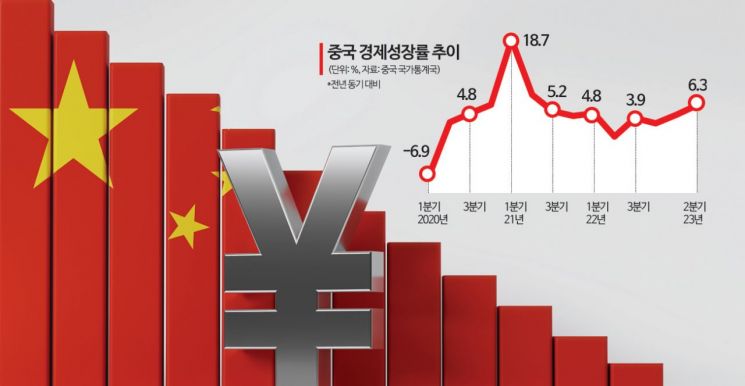
Meanwhile, economic indicators for China's second quarter and June, released the previous day by the National Bureau of Statistics of China, all fell short of expectations. The Q2 gross domestic product (GDP) growth rate recorded 6.3% year-on-year, significantly below market forecasts (7.0?7.3%). Retail sales in the previous month increased by 3.1% year-on-year, missing the forecast (3.2%), while industrial production rose 4.4% year-on-year, surpassing both the previous month's figure (3.5%) and the forecast (2.7%). The youth (ages 16?24) unemployment rate, considered a trigger for the Chinese economy, soared to 21.3%, breaking the previous record set in May (20.8%).
© The Asia Business Daily(www.asiae.co.kr). All rights reserved.
!["The Woman Who Threw Herself into the Water Clutching a Stolen Dior Bag"...A Grotesque Success Story That Shakes the Korean Psyche [Slate]](https://cwcontent.asiae.co.kr/asiaresize/183/2026021902243444107_1771435474.jpg)
















