Expert: "Disaster Management Culture Poorly Established"
"Avoid Flooded Areas and Prevent Access"
Experts commonly point out that if road closures had been implemented in a timely manner regarding the flooding accident at Osong underpass caused by the breach of the Miho River embankment in Cheongju, Chungbuk due to heavy rain, major casualties could have been prevented.
Despite a flood warning being issued around the Miho River area more than four hours before the disaster, there was no vehicle control or detour guidance for the underpass at all.
Meanwhile, water rapidly flowed onto the road. According to the vehicle black box footage from the time of the accident, drivers tried to turn their cars around and exit the underpass upon seeing the incoming water, but some hesitated briefly and still entered the underpass.
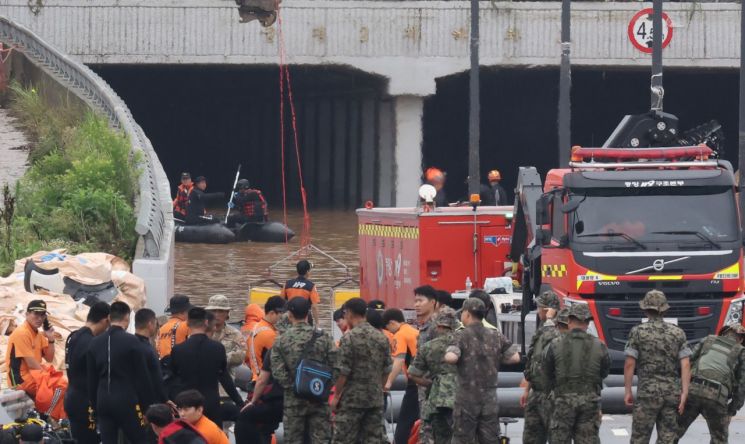 Search operations for missing persons are underway on the morning of the 16th at Gungpyeong 2 Underpass in Osong-eup, Cheongju-si, Chungbuk, which was flooded due to the collapse of the Miho River embankment. 2023.7.16 [Image source=Yonhap News]
Moon Hyun-cheol, Vice President of the Korean Disaster Management Association (Professor at Honam University), explained in a YTN radio interview, "The national disaster management system was established, designed, and implemented when the Framework Act on the Management of Disasters and Safety was enacted 20 years ago. In urgent situations, local government heads have the legal authority to activate disaster safety countermeasure headquarters and take emergency actions."
Moon added, "Traffic bans, traffic restrictions, and evacuation orders should be activated by the basic local governments closest to the scene, but strangely, these systems did not operate."
He said, "Local government heads are not trained in (disaster response systems)," adding, "Most seem unaware that they have such important obligations. It’s not about requiring advanced expertise to operate some scientific technology, but despite being stipulated by law, they simply do not know."
Jang Seok-hwan, Professor of Construction Systems Engineering at Daejin University, said, "If traffic control had been implemented at 6 a.m., the situation would have been completely different," adding, "The flood control office issues alert warnings and notifies local governments, but how the recipients accept and assess the situation and its severity on site changes the outcome."
Professor Jang emphasized that in such disaster situations, "The priority is not to enter, and it is important to guide people not to enter," and stressed, "Existing regulations, systems, and design standards for underground facilities, from semi-basements to underpasses and underground parking lots, need to be significantly revised."
© The Asia Business Daily(www.asiae.co.kr). All rights reserved.

















