Hankyung Research Institute, Lawyer Song Ji-yong's Case Analysis to be Announced on the 18th
"Negative Impact on SMEs if Applied to Workplaces with Fewer Than 50 Employees Next Year"
The Korea Economic Research Institute under the Federation of Korean Industries raised concerns on the 18th about the rulings on violations of Articles 1 and 2 of the Serious Accidents Punishment Act. They argued that the court forcibly interpreted causality by linking the Industrial Safety and Health Act, which has different applicable subjects and content from the Serious Accidents Punishment Act.
The first accident (Onyu Partners accident) involved a subcontractor worker who fell to their death while working without wearing a safety harness at an opening. The CEO was sentenced to 1 year and 6 months in prison with a 3-year probation, and the corporation was fined 30 million KRW. The second accident (Korea Steel accident) involved a subcontractor worker who died after being struck by a 1.2-ton heat shield. CEO Sung Hyung-sik was sentenced to 1 year in prison.
Attorney Song pointed out that there is a difference between the 'obligation to secure safety and health' under the Serious Accidents Punishment Act and the 'obligation to take safety measures' under the Industrial Safety and Health Act, yet the court broadly recognized causality. He also noted that there was a misunderstanding of legal principles during the judgment process.
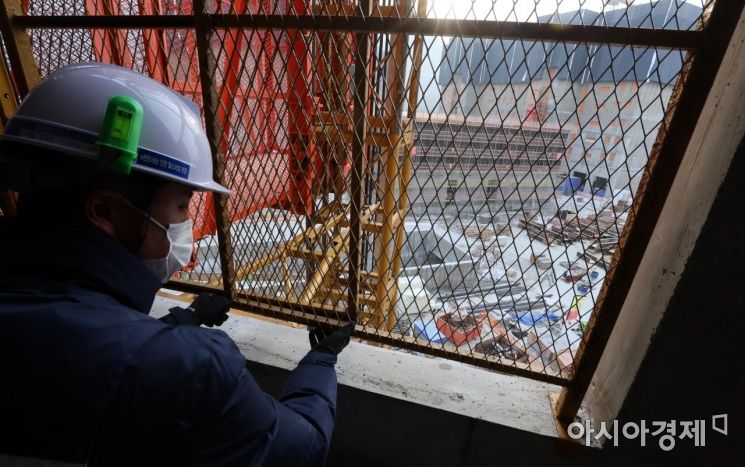 On January 27, 2021, the first day of the Serious Accidents Punishment Act enforcement, managers are conducting a safety inspection at an apartment construction site in Gyeonggi-do. Photo by Hyunmin Kim kimhyun81@
He criticized the first-instance ruling by the Masan branch of Changwon District Court. The Masan branch recognized causality between the principal contractor's violation of the obligation to secure safety and health and the worker's death, based on the subcontractor's lack of industrial accident prevention capability and the absence of a heavy object handling work plan. Attorney Song argued that it is difficult to find causality between the obligation to improve workplace risk factors under the Serious Accidents Punishment Act and the obligation to prepare a heavy object handling work plan under the Industrial Safety and Health Act. He stated, "The court forcibly interpreted and recognized causality between the violation of the obligation to secure safety and health under the Serious Accidents Punishment Act and the obligation to take safety and health measures under the Industrial Safety and Health Act."
Attorney Song said that both cases fall under 'real concurrence' but the court applied 'ideal concurrence,' which is problematic. Real concurrence applies separate crimes to each act, while ideal concurrence applies two or more crimes to a single act.
The court stated, "Both violations of the Serious Accidents Punishment Act and the Industrial Safety and Health Act are closely related as they are both industrial accident prevention laws, and each violation led to the victim's death, so they can be considered a single act." Attorney Song responded, "The purposes of the Serious Accidents Punishment Act violation, the Industrial Safety and Health Act violation, and the crime of professional negligence causing death or injury are different, and there is no unity of act," adding, "This is a case of real concurrence, not ideal concurrence."
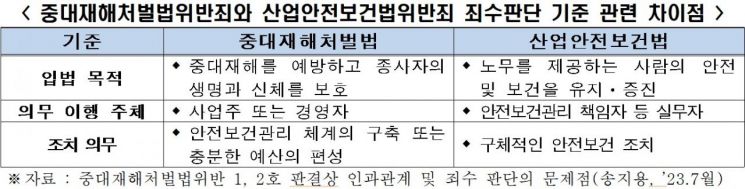
He emphasized that violations of the Serious Accidents Punishment Act and the Industrial Safety and Health Act should be judged separately. He recalled that the Masan branch also acknowledged that the 'duty of care' constituting the elements of the two crimes differ in content. Regarding this, Attorney Song said, "The court has effectively admitted that there is no identity between the two acts." He stated that the legislative purposes, subjects obligated to perform duties, and contents of the Serious Accidents Punishment Act and the Industrial Safety and Health Act are all different.
From next year, the Serious Accidents Punishment Act will apply to workplaces with fewer than 50 employees, which is expected to increase confusion. Attorney Song expressed concern, saying, "Applying the Serious Accidents Punishment Act to small and medium-sized workplaces may have a negative impact on the industry," and added, "The court, which holds the authority to interpret the law, is delaying the decision on the constitutional review request of the Serious Accidents Punishment Act." He concluded, "I hope that the court will proceed with more careful logical development by reflecting the opinions of citizens and various experts."
© The Asia Business Daily(www.asiae.co.kr). All rights reserved.


















