Concentration of Damage on Cultivation Greenhouses and Fruit Production Areas
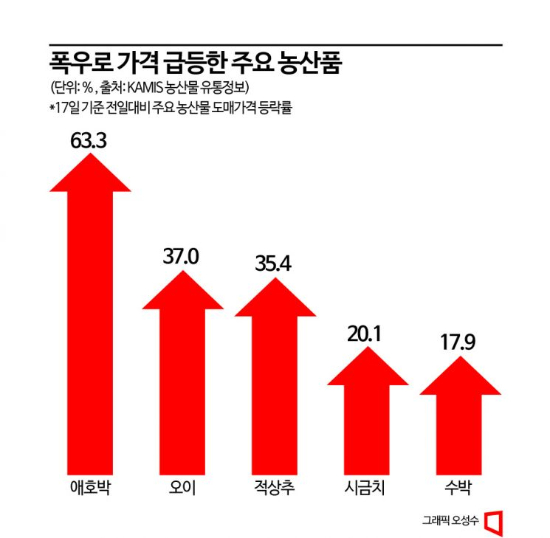
Acorn Squash Prices Surge 63% in One Day, Cucumbers Up 37%
Concerns Over Rising Food Service Prices Due to Crop Price Hikes
Government Strengthens Supply and Demand Measures to Defend Against Agricultural and Fishery Product Price Inflation
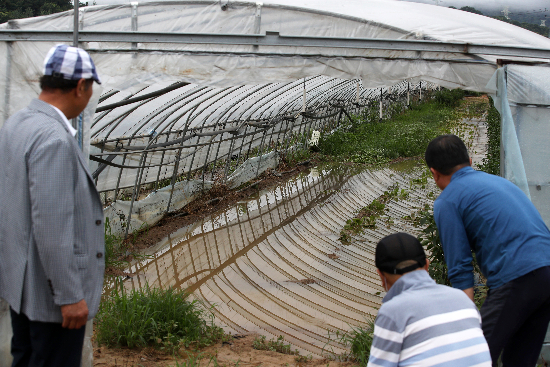
Due to unprecedented heavy rainfall, damage to domestic agricultural production has increased significantly, causing prices to soar. The heavy rain was concentrated in the Chungcheong and Gyeongbuk regions, where facility-grown greenhouses and fruit production areas are located, directly hitting the shipment volume. Prices have surged across various items, including lettuce, watermelon, chili peppers, peaches, and apples, with some wholesale prices rising by more than 60% in just one day. In particular, as the prices of raw agricultural products rise, consumer burdens are expected to increase, including dining-out costs and overall food prices.
According to the Agricultural Products Distribution Information (KAMIS) of the Korea Agro-Fisheries & Food Trade Corporation on the 18th, the wholesale price of zucchini was 24,460 won for 50 pieces the previous day, a staggering 63.3% increase from the day before (14,980 won). Prices also rose consecutively for cucumbers (37.0%), red leaf lettuce (35.4%), spinach (20.1%), watermelon (17.9%), and peaches (12.8%). The Ministry of Agriculture, Food and Rural Affairs reported that the area of farmland damaged by crop flooding and fruit drop from the 10th to the previous day was 27,094.8 hectares, equivalent to about 38,000 soccer fields (0.714 hectares each). This is 6.1 times the damage caused by last year’s wind and flood disasters (approximately 4,440 hectares).
The heavy rain was especially concentrated in greenhouse-grown crops and fruit production areas, causing a significant rise in agricultural product prices. When heavy rain falls, crops grown close to the ground are more likely to suffer flooding damage. Watermelon and lettuce are representative examples. Crops mainly produced in production areas, such as chili peppers and zucchini, are also inevitably affected by reduced production. The significant decrease in sunlight increases defects and lowers quality.
The problem is that the heavy rain is likely to continue for some time, which could cause agricultural product prices to rise further. According to the Korea Meteorological Administration, up to 200 mm of additional rain is expected in the Chungcheong region and southern areas by the 19th, with expected rainfall in parts of the southern coast of Jeollanam-do and Jeju Island reaching about 350 mm. Minister of Agriculture, Food and Rural Affairs Jeong Hwang-geun warned at an emergency meeting on the heavy rain situation, stating, "As the heavy rain expands to the southern regions, the damaged area could reach tens of thousands of hectares."
The Ministry of Economy and Finance is also closely monitoring the rise in agricultural and fishery product prices. There is a precedent of prices soaring sharply due to poor crop conditions caused by monsoons and typhoons. In 2011, during a once-in-a-century heavy rain event with hourly rainfall reaching 100 mm, the consumer price index rose by 4.7% year-on-year, the highest ever at that time. Fresh food prices surged by 9.0%, and agricultural, livestock, and fishery products jumped by 11.2%. In 2017, the combination of heatwaves and monsoons caused the fresh food index to soar by 12.3% year-on-year in July, increasing consumer burdens.
As agricultural product prices rise, the unstable trend in dining-out prices is also likely to continue. Last month, the dining-out price increase rate was 6.3%, significantly exceeding the overall consumer price increase rate of 2.7%. According to data compiled by the Korea Consumer Agency, the price of jajangmyeon (black bean noodles) in Seoul last month was 6,915 won, up 10.4% year-on-year, and naengmyeon (cold noodles) rose 8.6% to 11,154 won, continuing the upward trend in representative dining-out menu prices. The government has pressured the industry to reflect raw material price decreases in prices, but if agricultural product prices continue to rise, the rationale for demanding price increase restraint will also weaken. A Ministry of Economy and Finance official said, "If crop damage worsens, the rise in ingredient costs could partially affect dining-out prices," adding, "We are currently assessing the scale of damage to agricultural and fishery product prices."
The government has also hinted at possible intervention to defend against agricultural and fishery product price inflation. This is because seasonal factors such as the upcoming Chuseok holiday must be considered even after the heavy rain ends. The government plans to focus on supply and demand management by quickly increasing related imports or implementing government-led discount events as short-term measures if agricultural and fishery inflation continues.
© The Asia Business Daily(www.asiae.co.kr). All rights reserved.


















