Money Flow Stagnation, Only a Few Cases Converted to Project Finance Due to Poor Business Viability
10 Trillion KRW Bridge Loans Maturing This Year... Short-Term Extensions of 6 Months to 1 Year
If Business Normalization Fails, High Risk of Deterioration Remains
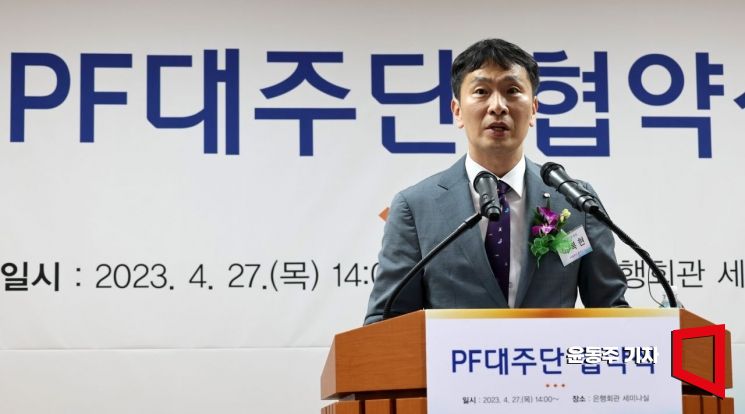 Financial Supervisory Service Governor Lee Bok-hyun attended the PF Lenders Agreement Ceremony held at the Bankers Association Building in Myeongdong 1-ga, Jung-gu, Seoul on the 27th and delivered a congratulatory speech.
 Photo by Yoon Dong-joo doso7@
As the delinquency rate of securities firms' project financing (PF) rapidly rises, fears of widespread defaults are growing amid additional negative factors such as the Saemaeul Geumgo crisis and GS Construction's poor construction scandal. Several trillion won worth of bridge loans maturing within the year are being identified as potential sources of default. Although some cases of bridge loans converting into main PF have emerged, the prevailing assessment is that this cannot be seen as a sign of market improvement. This is because most projects have not progressed to sales and only loan extensions are being made. Critics argue that this merely postpones defaults.
Securities Firms + Secondary Financial Institutions’ Bridge Loans Approaching 10 Trillion Won Maturing Within the Year
According to the investment banking (IB) industry, among the 22.2 trillion won of PF exposure (including loans and contingent liabilities such as guarantees) held by 23 domestic securities firms, about 7.8 trillion won is set to mature within the year. Of this, approximately 5 trillion won is accounted for by bridge loans. When combined with bridge loans from other secondary financial institutions, the amount maturing within the year approaches 10 trillion won. Since bridge loans generally have short maturities, most of the loans maturing in the first half of the year were extended by 6 months to a year. It is known that only a very small portion of these cases have converted to main PF or had principal and interest repaid.
An executive in charge of PF at a securities firm said, "PF loans recorded as delinquent by securities firms were mostly converted to main PF several years ago, but recently many have faced difficulties in repaying principal and interest due to a sharp deterioration in PF project viability," adding, "Except for some amounts converted to main PF, most bridge loans are being extended as bridge loans, with a prevailing atmosphere of holding on."
Moves by securities firms to reduce risks during the extension of bridge loans have also been observed. Korea Investment & Securities recently replaced a 90 billion won bridge loan lender to the developer of an officetel project in Bongmyeong-dong, Yuseong-gu, Daejeon, without providing the previously offered capital replenishment and debt assumption agreements. The structure changed to one where the construction company, Kolon Global, solely provides credit support. This is interpreted as stepping away from default risk.
A representative from Korea Ratings said, "The composition of securities firms' PF assets includes a large proportion of projects with poor sales performance, new projects before sales, and bridge loans, so the soundness of development assets is deteriorating due to rising interest rates and a slowdown in the real estate market," expressing concern that "there is also a possibility of liquidity risk transmission under funding market tightening conditions similar to the second half of 2022."
Some Projects in Seoul and Daegu Converted to Main PF, but...
Eleven Construction, which has been promoting the development of the UN Command site in Yongsan, Seoul, succeeded in raising 1.3 trillion won in main PF funds in June. Unlike bridge loans, which are borrowed to secure land before obtaining project permits, main PF is borrowed for construction and other project costs after permits are finalized to actively proceed with the project. This PF involved lead managers including Meritz Securities, which provided trillion-won scale bridge loans even before permits, as well as Kookmin Bank and Mirae Asset Securities, completing the recruitment of the lending consortium (investors).
Recently, BOB Planning, a developer in Daegu, received 220 billion won in PF loans from KB Securities and Daishin Securities. BOB Planning is promoting a mixed-use development project with four basement floors and 48 above-ground floors in Bonri-dong 416, Dalseo-gu, Daegu. The construction company is SK Ecoplant, which completed the permit process last year and planned to start construction and sales in the second half. However, the project was continuously delayed due to worsening market conditions. This year, with support from KB Securities and others, the project was able to commence. KB Securities had previously arranged about 300 billion won in PF funds for the redevelopment project in Daemyeong-dong, Nam-gu, Daegu.
Although some projects have secured main PF loans, the dominant view is that the PF situation has not improved. This is because most projects have not converted to main PF and only extended bridge loans at maturity. It is also known that if developers cannot afford interest payments, cases of deferred interest payments or bridge loan extensions with added interest costs are common. A secondary financial institution official said, "If bridge loan maturities are not extended, it could lead to defaults, so loans are sometimes extended reluctantly."

A financial company PF officer said, "In a situation where real estate PF delinquencies and defaults are increasing, it is difficult to make new loans without guaranteed sales performance," and predicted, "Cases of loss of benefit of time (EOD) continue to occur in some local projects, and difficulties such as construction companies abandoning contract agreements will persist."
Even projects that succeeded in raising main PF funds cannot be seen as having completely resolved default risks. The Yongsan UN Command site and the Bonri-dong and Daemyeong-dong projects in Daegu are reportedly proceeding with post-sale rather than the typical pre-sale before construction. The plan is to first ease liquidity constraints for promising projects and then conduct sales to recover funds once the real estate situation improves. However, unsold inventories are accumulating in local projects such as Daegu, making it difficult to guarantee sales performance even with post-sale.
Not only securities firms but also construction companies' risk-averse tendencies have not been resolved. Hyundai Engineering & Construction, the contractor for the Yongsan UN Command site, reportedly did not provide credit support such as payment guarantees or debt assumption agreements for the main PF. DL E&C and GS Construction have also abandoned redevelopment and reconstruction projects in Gwacheon and Busan.
An IB industry official explained, "Cases converting to main PF are examples where urgent liquidity was supplied to keep projects running temporarily, but if post-sale performance is poor at PF loan maturity, it could lead to defaults." The official added, "If the real estate market does not recover and funds are not recovered according to sales performance, temporary liquidity supply will only have the effect of reducing or postponing defaults."
© The Asia Business Daily(www.asiae.co.kr). All rights reserved.

















