NYT Reports Citing UN Population Estimates
Changes That Took 60-100 Years in the West Occur in 20 Years
Emphasizes Need to Rethink Policies in Response to Changes
By 2050, South Korea is projected to become the second oldest country in the world. Considering that Hong Kong, ranked first, is effectively a city-state in size, South Korea can be regarded as the country with the most severe aging population globally.
On the 16th (local time), the US media outlet New York Times (NYT) cited the United Nations (UN) world population projections, reporting that Hong Kong and South Korea will rank first and second, respectively, as the oldest countries in the world by 2050.
Aging is estimated by the ratio of the population aged 65 and over to the working-age population (ages 15 to 64). If South Korea maintains its current birth rate trend, by 2050, there will be 3 elderly people aged 65 or older for every 4 working-age individuals.
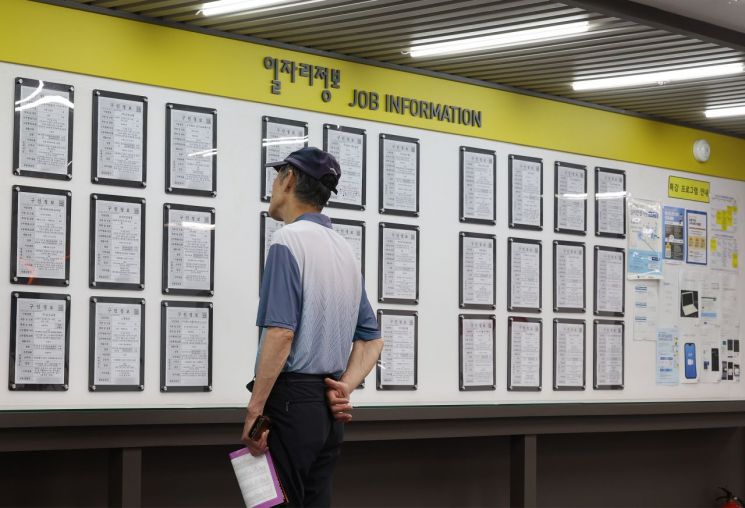 The number of employed people in their 60s has surpassed that of those in their 20s, coinciding with the aging trend. The photo shows a citizen looking at job information posted at the Seoul Western Employment Welfare Plus Center in Mapo-gu, Seoul, on the 19th of last month. Photo by Yonhap News
Following South Korea, Japan, Italy, Spain, Taiwan, Greece, Singapore, Slovenia, Thailand, Germany, China, Finland, the Netherlands, and Canada are expected to rank among the "world's oldest countries." The NYT pointed out that "most of the aged countries are in Asia and Europe."
The high aging ratio is expected to cause significant damage to the working population immediately. South Korea's working-age population currently stands at around 36 million but is projected to decrease to about 24 million by 2050.
During the same period, the elderly population aged 65 and over will nearly double from 9.5 million to 18 million. The population under 15 years old is expected to shrink from 5.8 million to 3.8 million.
The NYT emphasized the seriousness by stating, "The number of elderly will become almost equal to the working-age population." In Japan, which is currently facing a severe aging problem, the ratio of elderly aged 65 and over to working-age population is 1 to 2 as of this year.
Japan's elderly population is expected to increase moderately from 37 million this year to 39 million in 2050. However, the working-age population will sharply decline from 72 million to 53 million.
China, which rose to the status of "the world's factory" by leveraging its massive population, is also expected to experience rapid changes in its population structure due to aging. China’s working-age population is estimated to decrease by 200 million by 2050.
The NYT warned that if Asian countries, which lack social safety nets and welfare systems to support the oversized elderly population, rapidly age, social turmoil will be unavoidable. Experts advised the NYT to reconsider pension and immigration policies to prepare in advance for changes in population structure.
In particular, the media pointed out that while population structure changes took over 100 years in France and more than 60 years in the United States, in Asia, these changes are occurring within about 20 years.
© The Asia Business Daily(www.asiae.co.kr). All rights reserved.

















