Budget Deliberation to Envision Gwangju's Future, Not Immediate Gains
All Budget Committee Members Strive to See from Citizens' Perspective
Need for Procedural Changes in Controversial 'Jjokji Budget' Also Mentioned
There is a room in the Gwangju Metropolitan Council where the lights are unusually late to go out at night. In the room, the sound of pens and the rustling of papers can be heard incessantly. It is the office of Lee Myung-no, the Chairperson of the Budget and Accounts Committee.
Although the 9th Gwangju Metropolitan Council is known as a "studying council" due to its intense enthusiasm for learning, Councilor Lee Myung-no is so dedicated that the word "especially" does not feel awkward when describing him.
He has been famous as a studying councilor for the past year, but now that he has taken on the important role of Chairperson of the Budget and Accounts Committee, he is regarded as an even more studious councilor.
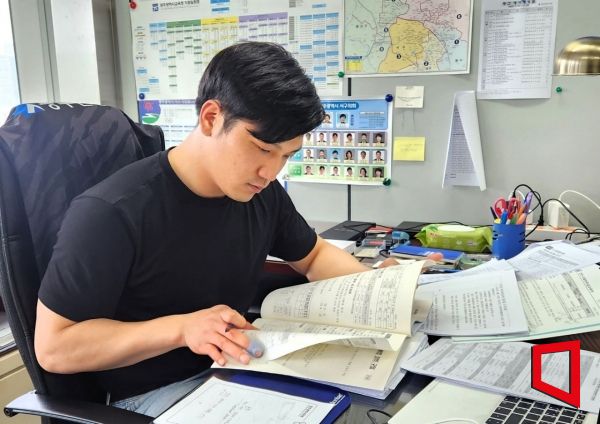 Lee Myung-no, Chairman of the Budget and Accounts Special Committee of the Gwangju Metropolitan Council, came to the office last weekend on the 15th to review the contents currently under deliberation.
The Budget and Accounts Special Committee of the Gwangju Metropolitan Council, which decides the city’s annual budget, is composed entirely of first-term members, and Lee, the youngest among the Gwangju councilors, serves as the chairperson. Although this brings a great sense of responsibility, he has expressed his ambition to overcome challenges with youthful vigor, principles, and common sense.
The schedule of this extraordinary session, which reviews the supplementary budget, has passed its halfway point. We listened to Councilor Lee’s aspirations as he takes on the important role of chairing the committee that decides the city’s annual budget.
Chairperson Lee Myung-no’s standard for this budget review is future-oriented, focusing on envisioning the future of Gwangju rather than short-sightedly pursuing immediate benefits.
He stated, “There are many parts of the budget that should have been allocated previously but were not due to various reasons such as tax revenue. We have agreed to allocate them next time. While we will not forcefully include them beyond procedures, we will consider them sufficiently.” He added, “We are conducting reviews to reduce differences of opinion between the departments that directly prepare the budget and those that actually execute it through smooth consensus.”
He also emphasized, “It is regrettable that the continuity of work is fading due to numerous organizational restructurings and personnel changes. Ensuring continuity of work is one of the main goals of this budget review.”
He also addressed the often controversial issue of councilors’ “note budgets.”
Chairperson Lee said, “The content of the note budgets is not bad, but the problem lies in the procedure. Since the council does not have the authority to allocate budgets, it is a way to express opinions on residents’ complaints or things overlooked by the executive branch. It is unfortunate that this is perceived as inherently wrong.”
He continued, “If during the preliminary budget preparation process, councilors’ requests are collected and delivered to the executive branch, and the executive branch distinguishes between what can be accepted and what is difficult and communicates this back, it might be easier to reach consensus during the review process.” He added, “I think it would be good if such a procedure could be established.”
Furthermore, he explained, “Departments worry that if they do not fully use their budget and return the remainder, their budget might be cut in the next review. I hope they do not force spending just to avoid this. If a budget is returned as unused and then cut next time, the council has said it will take responsibility and restore it if it is a legitimate budget.”
He hopes to create a precedent and establish a mechanism that can be steadily continued.
Chairperson Lee is trying to clarify past standards because the current review is deciding Gwangju’s budget after an abnormal three-year period of COVID-19.
He said, “It is not about unconditional cuts. I think it is also the role of councilors to allow projects for Gwangju to proceed again without using the COVID period as a baseline.”
Regarding the burden of being a young first-term councilor chairing the Budget and Accounts Committee, he said, “Politically, there are relatively fewer conflicts of interest, so I think this can be a strength that allows me to make more sincere and free judgments beyond the burden.” He added, “As we enter the second year of the 8th local government, I believe this important role was given to create a council that makes explosive attempts to achieve visible results and objectively judges whether promises are for the citizens.”
Chairperson Lee said, “It has been about two weeks since I took the chairperson position, and I am thinking simply.” He emphasized, “I try to view things from the citizens’ perspective with the mindset that ‘if I find a budget strange, the citizens will also find it strange.’”
He added, “If I can communicate with all nine committee members and view things with the vigor of a first-term member and an untainted perspective, I believe we can sufficiently reflect the citizens’ viewpoint.”
© The Asia Business Daily(www.asiae.co.kr). All rights reserved.
![Clutching a Stolen Dior Bag, Saying "I Hate Being Poor but Real"... The Grotesque Con of a "Human Knockoff" [Slate]](https://cwcontent.asiae.co.kr/asiaresize/183/2026021902243444107_1771435474.jpg)
















